Racomitrium canescens
Hoary Fringe-moss, Silver Moss, Grey Fringe-moss
A drought-tolerant moss with a wide distribution across the Northern Hemisphere. It forms low, silvery-green cushions and mats on sandy soils, gravel, and calcareous grassland. White-tipped leaf awns give it a frosted, hoary appearance when dry. It handles desiccation and poor soils well, making it one of the better mosses for open terrariums, rock gardens, and dry landscape setups. Now reclassified as Niphotrichum canescens.
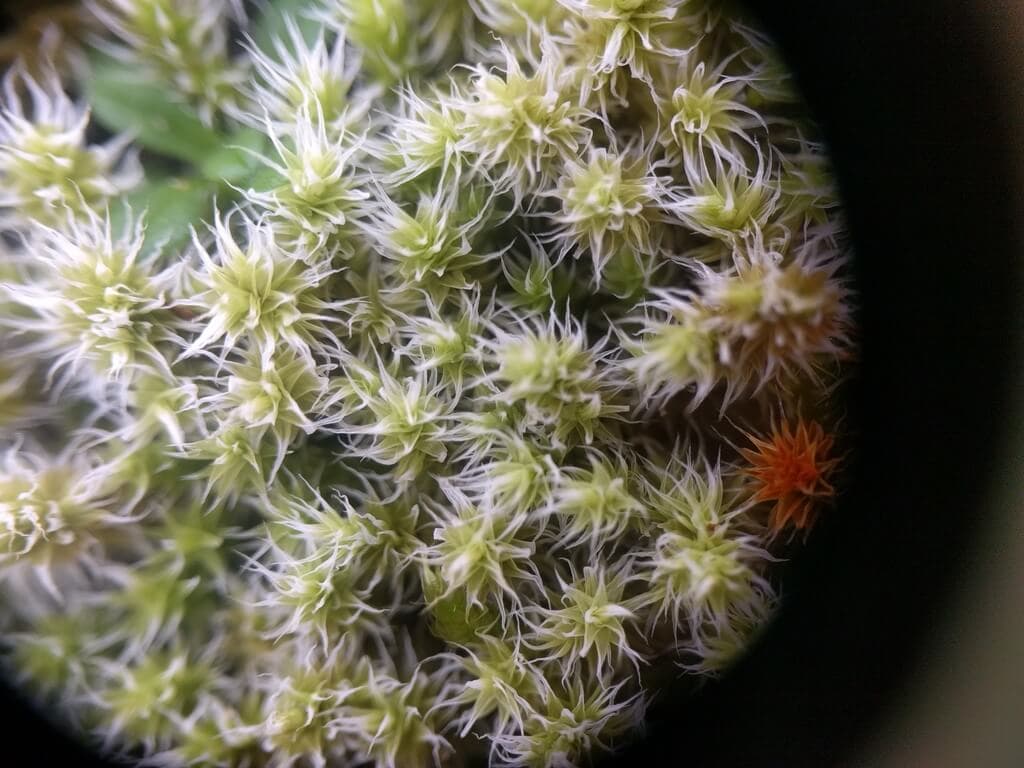
Photo by Michel Langeveld·CC BY 4.0
Care
Prefers medium humidity, bright indirect light, with -5–25 °C, and reaches 5 cm at maturity.
Light
Humidity
Temperature
Soil
Moisture
Soil pH
Propagation
Native range
Native to Northern Europe, Middle Europe, Southwestern Europe, Southeastern Europe, Eastern Europe, Northern Africa, Siberia, Russian Far East, Middle Asia, Caucasus, China, Mongolia, Eastern Asia, Indian Subcontinent, Australia, New Zealand, Subarctic America, Western Canada, Eastern Canada, Northwestern U.S.A., North-Central U.S.A., Northeastern U.S.A., Southwestern U.S.A., South-Central U.S.A., and Southeastern U.S.A..
Appearance
Growth habit
Leaf shape
Leaf texture
Frequently asked
Can Hoary Fringe-moss grow in a closed terrarium?
Hoary Fringe-moss prefers medium (40–60%) humidity, which is below the level a closed terrarium typically maintains. It is better suited to an open terrarium or houseplant setup.
Does Hoary Fringe-moss need drainage?
Yes. Hoary Fringe-moss prefers a dry-leaning substrate and benefits from a drainage layer to prevent root rot.
What humidity does Hoary Fringe-moss need?
Hoary Fringe-moss does best in medium (40–60%) humidity.
Is Hoary Fringe-moss pet-safe?
Hoary Fringe-moss is considered non-toxic to common household pets.
How tall does Hoary Fringe-moss grow?
Hoary Fringe-moss typically reaches 1–5 cm at maturity.
How do you propagate Hoary Fringe-moss?
Hoary Fringe-moss can be propagated by division or spores.
References
- 1
GBIF — Niphotrichum canescens (Hedw.) Bedn.-Ochyra & Ochyra
https://www.gbif.org/species/7572691 - 2
World Flora Online — Racomitrium canescens (Hedw.) Brid.
https://www.worldfloraonline.org/taxon/wfo-0001172006 - 3
British Bryological Society — Racomitrium canescens
https://www.britishbryologicalsociety.org.uk/learning/species-finder/racomitrium-canescens/ - 4
Montana Field Guide — Silver Moss
https://fieldguide.mt.gov/speciesDetail.aspx?elcode=NBMUS6B040 - 5
MINICRAFT — Racomitrium canescens: The Hardy Moss of Dry Landscapes
https://www.theminicraft.com/blogs/moss-instructions/racomitrium-canescens-the-hardy-moss-of-dry-landscapes - 6
Terrarium Creations — Racomitrium canescens Terrarium Care Guide
https://terrariumcreations.com/racomitrium-canescens-moss-in-terrariums-care-guide-to-help-your-moss-thrive/