Pogonatum urnigerum
Urn Haircap Moss, Urn-bearing Hair Moss
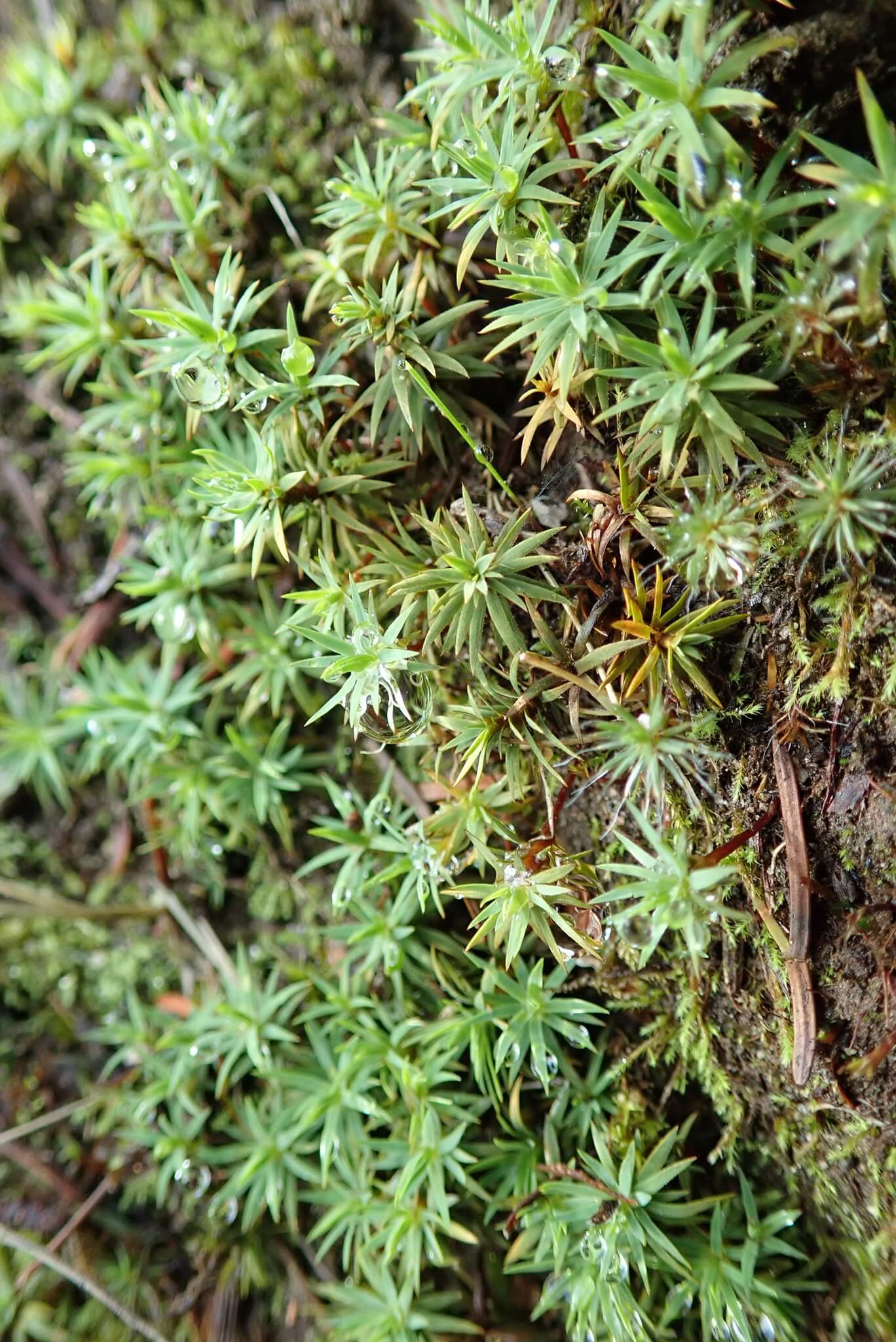
A small, upright moss with wine-red stems and bluish-green leaves that shift to brown with age. Pogonatum urnigerum belongs to the haircap family (Polytrichaceae), a group known for unusually complex leaf structure — each leaf carries dozens of thin ridges called lamellae on its upper surface, which help regulate moisture loss. In the wild it colonises disturbed ground, sandy banks, and rock crevices from subarctic Alaska and Greenland through the mountains of Europe and Asia, often appearing where snow lingers late into the season. It does best in cool, humid conditions with indirect light and an acidic, well-draining substrate, making it a good fit for temperate closed terrariums kept below 20 °C.
Care
Prefers high humidity, indirect light, with 0–20 °C, and reaches 5 cm at maturity.
Light
Humidity
Temperature
Soil
Moisture
Soil pH
Propagation
Native range
Native to Northern Europe, Middle Europe, Southwestern Europe, Southeastern Europe, Eastern Europe, Siberia, Russian Far East, China, Mongolia, Eastern Asia, Indian Subcontinent, Indo-China, Malesia, Papuasia, Subarctic America, Western Canada, Eastern Canada, Northwestern U.S.A., North-Central U.S.A., Northeastern U.S.A., and Southwestern U.S.A..
Appearance
Growth habit
Leaf shape
Leaf texture
Frequently asked
Can Urn Haircap Moss grow in a closed terrarium?
Yes. Urn Haircap Moss prefers high (60–80%) humidity, which is what a closed terrarium provides, and tolerates indirect-light-loving conditions.
Does Urn Haircap Moss need drainage?
Urn Haircap Moss prefers a moist substrate. Drainage is helpful but not critical; consistent moisture matters more.
What humidity does Urn Haircap Moss need?
Urn Haircap Moss does best in high (60–80%) humidity.
Is Urn Haircap Moss pet-safe?
Urn Haircap Moss is considered non-toxic to common household pets.
How tall does Urn Haircap Moss grow?
Urn Haircap Moss typically reaches 2–5 cm at maturity.
How do you propagate Urn Haircap Moss?
Urn Haircap Moss can be propagated by division or spores.
References
- 1
Wikipedia — Pogonatum urnigerum
https://en.wikipedia.org/wiki/Pogonatum_urnigerum - 2
Flora of North America — Pogonatum urnigerum
https://floranorthamerica.org/Pogonatum_urnigerum - 3
British Bryological Society — Pogonatum urnigerum species profile
https://www.britishbryologicalsociety.org.uk/learning/species-finder/pogonatum-urnigerum/ - 4
GBIF — Pogonatum urnigerum (taxonKey 2682986)
https://www.gbif.org/species/2682986 - 5
Minnesota DNR — Pogonatum urnigerum rare species guide
https://www.dnr.state.mn.us/rsg/profile.html?action=elementDetail&selectedElement=NBMUS5R060