Marchantia polymorpha
Common Liverwort, Umbrella Liverwort, Cudweed
Marchantia polymorpha is a flat, ribbon-like liverwort that grows on damp soil, stream banks, burned ground, and the surface of nursery pots across every continent except Antarctica. The thallus — the flat green body that takes the place of stems and leaves — is divided down the middle by a fine dark line and lies pressed close to the substrate, spreading by branching at the tip. Its most distinctive feature is the gemma cup: small green discs scattered across the surface that hold lens-shaped buds called gemmae, which splash out when rain hits them and start new plants where they land. In a terrarium it does best in cool, shaded, very humid conditions on bare damp soil or wet wood, and is one of the few liverworts that can flush out the parasol-shaped reproductive structures — the umbrella-like archegoniophores and antheridiophores — that earned the species its 'umbrella liverwort' name.
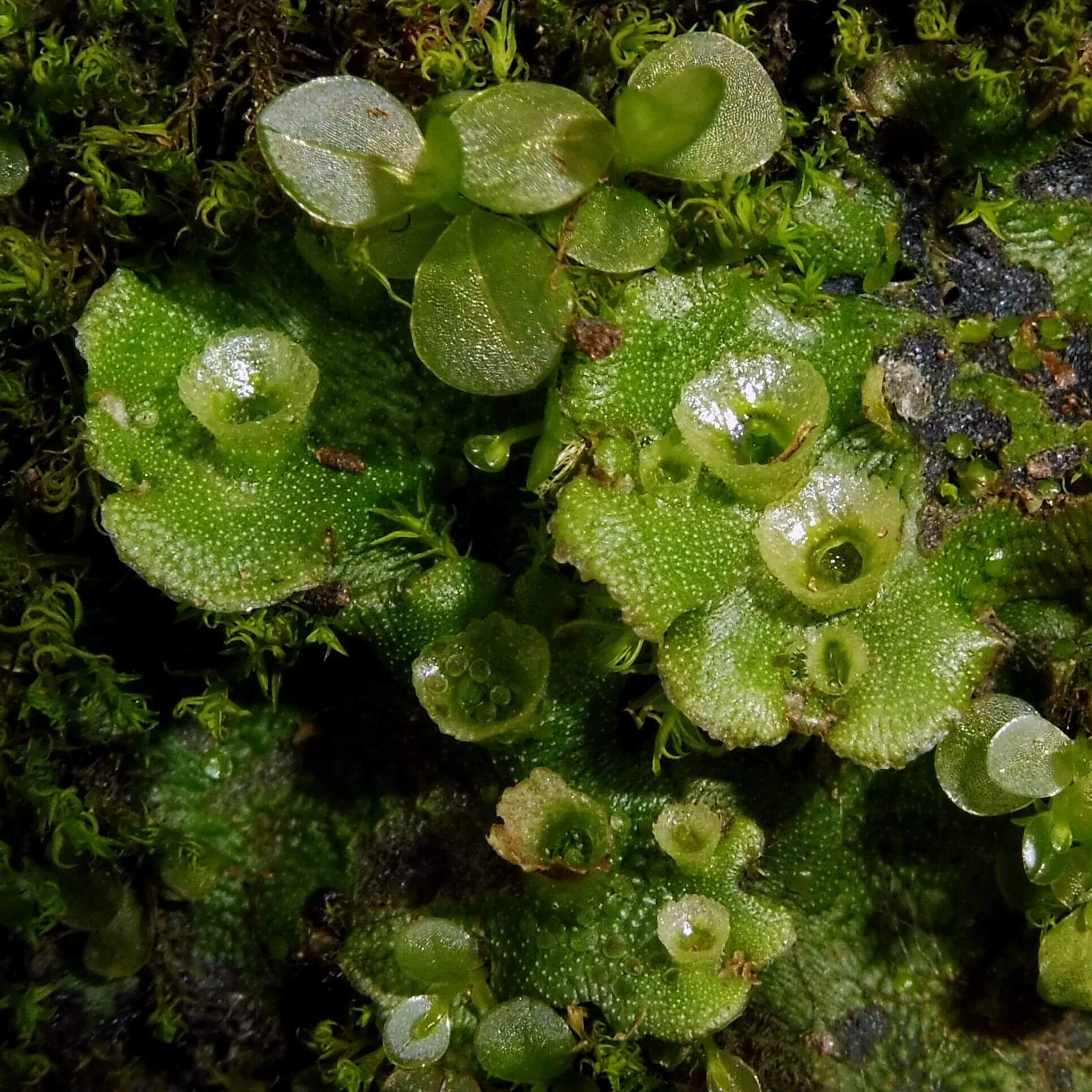
Photo by Barry Walter·CC BY 4.0
Care
Prefers very high humidity, low light, with 5–24 °C, and reaches 5 cm at maturity.
Light
Humidity
Temperature
Soil
Moisture
Soil pH
Propagation
Native range
Native to Northern Europe, Middle Europe, Southwestern Europe, Southeastern Europe, Eastern Europe, Macaronesia, Siberia, Russian Far East, Middle Asia, Caucasus, China, Eastern Asia, Subarctic America, Western Canada, Eastern Canada, Northwestern U.S.A., North-Central U.S.A., Northeastern U.S.A., Southwestern U.S.A., South-Central U.S.A., Southeastern U.S.A., and Western South America.
Appearance
Growth habit
Leaf shape
Leaf texture
Frequently asked
Can Common Liverwort grow in a closed terrarium?
Yes. Common Liverwort prefers very high (above 80%) humidity, which is what a closed terrarium provides, and tolerates shade-tolerant conditions.
Does Common Liverwort need drainage?
Common Liverwort prefers a wet substrate. Drainage is helpful but not critical; consistent moisture matters more.
What humidity does Common Liverwort need?
Common Liverwort does best in very high (above 80%) humidity.
Is Common Liverwort pet-safe?
Common Liverwort is considered non-toxic to common household pets.
How tall does Common Liverwort grow?
Common Liverwort typically reaches 1–5 cm at maturity.
How do you propagate Common Liverwort?
Common Liverwort can be propagated by division or spores.
References
- 1
GBIF — Marchantia polymorpha L.
https://www.gbif.org/species/2688570 - 2
Wikipedia — Marchantia polymorpha
https://en.wikipedia.org/wiki/Marchantia_polymorpha - 3
US Forest Service FEIS — Marchantia polymorpha, common liverwort
https://research.fs.usda.gov/feis/species-reviews/marpol - 4
NC State Extension — Marchantia polymorpha (Common Liverwort)
https://plants.ces.ncsu.edu/plants/marchantia-polymorpha/ - 5
UF/IFAS ENH278/EP542 — Biology and Management of Liverwort (Marchantia polymorpha) in Ornamental Crop Production
https://ask.ifas.ufl.edu/publication/EP542 - 6
Michigan State Extension — How to identify and manage liverwort in nurseries and greenhouses
https://www.canr.msu.edu/news/how-to-identify-and-manage-liverwort-in-nurseries-and-greenhouses - 7
Leaf Empire — Marchantia Polymorpha Care Guide
https://www.leafempire.co.za/post/marchantia-polymorpha-care-guide - 8
Plantiary — Common Liverwort (Marchantia Polymorpha) Plant Care
https://plantiary.com/plant/marchantia-polymorpha_4802.html