Pinguicula vulgaris L.
Common Butterwort, Steepgrass, Valentine's Flower
Pinguicula vulgaris is a small carnivorous perennial of the cold, calcareous bogs and wet rocky ledges of the northern hemisphere — its circumboreal range stretches from northern Europe and Siberia across Subarctic America to the northern United States. It forms a flat, ground-hugging rosette of pale yellow-green leaves, three to six centimetres long, whose upper surface is coated in microscopic sticky glands that trap small insects and digest them on the leaf. In late spring and early summer it sends up slender stalks carrying a single violet-purple flower with a long backward spur. Note: this is a cold-temperate species that requires a near-freezing winter dormancy — it forms a tight resting bud called a hibernaculum each autumn — and is not suited to a warm closed terrarium. It does best in a cool, open bog-style setup with bright light, alkaline soil, and standing water year-round.
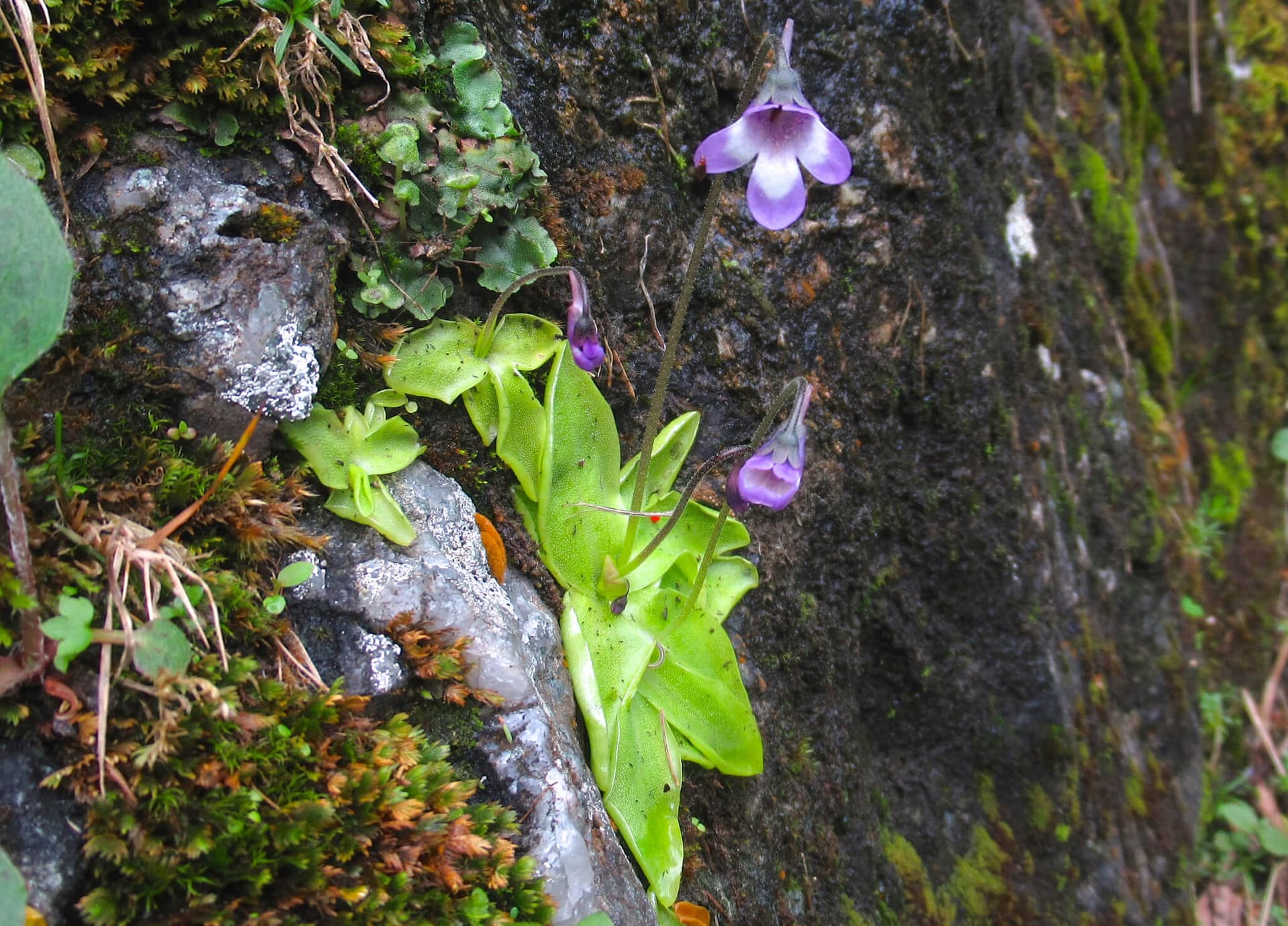
Photo by Roger Frost·CC BY-NC 4.0
Care
Prefers high humidity, bright indirect light, with -5–25 °C, and reaches 16 cm at maturity.
Light
Humidity
Temperature
Soil
Moisture
Soil pH
Propagation
Native range
Native to Northern Europe, Middle Europe, Southwestern Europe, Southeastern Europe, Eastern Europe, Siberia, Subarctic America, Western Canada, Eastern Canada, North-Central U.S.A., and Northeastern U.S.A..
Appearance
Growth habit
Leaf shape
Leaf texture
Frequently asked
Can Common Butterwort grow in a closed terrarium?
Yes. Common Butterwort prefers high (60–80%) humidity, which is what a closed terrarium provides, and tolerates bright-indirect-light-loving conditions.
Does Common Butterwort need drainage?
Common Butterwort prefers a wet substrate. Drainage is helpful but not critical; consistent moisture matters more.
What humidity does Common Butterwort need?
Common Butterwort does best in high (60–80%) humidity.
Is Common Butterwort pet-safe?
Common Butterwort is considered non-toxic to common household pets.
How tall does Common Butterwort grow?
Common Butterwort typically reaches 3–16 cm at maturity.
How do you propagate Common Butterwort?
Common Butterwort can be propagated by division or seeds.
References
- 1
Plants of the World Online — Pinguicula vulgaris L.
https://powo.science.kew.org/taxon/526527-1 - 2
Wikipedia — Pinguicula vulgaris
https://en.wikipedia.org/wiki/Pinguicula_vulgaris - 3
International Carnivorous Plant Society — Growing Cold Temperate Pinguicula
https://www.carnivorousplants.org/grow/guides/temperatePinguicula - 4
Lady Bird Johnson Wildflower Center — Pinguicula vulgaris
https://www.wildflower.org/plants/result.php?id_plant=PIVU - 5
Minnesota Wildflowers — Pinguicula vulgaris (Butterwort)
https://www.minnesotawildflowers.info/flower/butterwort - 6
Carnivero — Pinguicula (Butterwort) Care Guide
https://www.carnivero.com/pages/how-to-care-for-butterworts-pinguicula - 7
California Carnivores — Guide to Pinguicula Winter Succulent Dormancy
https://www.californiacarnivores.com/blogs/calcarn-video-care-guides/california-carnivores-guide-to-pinguicula-winter-succulent-dormancy - 8
Propagate One — How to Propagate Pinguicula vulgaris
https://propagate.one/how-to-propagate-pinguicula-vulgaris/