Polypodium vulgare
Common Polypody, Adder's Fern, Wall Fern, Golden Polypody, Rock Polypody
Polypodium vulgare grows wild across the temperate woodlands and rocky outcrops of Europe, North Africa, Macaronesia, and parts of South Africa, where its creeping rhizome anchors to mossy tree trunks, old stone walls, and shaded boulders. The lance-shaped fronds rise singly along the surface-running rhizome — each deeply pinnate with rounded lobes — and turn the undersides of mature fronds golden in late summer as the sori ripen, which earned the plant its old name 'golden polypody'. As an epiphyte that also grows on rock, it asks for very little substrate: a thin layer of moisture-retentive moss or leaf litter over a free-draining base is enough. It is a cool-temperate species rather than a tropical one, tolerating near-freezing winters and resenting prolonged warmth, so in a terrarium it does best in a cool, shaded setup with steady humidity and good airflow.
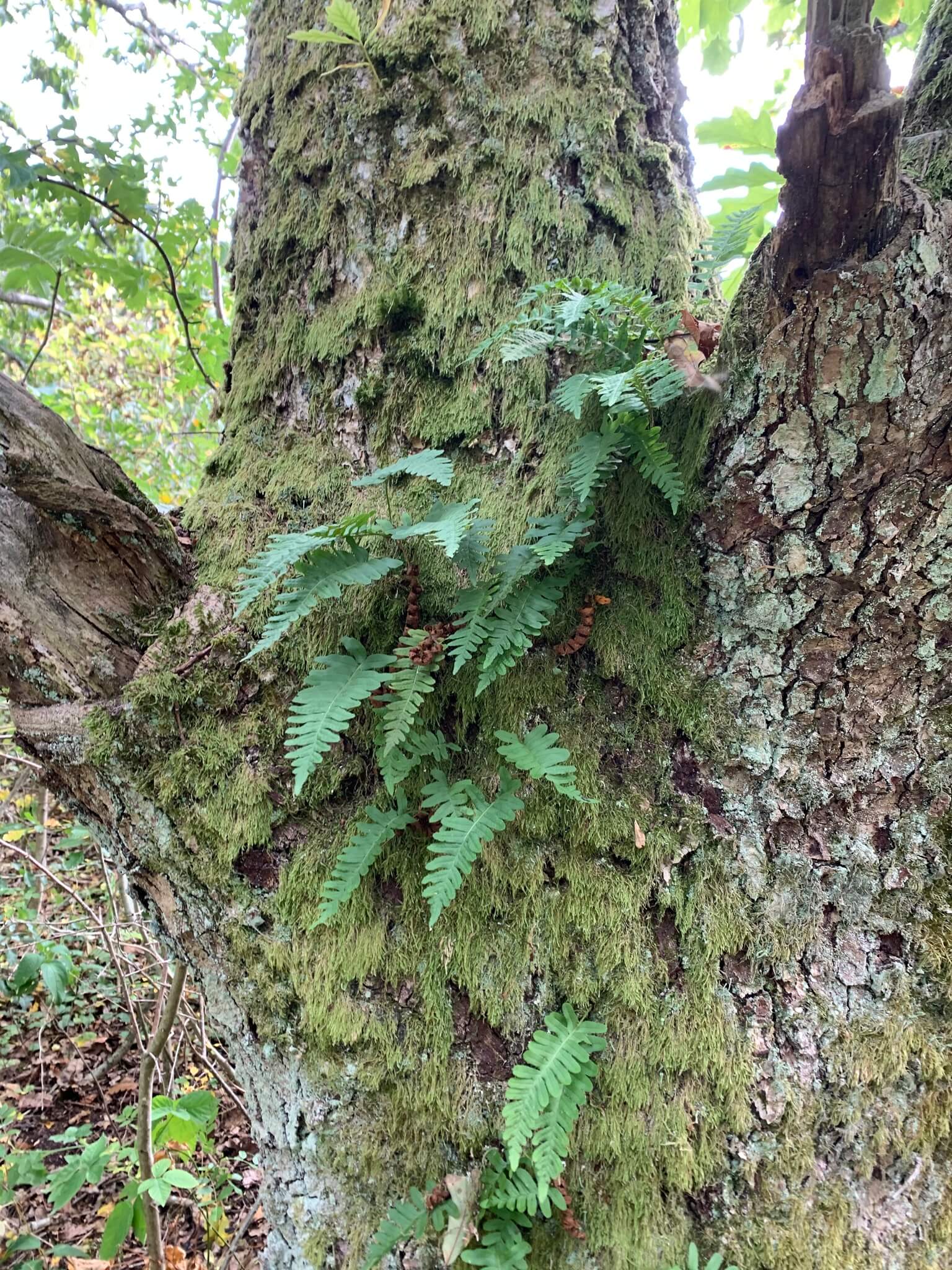
Photo by vesper·CC BY-NC 4.0
Care
Prefers high humidity, indirect light, with 2–22 °C, and reaches 40 cm at maturity.
Light
Humidity
Temperature
Soil
Moisture
Soil pH
Propagation
Native range
Native to Northern Europe, Middle Europe, Southwestern Europe, Southeastern Europe, Eastern Europe, Northern Africa, Macaronesia, Southern Africa, Siberia, Caucasus, and Western Asia.
Appearance
Growth habit
Leaf shape
Leaf texture
Frequently asked
Can Common Polypody grow in a closed terrarium?
Yes. Common Polypody prefers high (60–80%) humidity, which is what a closed terrarium provides, and tolerates indirect-light-loving conditions.
Does Common Polypody need drainage?
Common Polypody prefers a moist substrate. Drainage is helpful but not critical; consistent moisture matters more.
What humidity does Common Polypody need?
Common Polypody does best in high (60–80%) humidity.
Is Common Polypody pet-safe?
Common Polypody is considered non-toxic to common household pets.
How tall does Common Polypody grow?
Common Polypody typically reaches 10–40 cm at maturity.
How do you propagate Common Polypody?
Common Polypody can be propagated by rhizome division or spores.
References
- 1
Plants of the World Online — Polypodium vulgare L.
https://powo.science.kew.org/taxon/urn:lsid:ipni.org:names:300720-2 - 2
RHS — Polypodium vulgare (common polypody)
https://www.rhs.org.uk/plants/13464/polypodium-vulgare/details - 3
Gardenia.net — Polypodium vulgare (Common Polypody)
https://www.gardenia.net/plant/polypodium-vulgare - 4
NC State Extension — Polypodium vulgare (Common Polypody)
https://plants.ces.ncsu.edu/plants/polypodium-vulgare/ - 5
Gardening Know How — Polypodium Care: How To Grow Polypodium Ferns
https://www.gardeningknowhow.com/ornamental/foliage/polypodium-fern-care - 6
Gardener's HQ — How To Grow Common Polypody Fern (Polypodium vulgare)
https://www.gardenershq.com/inthegarden/common-polypody-fern-polypodium-vulgare/ - 7
Greg.app — Propagating Common Polypody
https://greg.app/propagate-common-polypody/