Plagiomnium undulatum
Hart's-tongue Thyme-moss, Palm-tree Moss
Plagiomnium undulatum is a large, conspicuous moss of damp woodland across Europe, ranging from Iceland and southern Finland to North Africa, Turkey and Iran. Its upright stems reach up to 10 cm and branch near the top like a tiny tree, carrying tongue-shaped, toothed leaves 6–10 mm long that ripple crosswise when moist and curl and twist when dry. In the wild it covers shaded soil, logs and base-rich rocks, spreading by creeping, often buried stems that send up new shoots; spore capsules are rare, as male plants are less common than female ones. It grows on neutral to basic ground rather than acidic peat, and does best in shade with steady moisture and high humidity.
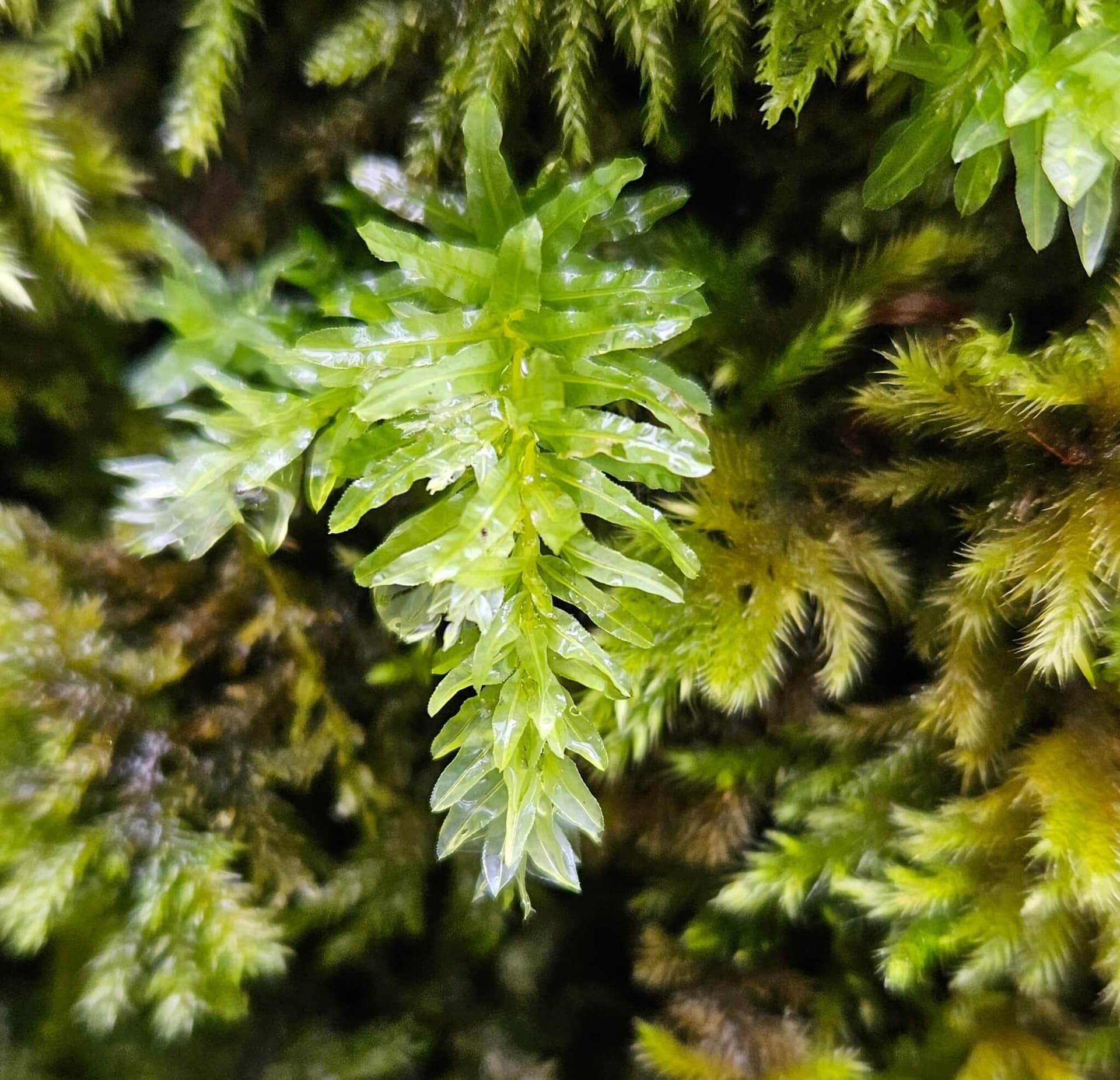
Photo by Helen Waterman·CC BY 4.0
Care
Prefers high humidity, low light, with 5–22 °C, and reaches 10 cm at maturity.
Light
Humidity
Temperature
Soil
Moisture
Propagation
Plagiomnium undulatum spreads by creeping, stolon-like stems — often buried and leafless — that send up new upright shoots. Lift a section where a stolon has already produced an upright shoot and lay it on damp, neutral to basic substrate in shade, keeping humidity high while it settles in. Spore capsules are rare, so spores are not a practical route.
Native range
Native to Northern Europe, Middle Europe, Southwestern Europe, Southeastern Europe, Eastern Europe, Northern Africa, Macaronesia, Caucasus, and Western Asia.
Native range
Appearance
Growth habit
Leaf shape
Leaf texture
Frequently asked
Can Hart's-tongue Thyme-moss grow in a closed terrarium?
Yes. Hart's-tongue Thyme-moss prefers high (60–80%) humidity, which is what a closed terrarium provides, and tolerates shade-tolerant conditions.
Does Hart's-tongue Thyme-moss need drainage?
Hart's-tongue Thyme-moss prefers a moist substrate. Drainage is helpful but not critical; consistent moisture matters more.
What humidity does Hart's-tongue Thyme-moss need?
Hart's-tongue Thyme-moss does best in high (60–80%) humidity.
Is Hart's-tongue Thyme-moss pet-safe?
Hart's-tongue Thyme-moss is considered non-toxic to common household pets.
How tall does Hart's-tongue Thyme-moss grow?
Hart's-tongue Thyme-moss typically reaches 1–10 cm at maturity.
How do you propagate Hart's-tongue Thyme-moss?
Hart's-tongue Thyme-moss can be propagated by runners.
References
- 1
Atlas of British & Irish Bryophytes (2), p. 408 — Plagiomnium undulatum (T.L. Blockeel), British Bryological Society
https://www.britishbryologicalsociety.org.uk/wp-content/uploads/2020/12/Atlas-of-British-and-Irish-Bryophytes-V2-408.pdf - 2
Flora of North America Vol. 28 — Plagiomnium undulatum
http://www.efloras.org/florataxon.aspx?flora_id=1&taxon_id=250099248 - 3
BRYOATT — Attributes of British and Irish Mosses, Liverworts and Hornworts (Hill, Preston, Bosanquet & Roy; updated 2017)
https://www.brc.ac.uk/bibcite/reference/27 - 4
NatureSpot — Hart's-tongue Thyme-moss
https://www.naturespot.org/species/harts-tongue-thyme-moss - 5
Botanical Electronic News 459 — Plagiomnium undulatum new to North America (Joya & McIntosh)
https://www.ou.edu/cas/botany-micro/ben/ben459.html - 6
Wikispecies — Plagiomnium undulatum
https://species.wikimedia.org/wiki/Plagiomnium_undulatum - 7
Maryland Biodiversity Project — Palm-Tree Moss
https://www.marylandbiodiversity.com/taxon/22603