Monstera adansonii Schott
Swiss Cheese Vine, Adanson's Monstera, Five Holes Plant, Monkey Mask Plant
Native to the tropical forests of Central and South America, Monstera adansonii climbs trees as a hemi-epiphyte — rooting in the soil but sending stems upward in search of light, clinging to bark with aerial roots as it goes. Its heart-shaped leaves are perforated with distinctive oval holes called fenestrations, which develop even on relatively young plants; in low light or in a terrarium without a tall climbing surface, leaves tend to stay smaller with fewer holes. It grows vigorously and does well in the steady warmth and high humidity of a large enclosed setup, though it will need regular pruning to stay contained. Like all aroids, its tissues contain insoluble calcium oxalate crystals — confirmed toxic to cats and dogs by the ASPCA.
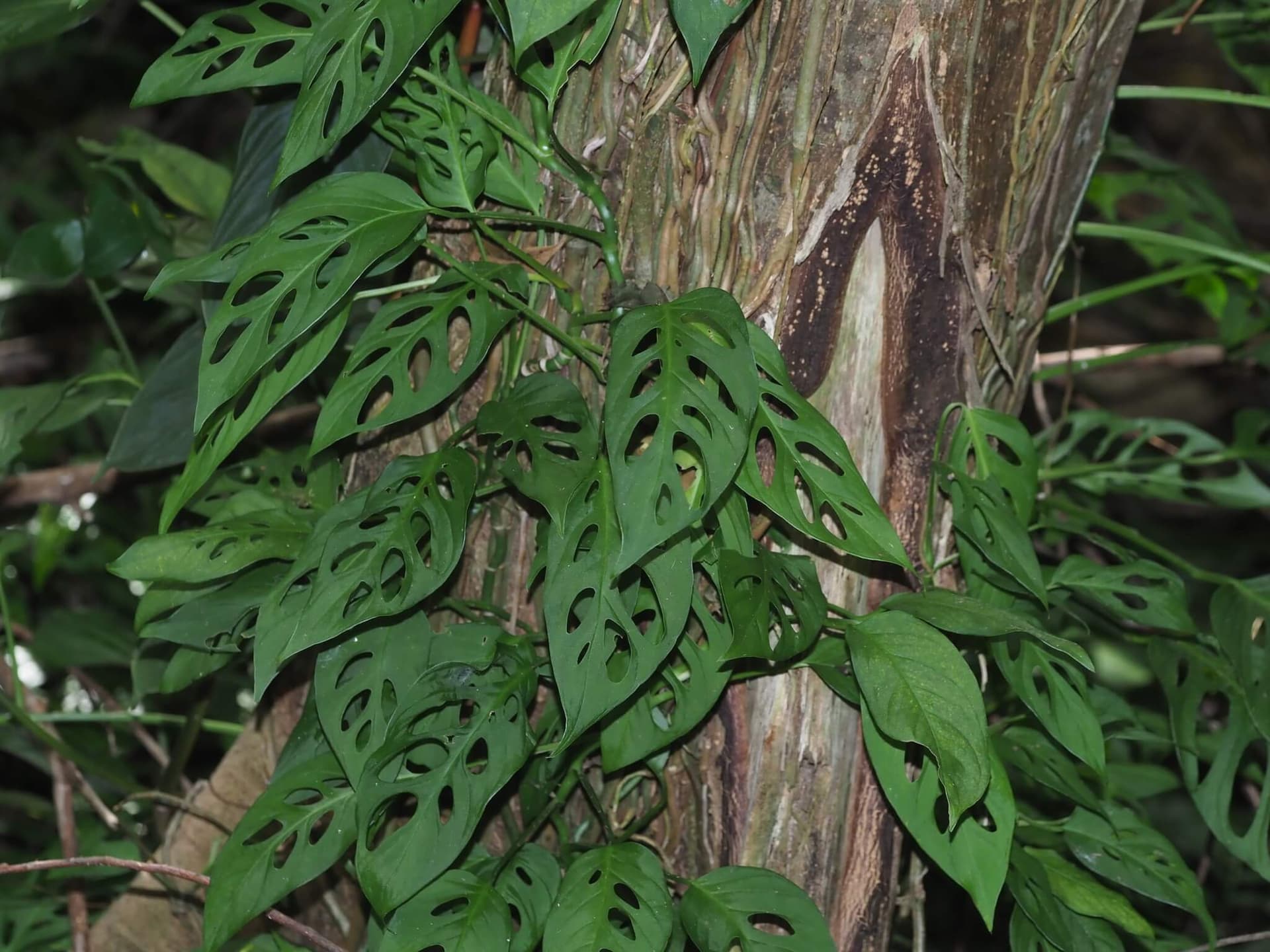
Photo by Kevin Faccenda·CC BY 4.0
Care
Prefers high humidity, bright indirect light, with 10–29 °C, and reaches 400 cm at maturity.
Light
Humidity
Temperature
Soil
Moisture
Soil pH
Propagation
Native range
Native to Northern South America, Mexico, Central America, Caribbean, Western South America, and Brazil.
Appearance
Growth habit
Leaf shape
Leaf texture
Frequently asked
Can Swiss Cheese Vine grow in a closed terrarium?
Yes. Swiss Cheese Vine prefers high (60–80%) humidity, which is what a closed terrarium provides, and tolerates bright-indirect-light-loving conditions.
Does Swiss Cheese Vine need drainage?
Swiss Cheese Vine prefers a moist substrate. Drainage is helpful but not critical; consistent moisture matters more.
What humidity does Swiss Cheese Vine need?
Swiss Cheese Vine does best in high (60–80%) humidity.
Is Swiss Cheese Vine pet-safe?
Swiss Cheese Vine is moderately toxic if ingested — keep out of reach of pets and children.
How tall does Swiss Cheese Vine grow?
Swiss Cheese Vine typically reaches 90–400 cm at maturity.
How do you propagate Swiss Cheese Vine?
Swiss Cheese Vine can be propagated by stem cuttings or air layering.
References
- 1
POWO (Kew) — Monstera adansonii Schott (accepted name; first published in Wiener Z. Kunst 4: 1028 (1830); family Araceae; native range: Bolivia, Brazil North, Brazil Northeast, Brazil South, Brazil Southeast, Brazil West-Central, Colombia, Costa Rica, Ecuador, French Guiana, Guyana, Leeward Islands, Netherlands Antilles, Nicaragua, Panama, Peru, Suriname, Trinidad-Tobago, Venezuela, Windward Islands; climbing plant in wet tropical biome; four recognised subspecies: adansonii, blanchetii, klotzschiana, laniata; synonyms include Monstera pertusa (L.) de Vriese, Dracontium pertusum L., Calla dracontium G.Mey., Calla pertusa (L.) Kunth)
https://powo.science.kew.org/taxon/urn:lsid:ipni.org:names:87464-1 - 2
NC State Extension Gardener Plant Toolbox — Monstera adansonii (common names: Adanson's Monstera, Cheese Plant, Five Hole Plant, Swiss Cheese Plant, Swiss Cheese Vine; family Araceae; native origin: Southern Mexico to Tropical America including Belize, Bolivia, Brazil, Colombia, Costa Rica, Ecuador, Guyana, Honduras, Mexico, Nicaragua, Panama, Peru, Suriname, Trinidad-Tobago, Venezuela, Windward Islands; USDA zones 10a–12b; light: partial shade 2–6 hours direct; soil: loam/silt, acid to neutral pH, good drainage, moist; toxicity: low severity — calcium oxalate crystals; symptoms: mouth/throat inflammation, vomiting, drooling, loss of appetite; propagation: stem cutting; height 3–8 ft indoors, 10–13 ft outdoors; width 1–3 ft; medium to dark green glossy heart-shaped perforated leaves)
https://plants.ces.ncsu.edu/plants/monstera-adansonii/ - 3
PlantCareToday — Monstera adansonii care guide (light: bright indirect, avoid prolonged direct sun; humidity: high, use humidifier in winter; temperature: 18–24 °C ideal, minimum 10 °C; soil: peat-based with orchid bark, well-draining; pH 5.5–7.0; water when top inch dry, approx. weekly indoors; care level: easy; toxicity: toxic to cats and dogs — swallowing issues, vomiting, mouth irritation; propagation: stem cuttings 4–8 inches with two nodes in water, also air-layering; leaves: heart-shaped with oval fenestrations, glossy; vine length up to 13 ft trellised, mature leaves 20–30 inches)
https://plantcaretoday.com/monstera-adansonii.html - 4
ASPCA Toxic and Non-Toxic Plants — Swiss Cheese Plant / Monstera (toxic to dogs and cats; toxic principle: insoluble calcium oxalates; clinical signs: oral irritation, intense burning and irritation of mouth, tongue and lips, excessive drooling, vomiting, difficulty swallowing)
https://www.aspca.org/pet-care/aspca-poison-control/toxic-and-non-toxic-plants/swiss-cheese-plant - 5
Terrarium Tribe — Which Monstera Actually Work in a Terrarium? (Monstera adansonii suitable for tall tropical terrariums with vertical space; climbing behaviour requires cork bark or wood for support; fast growth — regular pruning needed; best in larger, looser setups; fenestrations develop with maturity; not ideal for small terrariums due to size)
https://terrariumtribe.com/terrarium-plants/monstera-adansonii-swiss-cheese-plant/ - 6
Wikipedia — Monstera adansonii (scientific name Monstera adansonii Schott; family Araceae; native to South and Central America and West Indies; hemi-epiphyte vine; heart-shaped leaves with somewhat thick waxy texture and large oval perforations; grows 3–5 ft as houseplant, up to 13 ft as vine; four subspecies recognised)
https://en.wikipedia.org/wiki/Monstera_adansonii