Southern America · TDWG Level 2
Caribbean
Caribbean covers the islands of the Greater and Lesser Antilles, the Bahamas, and a few outliers — roughly 240,000 square kilometres of mostly tropical archipelago, from limestone Cuba in the west to volcanic Trinidad off Venezuela. The flora is one of the most distinctively endemic in the Americas, with roughly half of its ~13,000 plant species found nowhere else.
Caribbean is the TDWG region that gathers the West Indies into a single botanical unit. It covers about 240,000 square kilometres of islands grouped into three main blocks — the Lucayan Archipelago (Bahamas and the Turks and Caicos) in the north, the Greater Antilles (Cuba, Hispaniola, Jamaica, Puerto Rico, and the Cayman Islands) in the centre, and the Lesser Antilles curving south from Anguilla to Grenada. The region also formally includes Bermuda, Trinidad and Tobago, the Venezuelan Antilles, and a handful of Pacific outliers off Central America. Climate is tropical throughout, with strong seasonal rainfall on windward slopes and a long dry season on leeward sides. Hurricane season runs June to November.
The Greater Antilles are continental fragments — old, geologically complex, and tall. Pico Duarte in the Dominican Republic rises to 3,098 metres, the regional high point, with the rest of the Cordillera Central, Sierra Maestra (Cuba), Blue Mountains (Jamaica), and Cordillera Central (Puerto Rico) all carrying montane forest. The Lesser Antilles are a younger volcanic arc, with active or recently active volcanoes on Saint Vincent, Martinique, and Montserrat. Mangroves and coral reefs ring most of the islands; the Bahamas sit on a low limestone platform with no relief above 70 metres.
The Caribbean is one of the world's biodiversity hotspots. Roughly 13,000 vascular plant species occur here, with about 6,500 endemic — close to fifty percent endemism, and the highest concentration of endemic plant species per square kilometre in the Americas. Cuba alone holds around 6,300 species, half of them endemic. The classic vegetation belts are: lowland rainforest and seasonally dry forest at the base; the Caribbean pine forests of Cuba, Hispaniola, and the Bahamas (Pinus caribaea, P. occidentalis, P. tropicalis) on poor soils; cloud forest at the summits with Magnoliaceae, Lauraceae, tree ferns, and a rich epiphyte flora of Orchidaceae, Bromeliaceae, and Peperomia; and on serpentine and karst substrates, highly specialised endemic communities. Hispaniola has its own arid intermontane valleys with cacti and thorny scrub.
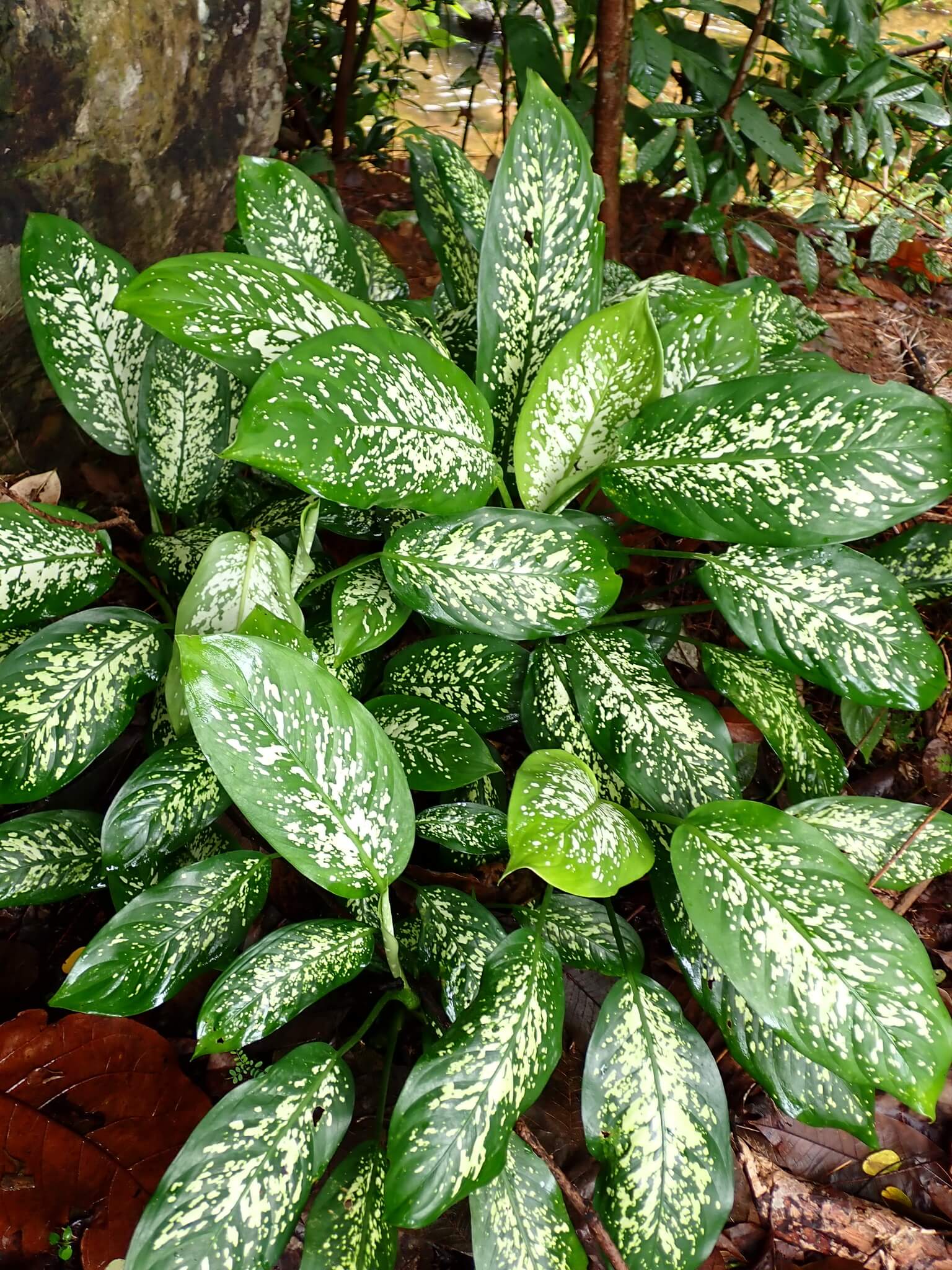
The Verdarium catalogue tags twenty-seven species here, including signatures of the Greater Antilles: the Cuban Marcgravia umbellata and Puerto Rican M. sintenisii (shingle vines that flatten themselves against bark), the Lesser Antillean Vriesea splendens, and Dieffenbachia seguine, originally described from the West Indies.
The Jardín Botánico Nacional in Cuba and the Jardín Botánico de Río Piedras in Puerto Rico are leading research collections for the regional flora.
Native to Caribbean
Explore plants from this region
References
- Encyclopedia BritannicaGeography and biogeography of the West Indies.
- Kew POWOUsed to confirm characteristic genera (Marcgravia, Pinus caribaea, P. occidentalis, Vriesea, Guzmania, Coccothrinax).
- WikipediaTotal area (239,681 km²), island groupings, and climate baseline.
- WikipediaConfirms 3,098 m as the regional maximum (Dominican Republic).
- WikipediaPlant species richness (~13,000) and endemism (~50%) for the Caribbean hotspot.
- TDWG WGSRPDAuthoritative Level 3 table — confirms member units of region 81 (ARU, BAH, BER, CAY, CPI, CUB, DOM, HAI, JAM, LEE, NLA, PUE, SWC, TCI, TRT, VNA, WIN). Bermuda and the Central American Pacific Islands are included for botanical convenience, despite lying outside the Caribbean Sea proper.