Selaginella erythropus
Red Spikemoss, Ruby Red Club Moss, Red Club Moss
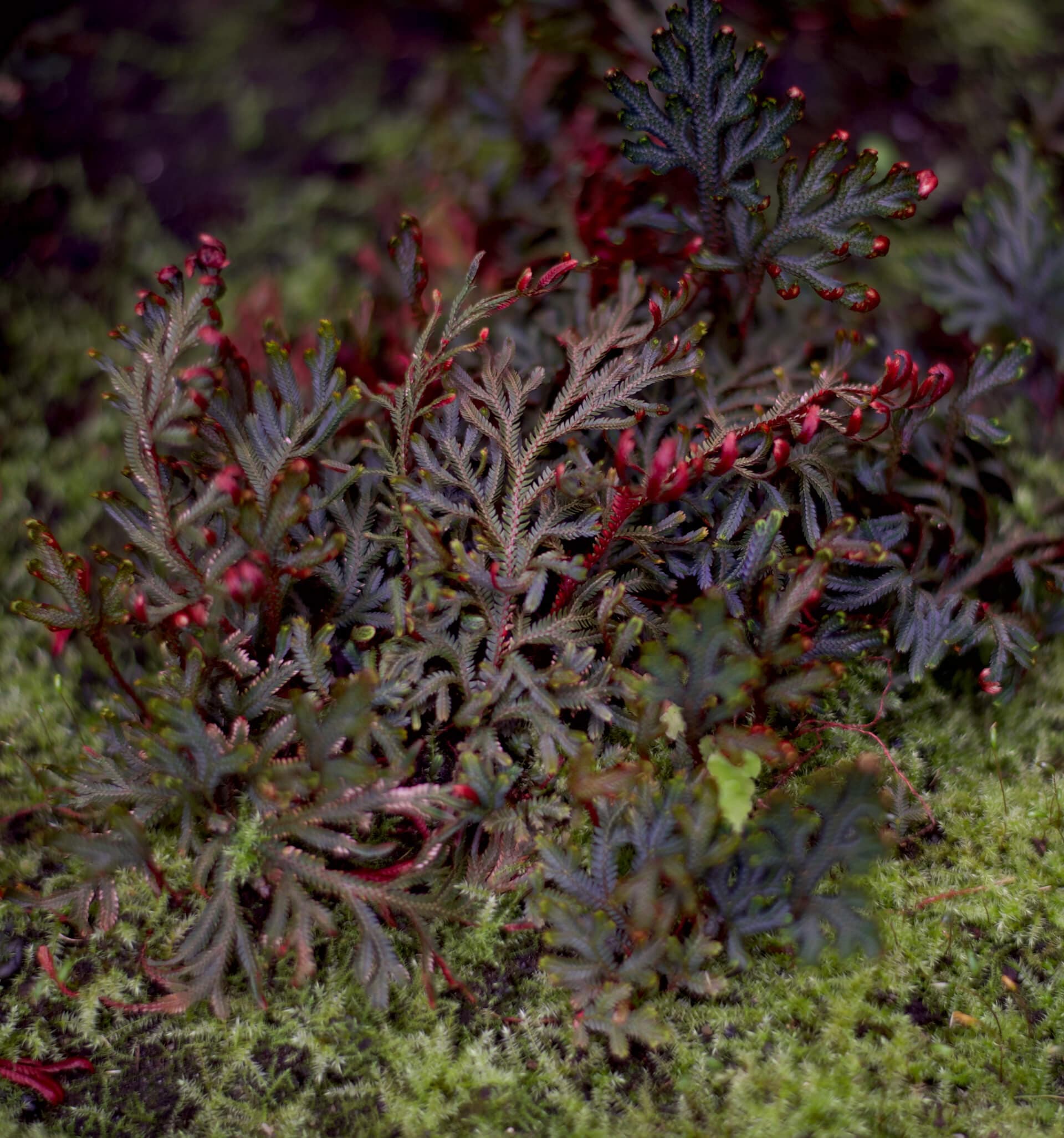
Selaginella erythropus is a spikemoss from the wet lowland forests of Costa Rica and tropical South America, where it grows along riverbanks and in thickets beneath dense forest. Each upright red stem branches into a flat, fern-like frond that is dark green on top and ruby red underneath. It is a lycophyte — one of the oldest surviving lineages of vascular plants — rather than a true moss, and in a closed terrarium it usually stays 5–15 cm tall, spreading slowly from underground rhizomes. It does best in shade to bright indirect light with constantly moist substrate and humidity of 70% or more; the fronds crisp quickly if the substrate dries out, and strong light can bleach their colour.
Care
Prefers very high humidity, low light, with 10–28 °C, and reaches 25 cm at maturity.
Light
Humidity
Temperature
Soil
Moisture
Soil pH
Propagation
Stem sections root readily wherever they touch moist substrate, and cuttings often already carry aerial roots from the branch points. Laid on damp substrate in a closed container, they establish as long as the humidity stays high.
Native range
Native to Central America, Western South America, and Brazil.
Native range
Appearance
Growth habit
Leaf shape
Leaf texture
Frequently asked
Can Red Spikemoss grow in a closed terrarium?
Yes. Red Spikemoss prefers very high (above 80%) humidity, which is what a closed terrarium provides, and tolerates shade-tolerant conditions.
Does Red Spikemoss need drainage?
Red Spikemoss prefers a moist substrate. Drainage is helpful but not critical; consistent moisture matters more.
What humidity does Red Spikemoss need?
Red Spikemoss does best in very high (above 80%) humidity.
Is Red Spikemoss pet-safe?
Red Spikemoss is considered non-toxic to common household pets.
How tall does Red Spikemoss grow?
Red Spikemoss typically reaches 5–25 cm at maturity.
How do you propagate Red Spikemoss?
Red Spikemoss can be propagated by stem cuttings or rhizome division or spores.
References
- 1
Kew Plants of the World Online — Selaginella erythropus
https://powo.science.kew.org/taxon/urn:lsid:ipni.org:names:30243959-2 - 2
GBIF — World Checklist of Vascular Plants distribution for Selaginella erythropus
https://www.gbif.org/species/207818862 - 3
NParks Flora & Fauna Web — Selaginella erythropus
https://www.nparks.gov.sg/florafaunaweb/flora/1/5/1576 - 4
Wikipedia — Selaginella erythropus
https://en.wikipedia.org/wiki/Selaginella_erythropus - 5
RHS — Selaginella erythropus var. sanguinea
https://www.rhs.org.uk/plants/281579/selaginella-erythropus-var-sanguinea/details - 6
New England Herpetoculture — Selaginella erythropus
https://neherpetoculture.com/selaginella - 7
Josh's Frogs — Selaginella erythropus 'Sanguinea'
https://joshsfrogs.com/sp/selaginella-erythropus--sanguinea--plant1271 - 8
Logee's — Ruby Red Club Moss
https://www.logees.com/products/ruby-red-club-moss - 9
Cistus Nursery — Selaginella erythropus 'Sanguinea'
https://cistus.com/products/retail-selaginella-erythropus-sanguinea - 10
Jungle Leaves — Selaginella erythropus
https://www.jungle-leaves.de/en/products/selaginella-erythropus - 11
Frog Daddy — Selaginella erythropus
https://frogdaddy.net/products/selaginella-erythropus-1 - 12
Horizon Aquatics — Red Spike Moss
https://www.horizonaquatics.co.uk/products/red-spike-moss-selaginella-erythropus - 13
Terrarium Tribe — Selaginella guide (propagation)
https://terrariumtribe.com/selaginella/ - 14
ASPCA — Tropical Moss (S. kraussiana; S. erythropus not listed)
https://www.aspca.org/pet-care/aspca-poison-control/toxic-and-non-toxic-plants/tropical-moss