Pyrrosia piloselloides
Dragon Scale Fern, Dragon's Scale Fern, Dwarf Tongue Fern
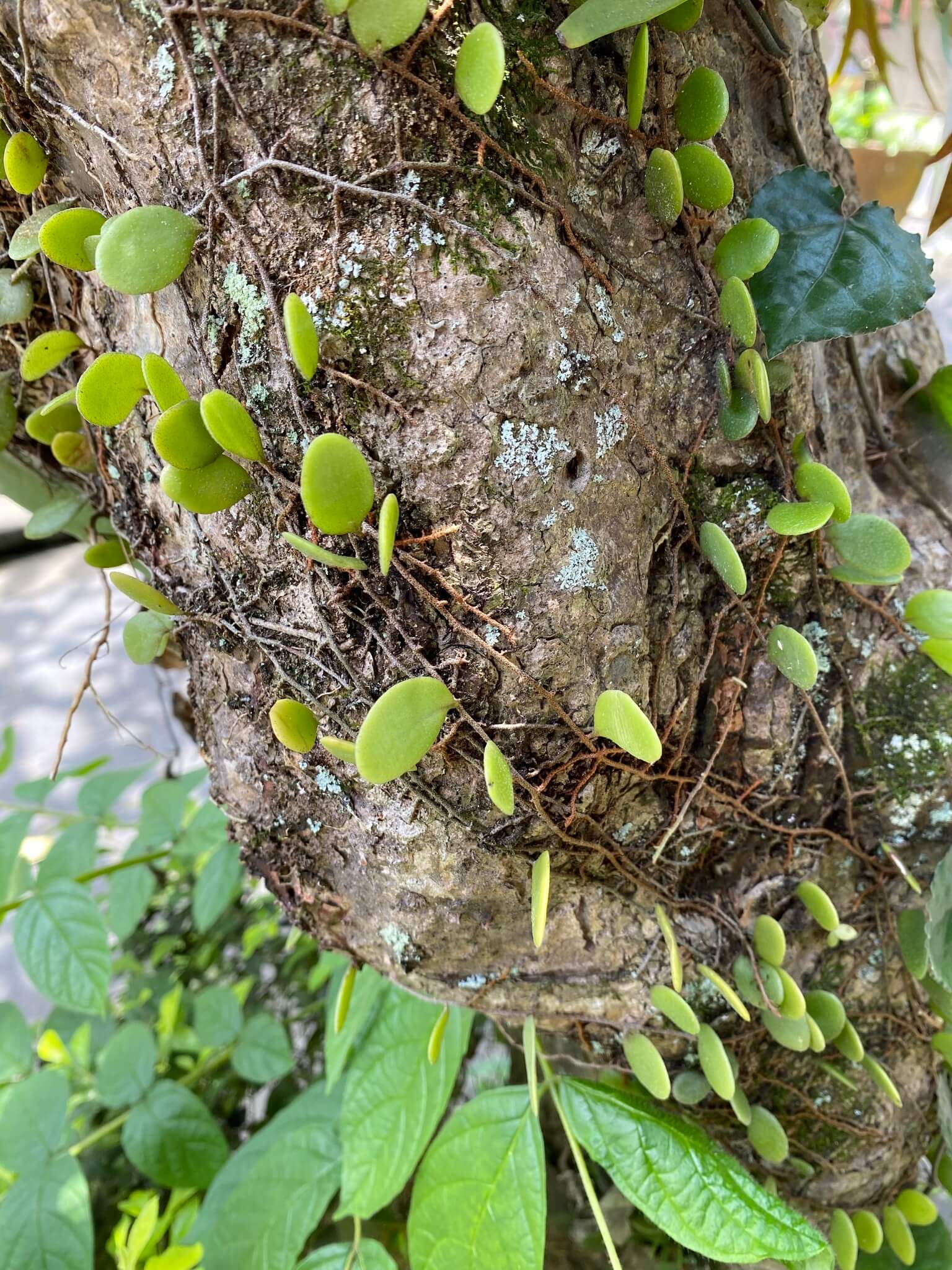
A miniature creeping fern from tropical Asia with button-like, fleshy round leaves that overlap as the rhizome — a horizontal stem — spreads along surfaces. It is an epiphyte, naturally growing on tree trunks and branches rather than in soil. In a terrarium, it does best mounted on driftwood or bark. Once established, it gradually blankets hardscape in a dense layer of green scales.
Care
Prefers high humidity, indirect light, with 18–26 °C, and reaches 5 cm at maturity.
Light
Humidity
Temperature
Soil
Moisture
Propagation
Native range
Native to China, Eastern Asia, Indian Subcontinent, Indo-China, Malesia, and Papuasia.
Appearance
Growth habit
Leaf shape
Leaf texture
Frequently asked
Can Dragon Scale Fern grow in a closed terrarium?
Yes. Dragon Scale Fern prefers high (60–80%) humidity, which is what a closed terrarium provides, and tolerates indirect-light-loving conditions.
Does Dragon Scale Fern need drainage?
Dragon Scale Fern prefers a moist substrate. Drainage is helpful but not critical; consistent moisture matters more.
What humidity does Dragon Scale Fern need?
Dragon Scale Fern does best in high (60–80%) humidity.
Is Dragon Scale Fern pet-safe?
Dragon Scale Fern is considered non-toxic to common household pets.
How tall does Dragon Scale Fern grow?
Dragon Scale Fern typically reaches 2–5 cm at maturity.
How do you propagate Dragon Scale Fern?
Dragon Scale Fern can be propagated by rhizome division or spores.
References
- 1
Plants of the World Online (Kew)
https://powo.science.kew.org/taxon/urn:lsid:ipni.org:names:17453390-1 - 2
- 3
- 4
Glass Box Tropicals
https://glassboxtropicals.com/pyrrosia-piloselloides/ - 5
NParks Singapore
https://www.nparks.gov.sg/florafaunaweb/flora/1/5/1571 - 6