Marcgravia rectiflora
Shingle Vine, Shingle Plant
Marcgravia rectiflora is a shingling vine from the wet tropical forests of Central America, the Caribbean, and northern South America, where it climbs tree trunks by pressing its young leaves flat against the bark. In juvenile form the leaves are small, leathery, and asymmetrically heart-shaped, arranged in two tight ranks that overlap like roof tiles — many forms flush a reddish-bronze before darkening to deep green. It is the most widely grown Marcgravia in the terrarium trade because it tolerates a broader light range (low to bright indirect) than its relatives, though it still needs humidity above 75% and warm temperatures around 22–28 °C to settle and attach.
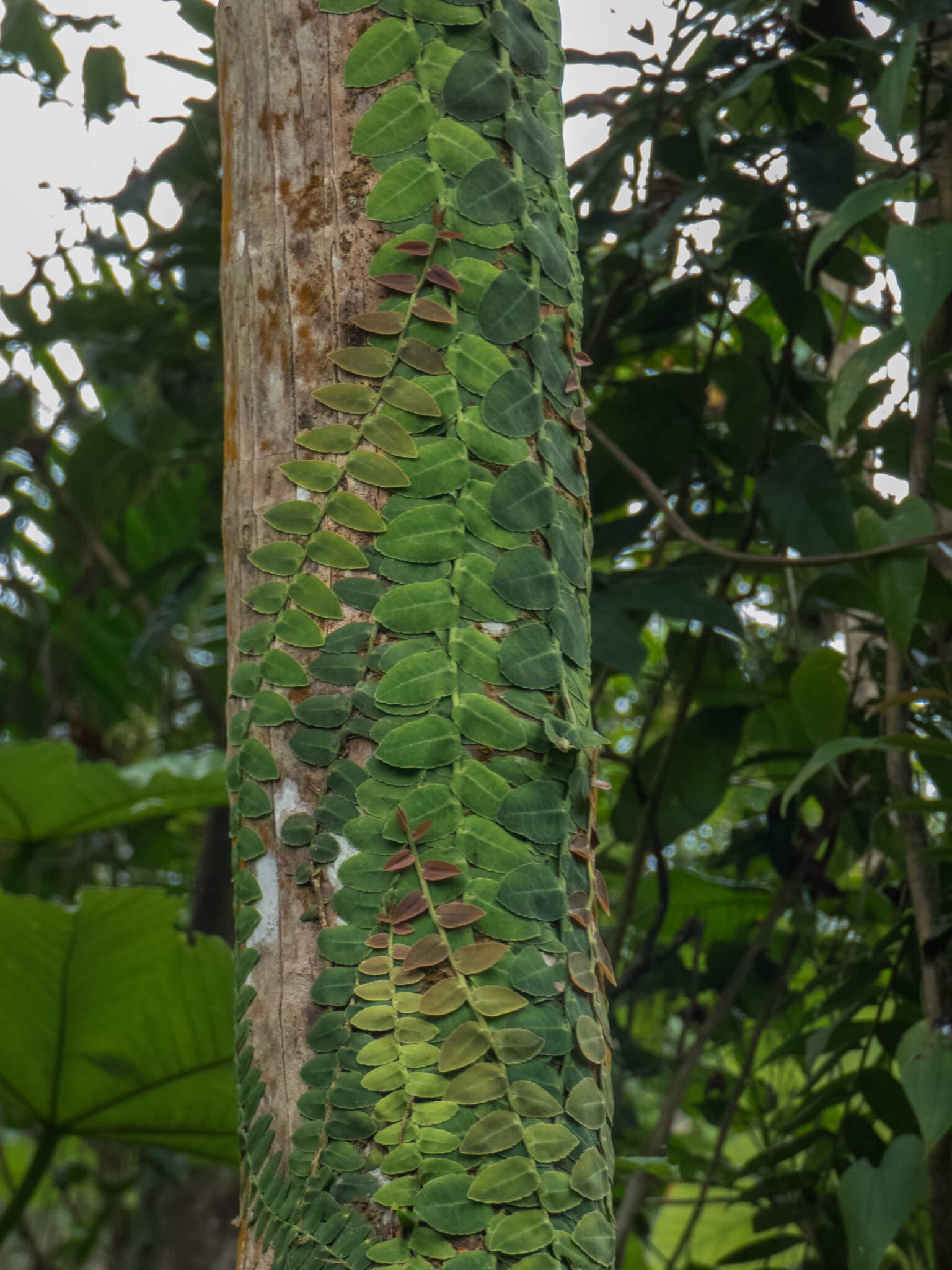
Photo by Alina Martin·CC BY 4.0
Care
Prefers very high humidity, indirect light, with 18–28 °C, and reaches 150 cm at maturity.
Light
Humidity
Temperature
Soil
Moisture
Soil pH
Propagation
Native range
Native to Northern South America, Central America, Caribbean, and Western South America.
Appearance
Growth habit
Leaf shape
Leaf texture
Frequently asked
Can Shingle Vine grow in a closed terrarium?
Yes. Shingle Vine prefers very high (above 80%) humidity, which is what a closed terrarium provides, and tolerates indirect-light-loving conditions.
Does Shingle Vine need drainage?
Shingle Vine prefers a moist substrate. Drainage is helpful but not critical; consistent moisture matters more.
What humidity does Shingle Vine need?
Shingle Vine does best in very high (above 80%) humidity.
Is Shingle Vine pet-safe?
Shingle Vine is considered non-toxic to common household pets.
How tall does Shingle Vine grow?
Shingle Vine typically reaches 10–150 cm at maturity.
How do you propagate Shingle Vine?
Shingle Vine can be propagated by stem cuttings.
References
- 1
Kew Plants of the World Online — Marcgravia rectiflora Triana & Planch.
https://powo.science.kew.org/taxon/urn:lsid:ipni.org:names:321278-2 - 2
Ariumology — Marcgravia Species For Bioactive Terrariums
https://ariumology.com/2026/02/17/marcgravia-species-for-bioactive-terrariums/ - 3
Glass Box Tropicals — Marcgravia rectiflora
https://glassboxtropicals.com/marcgravia-rectiflora/ - 4
FrogDaddy — Marcgravia rectiflora Terrarium Plant
https://frogdaddy.net/products/marcgravia-rectiflora - 5
Dendroboard — The Many Faces of Marcgravia "rectiflora"
https://www.dendroboard.com/threads/the-many-faces-of-marcgravia-rectiflora.201545/ - 6
Plant Circle — Marcgravia Care Tips
https://plantcircle.com/blogs/plant-care-tips-part-2/marcgravia-care-tips