Polka Dot Plant is naturally a short-lived perennial sold as a houseplant annual - it flowers and dies within a season or two. Pinch flower buds to delay the cycle, and propagate from stem cuttings to keep the planting going.
Hypoestes phyllostachya
Polka Dot Plant, Freckle Face, Measles Plant, Flamingo Plant
Easy careTerrestrialNon-toxic10–60 cm
Hypoestes phyllostachya is a low, bushy evergreen from Madagascar, grown for its dark green leaves speckled with pink — the pattern behind its common name, polka dot plant. Herbarium collections place it across much of the island, from dry forest and limestone outcrops in the west and south-west to forest edges in the humid north and east, from near sea level to about 1,100 m. Garden references often say it also comes from southern Africa and South-East Asia, but that is the range of the genus as a whole; this species is native only to Madagascar, and the name H. sanguinolenta, found in some older references, is now treated as a synonym. Its opposite, oval leaves are 2.5–7.5 cm long and softly downy, with spots that show pink above and cream to white beneath. Seed strains such as the Confetti and Splash series swap the pink for red, white or rose, and some reverse the pattern to pink leaves flecked with green; the Confetti series also stays smaller, at about 20 cm. It grows fast to 30–60 cm and turns leggy with age, so in a terrarium it needs regular pinching to stay bushy, and Wisconsin's extension service notes that houseplants eventually need replacing — easily done from cuttings. It is a short-day plant: a 1991 Virginia Tech study found it flowers sooner as the days shorten, and indoors it usually sends up spikes of small, tubular pink to lilac flowers in late summer or autumn. NC State notes that removing them keeps the plant's energy in its leaves. It does best in bright, filtered light, humidity above about 50% and 15–26 °C, in soil that stays evenly moist: the spots fade and the stems stretch in dim light, strong direct sun crinkles the leaves, and it wilts quickly when it dries out, which makes a closed terrarium an easy fit. ASPCA lists it as non-toxic to cats and dogs.
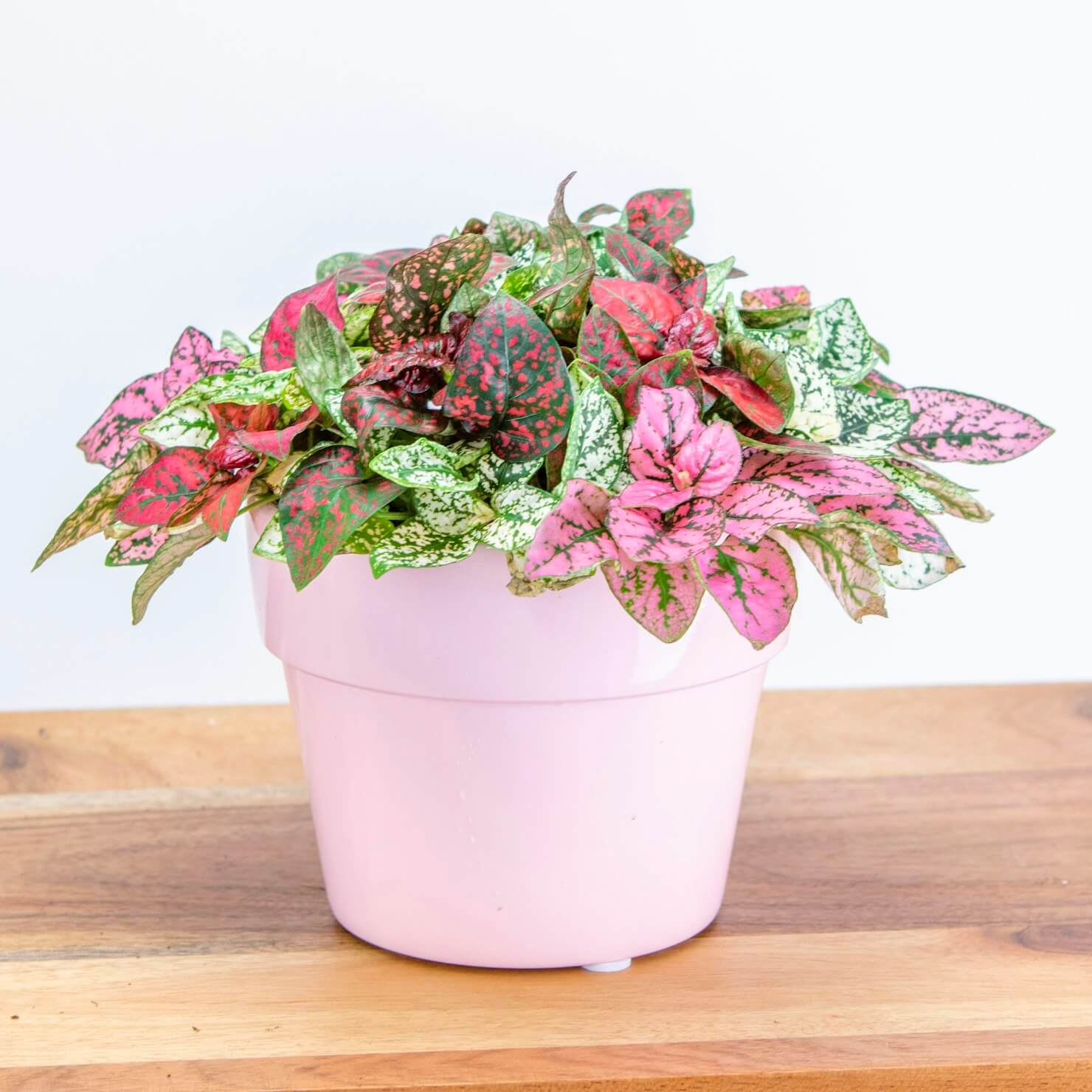
Care
Prefers high humidity, bright indirect light, with 15–30 °C, and reaches 60 cm at maturity.
Light
Bright indirect(preferred)Indirect light
Humidity
High (60–80%)(preferred)Medium (40–60%)Very high (80%+)
Temperature
10°C25°C40°C
15°C – 30°C
Soil
Loamy(preferred)Well drainingPeat moss
Moisture
Moist(preferred)
Soil pH
5.5 – 6.5
Propagation
Tip cuttings about 10 cm long, with the lower leaves stripped, root readily in water or moist substrate, according to Wisconsin's extension service. The RHS suggests softwood cuttings in late spring or semi-ripe cuttings in summer, and a Virginia Tech study found that cuttings with three nodes — the joints where leaves attach — rooted faster and more heavily than two-node cuttings. The tips pinched from a leggy plant can be rooted to restart it.
Native range
Native to Western Indian Ocean.
Native range
Appearance
Growth habit
BushyUpright
Leaf shape
Oval
Leaf texture
Velvety
Frequently asked
Can Polka Dot Plant grow in a closed terrarium?
Yes. Polka Dot Plant prefers high (60–80%) humidity, which is what a closed terrarium provides, and tolerates bright-indirect-light-loving conditions.
Does Polka Dot Plant need drainage?
Polka Dot Plant prefers a moist substrate. Drainage is helpful but not critical; consistent moisture matters more.
What humidity does Polka Dot Plant need?
Polka Dot Plant does best in high (60–80%) humidity.
Is Polka Dot Plant pet-safe?
Polka Dot Plant is considered non-toxic to common household pets.
How tall does Polka Dot Plant grow?
Polka Dot Plant typically reaches 10–60 cm at maturity.
How do you propagate Polka Dot Plant?
Polka Dot Plant can be propagated by stem cuttings or seeds or division.
Observations
Cultivation
References
- 1
Kew Plants of the World Online — Hypoestes phyllostachya
https://powo.science.kew.org/taxon/urn:lsid:ipni.org:names:49962-1 - 2
GBIF — World Checklist of Vascular Plants distribution and synonyms for Hypoestes phyllostachya
https://www.gbif.org/species/206462894 - 3
GBIF — Madagascar occurrence records for Hypoestes phyllostachya (habitat and elevation)
https://www.gbif.org/occurrence/search?taxon_key=3173196&country=MG - 4
RHS — Hypoestes phyllostachya (v)
https://www.rhs.org.uk/plants/73160/hypoestes-phyllostachya-v/details - 5
NC State Extension — Hypoestes phyllostachya
https://plants.ces.ncsu.edu/plants/hypoestes-phyllostachya/ - 6
Wisconsin Horticulture (UW–Madison Extension) — Polka Dot Plant
https://hort.extension.wisc.edu/articles/polka-dot-plant-hypoestes-phyllostachya/ - 7
Wang (1991), Virginia Tech — Propagation, height control, and flowering of Hypoestes phyllostachya
https://vtechworks.lib.vt.edu/handle/10919/41032 - 8
Australian Tropical Rainforest Plants — Hypoestes phyllostachya
https://apps.lucidcentral.org/rainforest/text/entities/Hypoestes_phyllostachya.htm - 9
Weeds of Australia — Hypoestes phyllostachya
https://keyserver.lucidcentral.org/weeds/data/media/Html/hypoestes_phyllostachya.htm - 10
NParks Flora & Fauna Web — Hypoestes phyllostachya
https://www.nparks.gov.sg/florafaunaweb/flora/8/1/8117 - 11
Wikipedia — Hypoestes phyllostachya
https://en.wikipedia.org/wiki/Hypoestes_phyllostachya - 12
Blooming Biomes — Polka Dot Plant terrarium care
https://bloomingbiomes.com/polka-dot-plant-terrarium/ - 13
UK Houseplants — Polka Dot Plants
https://www.ukhouseplants.com/plants/hypoestes-polka-dot-plants - 14
- 15
Walmart — Tri-Color Polka Dot Plant (availability)
https://www.walmart.com/ip/587147187