Drosera spatulata
Spoon-leaved Sundew, Spoonleaf Sundew, Rosy Sundew
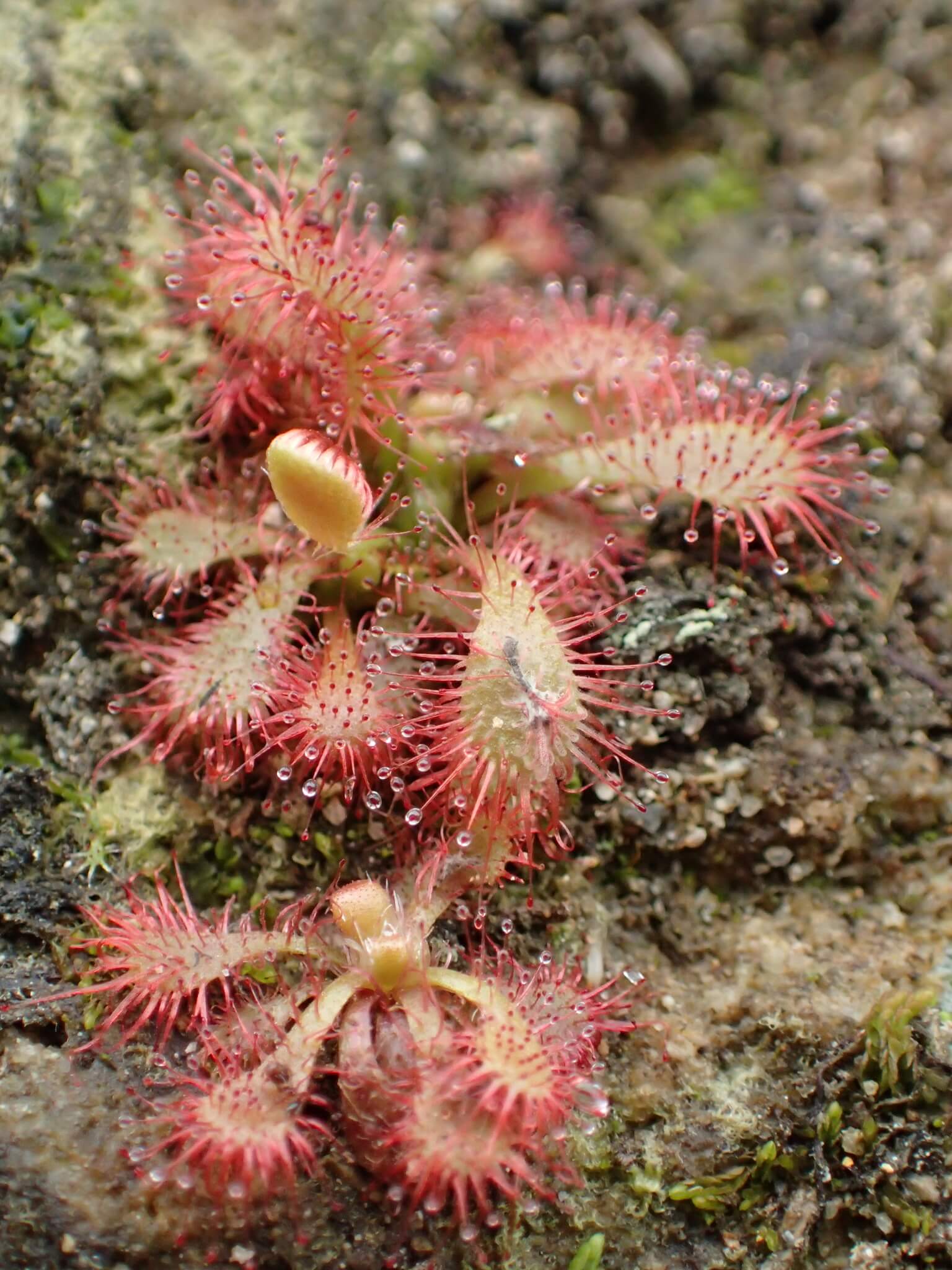
A tiny but tenacious carnivorous plant native to open, sunlit bogs across East Asia and Australasia — from the mountains of southern China and Japan through the Philippines and New Guinea all the way to New Zealand. Its compact rosette of spoon-shaped leaves is armed with reddish, glandular tentacles tipped with glittering sticky mucilage that lures and traps small insects, compensating for the nutrient-poor, waterlogged soils it naturally grows in. In bright light the whole rosette can flush deep scarlet, making it one of the most visually striking miniature carnivorous plants available. It does best sitting in a shallow tray of distilled or rainwater in full light — tap water minerals accumulate quickly and will weaken or kill it over time.
Care
Prefers high humidity, bright indirect light, with 7–32 °C, and reaches 8 cm at maturity.
Light
Humidity
Temperature
Soil
Moisture
Soil pH
Propagation
Native range
Native to China, Eastern Asia, Malesia, Papuasia, Australia, New Zealand, and Northwestern Pacific.
Appearance
Growth habit
Leaf shape
Leaf texture
Frequently asked
Can Spoon-leaved Sundew grow in a closed terrarium?
Yes. Spoon-leaved Sundew prefers high (60–80%) humidity, which is what a closed terrarium provides, and tolerates bright-indirect-light-loving conditions.
Does Spoon-leaved Sundew need drainage?
Spoon-leaved Sundew prefers a wet substrate. Drainage is helpful but not critical; consistent moisture matters more.
What humidity does Spoon-leaved Sundew need?
Spoon-leaved Sundew does best in high (60–80%) humidity.
Is Spoon-leaved Sundew pet-safe?
Spoon-leaved Sundew is considered non-toxic to common household pets.
How tall does Spoon-leaved Sundew grow?
Spoon-leaved Sundew typically reaches 2–8 cm at maturity.
How do you propagate Spoon-leaved Sundew?
Spoon-leaved Sundew can be propagated by leaf cuttings or division or seeds.
References
- 1
Kew Plants of the World Online — Drosera spatulata
https://powo.science.kew.org/taxon/urn:lsid:ipni.org:names:321972-1 - 2
Wikipedia — Drosera spatulata
https://en.wikipedia.org/wiki/Drosera_spatulata - 3
Venus Flytrap World — Drosera spatulata care sheet
https://venusflytrapworld.com/drosera-spatulata-care-instructions-with-care-sheet/ - 4
Carnivorous Plants Guide — Drosera spatulata care
https://www.carnivorousplantsguide.com/drosera-spatulata-care-spoon-leaved-sundew/ - 5
ICPS — Growing Subtropical Drosera
https://www.carnivorousplants.org/grow/guides/SubtropicalDrosera - 6
ICPS — Drosera Leaf Cuttings propagation guide
https://www.carnivorousplants.org/grow/propagation/DroseraLeafCuttings - 7
PlantIn — Drosera spatulata care
https://myplantin.com/plant/2200 - 8
ASPCA Toxic Plant List — D listing (Drosera not listed; genus confirmed non-toxic)
https://www.aspca.org/pet-care/animal-poison-control/toxic-and-non-toxic-plants/d - 9
Terrarium Plant In — Complete Sundew Growing and Care Guide
https://plantinterrarium.com/complete-sundew-growing-care-guide/ - 10
Grow Sundews — Drosera spatulata species page
https://www.growsundews.com/sundews/Drosera_spatulata.html