Restrepia lansbergii Rchb.f. & H.Wagener
Lansberg's Restrepia
Restrepia lansbergii is a miniature epiphytic orchid from the cloud forests of Venezuela, Ecuador, and Peru, where it grows on mossy tree branches at elevations between 700 and 3,000 m in cool, mist-drenched montane air. Each plant is built around a slender erect stem called a ramicaul — a single-leafed structure characteristic of the Pleurothallid orchid group — topped by a stiff, elliptic leaf that is distinctively purple-tinged on the underside. From the base of this leaf, it sends out delicate 3–6 cm inflorescences bearing small but intricate white flowers spotted with purple; in good conditions these can appear in any season, making it one of the more reliably free-blooming miniature orchids available. In cultivation it does best in cool-intermediate temperatures (10–24 °C) with very high humidity and consistently moist roots — making it a natural fit for a closed terrarium or orchidarium, where stable moisture and filtered shade replicate its cloud-forest home.
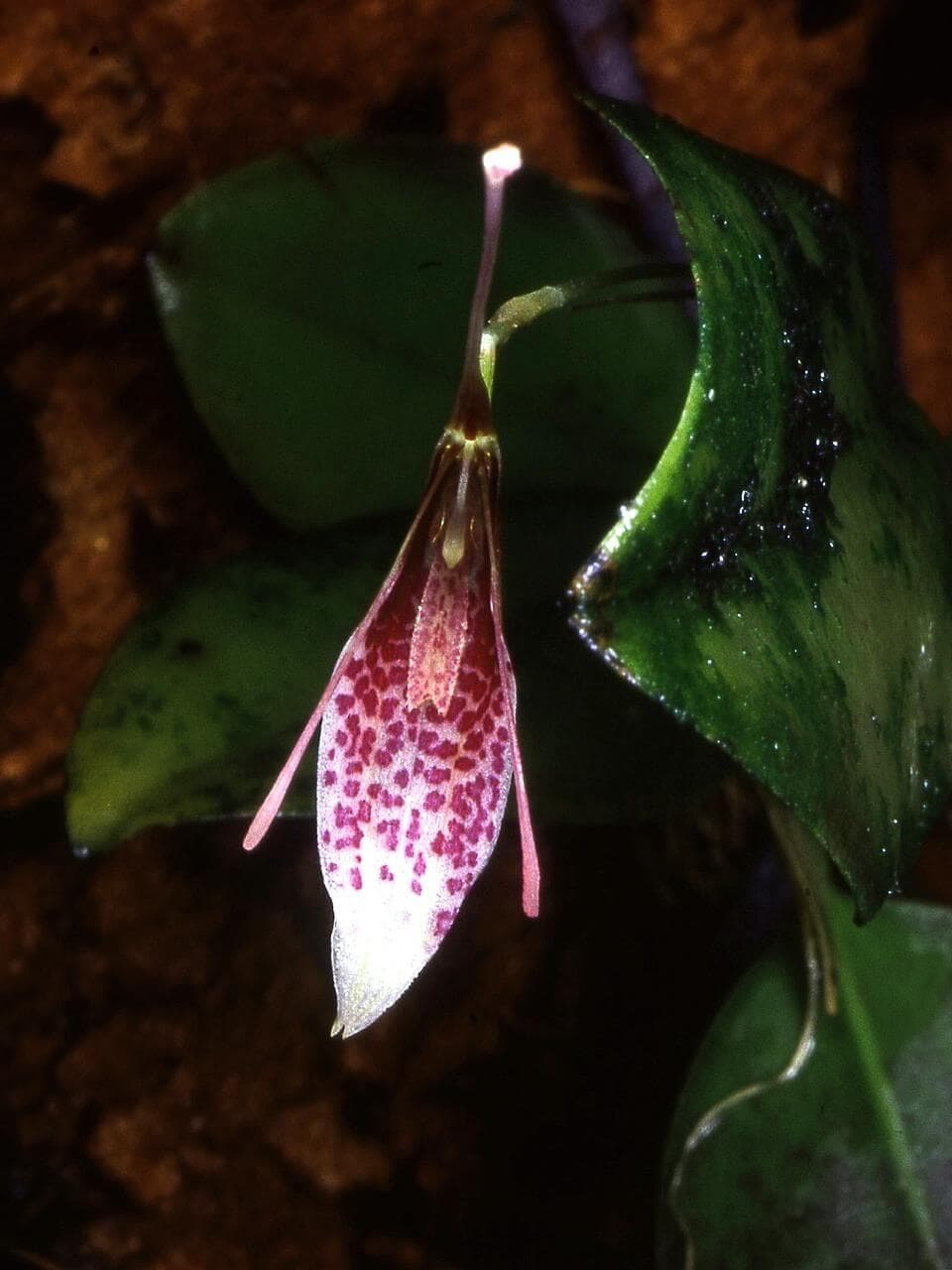
Photo by Orchi·CC BY-SA 3.0
Care
Prefers very high humidity, low light, with 10–24 °C, and reaches 15 cm at maturity.
Light
Humidity
Temperature
Soil
Moisture
Propagation
Native range
Native to Northern South America and Western South America.
Appearance
Growth habit
Leaf shape
Leaf texture
Frequently asked
Can Lansberg's Restrepia grow in a closed terrarium?
Yes. Lansberg's Restrepia prefers very high (above 80%) humidity, which is what a closed terrarium provides, and tolerates shade-tolerant conditions.
Does Lansberg's Restrepia need drainage?
Lansberg's Restrepia prefers a moist substrate. Drainage is helpful but not critical; consistent moisture matters more.
What humidity does Lansberg's Restrepia need?
Lansberg's Restrepia does best in very high (above 80%) humidity.
Is Lansberg's Restrepia pet-safe?
Lansberg's Restrepia is considered non-toxic to common household pets.
How tall does Lansberg's Restrepia grow?
Lansberg's Restrepia typically reaches 10–15 cm at maturity.
How do you propagate Lansberg's Restrepia?
Lansberg's Restrepia can be propagated by offsets or seeds.
References
- 1
POWO (Kew) — Restrepia lansbergii Rchb.f. & H.Wagener (accepted name, first published Bonplandia (Hannover) 2: 23 (1854); family Orchidaceae; native range NW. Venezuela to N. Central Peru; epiphytic; wet tropical biome)
https://powo.science.kew.org/taxon/urn:lsid:ipni.org:names:655544-1 - 2
IOSPE (orchidspecies.com) — Restrepia lansbergii Rchb.f. & Wagener 1854 (common name: Lansberg's Restrepia; distribution: Venezuela (Caracas), Ecuador (Pastaza, Tungurahua), Peru (Huanuco) at 700–3,000 m; miniature epiphyte with erect ramicauls; elliptical-ovate coriaceous leaves, purple beneath; inflorescence 3–6 cm, flower ~1 cm; white flowers with purple spots; blooms all seasons; cool to cold growing)
https://orchidspecies.com/reslansbergii.htm - 3
Glass Box Tropicals — Restrepia lansbergii (excellent terrarium addition; medium size ~10–15 cm; medium-to-high moisture; does not like to dry out for long; mounted epiphytically on wood or rock; bright pink and white flowers; Venezuela, Ecuador, Peru)
https://glassboxtropicals.com/restrepia-lansbergii/ - 4
OrchidWeb — Restrepia lansbergii (cool-intermediate; low-medium light; year-round blooming; CITES Appendix II species)
https://www.orchidweb.com/orchids/pleurothallidinae/species/restrepia-lansbergii - 5
Orchid Care Tips — Restrepias (genus care: max ~20 °C; 10–15 °F night temperature drop; humidity 70–100%; intermediate light ~2,000 fc; fine fir bark or NZ sphagnum; water when approaching dryness; keikis form at leaf base for easy propagation; orchidarium/terrarium ideal)
https://www.orchid-care-tips.com/restrepias.html - 6
ASPCA Toxic and Non-Toxic Plants — Phalaenopsis Orchid (Orchidaceae family confirmed non-toxic to cats, dogs, and horses; Restrepia not individually listed; orchids broadly non-toxic within the family)
https://www.aspca.org/pet-care/aspca-poison-control/toxic-and-non-toxic-plants/phalaenopsis-orchid