Pleurothallis costaricensis Rolfe
Costa Rican Pleurothallis
Pleurothallis costaricensis is a mini-miniature warm-growing epiphytic orchid native to the wet tropical forests of Costa Rica, Panama, Colombia, and Ecuador, found at 650–1,800 m on shaded, moss-covered branches. It belongs to the subtribe Pleurothallidinae (family Orchidaceae) and produces single narrowly strap-like, leathery leaves roughly 5 cm long on thread-thin ramicauls — caespitose clumps slowly spreading into trailing mats that suit background planting in a vivarium. In spring, summer, and fall it sends up compressed racemes carrying up to 12 simultaneous bright yellow flowers, each barely 5 mm across, which are eye-catching despite their size. It does best mounted on cork bark with a thin backing of New Zealand sphagnum kept consistently moist, inside a warm, high-humidity closed or semi-closed enclosure; it is one of the more forgiving pleurothallids in cultivation and tolerates a wider temperature range than most relatives.
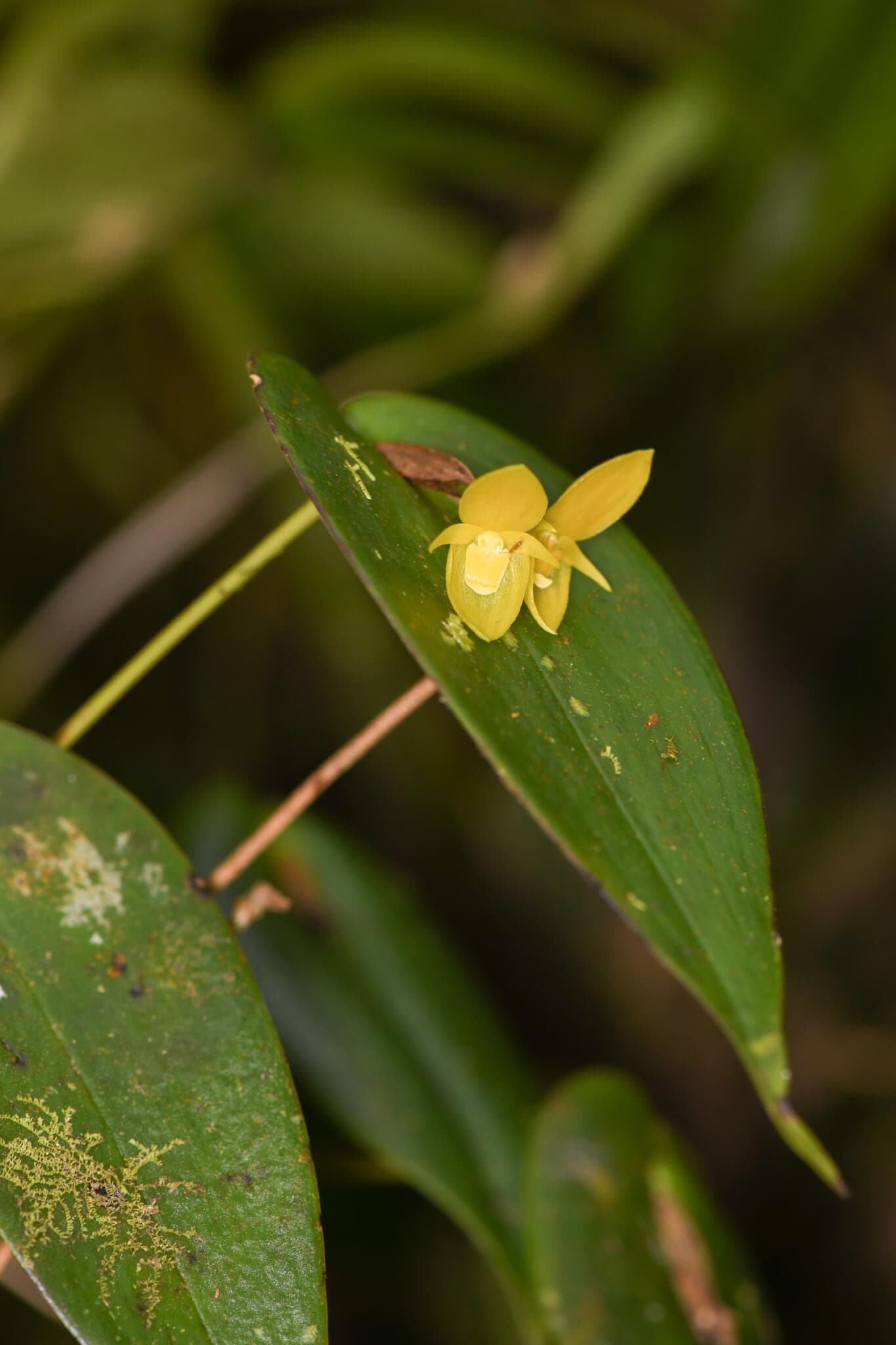
Photo by Trevor Van Loon·CC BY 4.0
Care
Prefers high humidity, low light, with 14–30 °C, and reaches 8 cm at maturity.
Light
Humidity
Temperature
Soil
Moisture
Propagation
Native range
Native to Central America and Western South America.
Appearance
Growth habit
Leaf shape
Leaf texture
Frequently asked
Can Costa Rican Pleurothallis grow in a closed terrarium?
Yes. Costa Rican Pleurothallis prefers high (60–80%) humidity, which is what a closed terrarium provides, and tolerates shade-tolerant conditions.
Does Costa Rican Pleurothallis need drainage?
Costa Rican Pleurothallis prefers a moist substrate. Drainage is helpful but not critical; consistent moisture matters more.
What humidity does Costa Rican Pleurothallis need?
Costa Rican Pleurothallis does best in high (60–80%) humidity.
Is Costa Rican Pleurothallis pet-safe?
Costa Rican Pleurothallis is considered non-toxic to common household pets.
How tall does Costa Rican Pleurothallis grow?
Costa Rican Pleurothallis typically reaches 4–8 cm at maturity.
How do you propagate Costa Rican Pleurothallis?
Costa Rican Pleurothallis can be propagated by division.
References
- 1
IOSPE (orchidspecies.com) — Pleurothallis costaricensis Rolfe 1917 (distribution: Costa Rica Cartago province and Panama at 650–1800 m; common name: The Costa Rican Pleurothallis; mini-miniature hot to warm growing epiphyte; narrowly ligulate coriaceous leaf; simultaneous 6–12 flowered distichous raceme on compressed peduncle; synonyms: Pleurothallis ehrhartiiflora Schltr. 1923, Specklinia costaricensis (Rolfe) Pridgeon & M.W.Chase 2001)
https://www.orchidspecies.com/pleurcostaricensis.htm - 2
POWO (Kew) — Specklinia costaricensis (Rolfe) Pridgeon & M.W.Chase (accepted name per POWO; native range Costa Rica to W. Ecuador; distribution: Colombia, Costa Rica, Ecuador, Panamá; epiphyte, wet tropical biome; published Lindleyana 16: 257 (2001))
https://powo.science.kew.org/taxon/urn:lsid:ipni.org:names:1193873-2 - 3
Glass Box Tropicals — Pleurothallis (Specklinia) costaricensis (warm to hot growing; trailing habit; leaves 1–2" narrow; bright yellow flowers; blooms several times per year; easier-growing species; mount with NZ sphagnum; tolerates terrarium conditions)
https://glassboxtropicals.com/pleurothallis-specklinia-costaricensis/ - 4
Orchidee.de — Specklinia costaricensis (leaves ~5 cm, very narrow; up to 12 bright yellow flowers per inflorescence; flowers mm-sized; lava granulate or sphagnum substrate; pot kept consistently moist; not particularly light-hungry; night temps 10–15 °C, day up to 30 °C; habitat: continuously moist wet tropics)
https://orchidee.de/en/specklinia-costaricensis/ - 5
ColPlanta — Specklinia costaricensis (Rolfe) Pridgeon & M.W.Chase (Colombian Plants: distribution confirmed Colombia; epiphyte, wet tropical biome)
https://colplanta.org/taxon/urn:lsid:ipni.org:names:1193873-2 - 6
Seattle Orchid — Pleurothallis costaricensis product page (origin: Costa Rica, Panama; warm to hot growing; low light; moist conditions)
https://www.seattleorchid.com/Pleurothallis-costaricensis-p/tspleu-costaricensis.htm - 7
OrchidWeb — Pleurothallidinae Orchid Care (day temps 18–24 °C, night temps 5–16 °C; humidity ~70%; thin-leaved species: 1200 fc light; NZ sphagnum substrate; media kept evening-damp; water mornings)
https://www.orchidweb.com/orchid-care/pleurothallidinae-orchid-care - 8
Orchid Care Tips — Pleurothallis genus (humidity minimum 70%; most species prefer below 21 °C but warm-growing species tolerate more; 700–1500 fc; fine-grade bark or NZ sphagnum; hate to dry out)
https://www.orchid-care-tips.com/pleurothallis.html - 9
AOS — Pleurothallis genus (high humidity essential; low-medium light; grow in seedling-grade epiphyte mix or mounted; water regularly, roots must not dry out; cool to warm depending on species; USDA zones 10–12)
https://www.aos.org/orchids/orchids-a-to-z/letter-p/pleurothallis.aspx - 10
ASPCA Toxic and Non-Toxic Plants — Orchidaceae (Phalaenopsis and Jewel Orchid confirmed non-toxic to cats, dogs, and horses; orchids family-wide considered non-toxic)
https://www.aspca.org/pet-care/aspca-poison-control/toxic-and-non-toxic-plants/phalaenopsis-orchid