Platystele aurea Garay
Ruby Pleurothallis
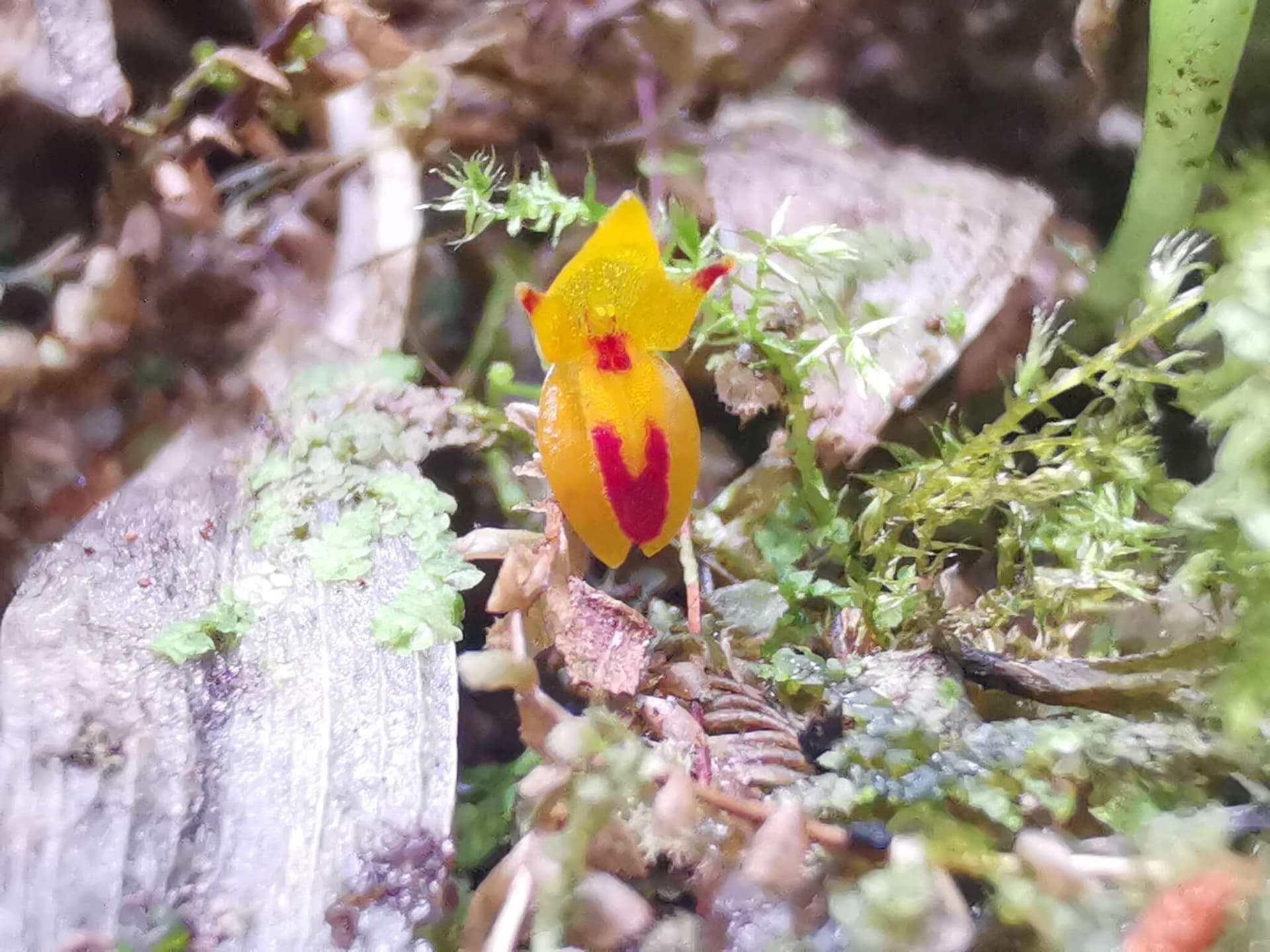
A miniature epiphytic orchid from the cloud forests of Panama and Colombia, where it grows on moss-covered branches at elevations of 1,100–1,400 m. It belongs to the subtribe Pleurothallidinae (family Orchidaceae) and forms slow-spreading caespitose mats — clusters of tiny ramicauls, each carrying a single leathery elliptic leaf — that rarely exceed 8 cm in height. In autumn it sends up single-flowered spikes bearing tiny 3 mm blooms in warm yellow-orange tones with a contrasting red lip; a well-grown clump in flower is striking despite its size. It does best mounted on cork bark with a thin backing of sphagnum moss kept consistently moist, inside a warm, high-humidity closed enclosure. Widely sold in the terrarium hobby under the synonym Pleurothallis rubella.
Care
Prefers high humidity, low light, with 14–30 °C, and reaches 8 cm at maturity.
Light
Humidity
Temperature
Soil
Moisture
Propagation
Native range
Native to Northern South America and Central America.
Appearance
Growth habit
Leaf shape
Leaf texture
Frequently asked
Can Ruby Pleurothallis grow in a closed terrarium?
Yes. Ruby Pleurothallis prefers high (60–80%) humidity, which is what a closed terrarium provides, and tolerates shade-tolerant conditions.
Does Ruby Pleurothallis need drainage?
Ruby Pleurothallis prefers a moist substrate. Drainage is helpful but not critical; consistent moisture matters more.
What humidity does Ruby Pleurothallis need?
Ruby Pleurothallis does best in high (60–80%) humidity.
Is Ruby Pleurothallis pet-safe?
Ruby Pleurothallis is considered non-toxic to common household pets.
How tall does Ruby Pleurothallis grow?
Ruby Pleurothallis typically reaches 4–8 cm at maturity.
How do you propagate Ruby Pleurothallis?
Ruby Pleurothallis can be propagated by division.
References
- 1
POWO (Kew) — Platystele aurea Garay (accepted name; synonym Pleurothallis rubella Luer; native distribution: Panama and Colombia; epiphyte, wet tropical biome; published Orquideologia 8: 182 (1973))
https://powo.science.kew.org/taxon/urn:lsid:ipni.org:names:201829-2 - 2
J&L Orchids — Pleurothallis rubella (trade listing; warm growing; single-flowered spike; yellow-orange flowers with red lip; cork mount with sphagnum; Bolivia listed as origin in trade description)
https://jlorchids.com/pleurothallis-rubella/ - 3
Orchids.org — Pleurothallis rubella (inflorescence ~5.6 cm; miniature warm-growing epiphyte; Pleurothallidinae)
https://www.orchids.org/grexes/pleurothallis-rubella - 4
AOS — Pleurothallis genus (high humidity essential; low-medium light; grow in seedling-grade epiphyte mix or mounted; water regularly, roots must not dry out; cool to warm depending on species)
https://www.aos.org/orchids/orchids-a-to-z/letter-p/pleurothallis.aspx - 5
Orchid Care Tips — Pleurothallis genus (humidity minimum 70%; warm-growing species 21–30 °C; 700–1500 fc; fine-grade bark or NZ sphagnum; hate to dry out)
https://www.orchid-care-tips.com/pleurothallis.html - 6
ASPCA Toxic and Non-Toxic Plants — Orchidaceae (Phalaenopsis and Jewel Orchid confirmed non-toxic to cats, dogs, and horses; orchids family-wide considered non-toxic)
https://www.aspca.org/pet-care/aspca-poison-control/toxic-and-non-toxic-plants/phalaenopsis-orchid