Pilea nummulariifolia
Creeping Charlie, Creeping Pilea
Pilea nummulariifolia is a creeping herb of moist, shaded ground from Central America and the Caribbean to Venezuela, Colombia, Ecuador and Peru, where its runners put down roots at every node as they spread. Its round to oval leaves, usually 1–2.5 cm across, are deeply scalloped and softly hairy, with sunken veins that give the surface a quilted, crinkled look — the species name refers to their coin-like shape, and it is unrelated to the lawn weed ground ivy, which shares the name creeping Charlie. The pinkish-brown stems grow 10–50 cm long and quickly knit into a dense mat or spill from a hanging basket; outside its native range it has naturalised in Hawaii, Bermuda and Taiwan. In a terrarium it makes a fast, forgiving ground cover that needs regular trimming to stay off its neighbours, and it does best in bright indirect light with steady moisture and humidity, since it does not tolerate drying out.
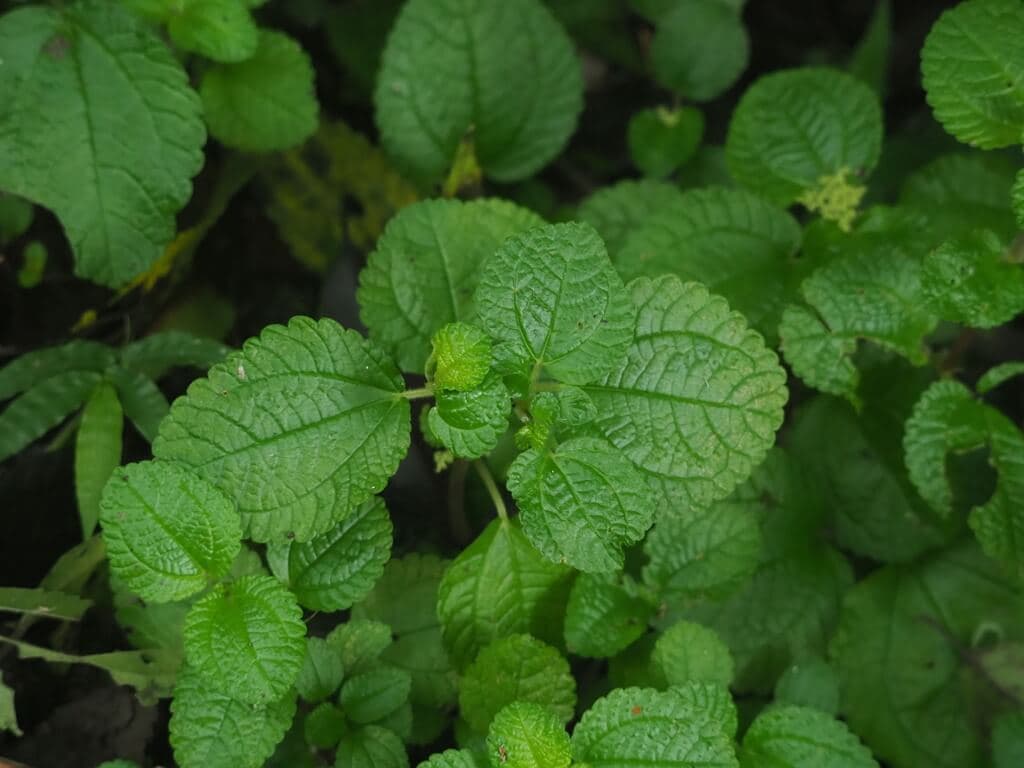
Care
Prefers high humidity, bright indirect light, with 10–27 °C, and reaches 15 cm at maturity.
Light
Humidity
Temperature
Soil
Moisture
Soil pH
Propagation
Softwood tip cuttings root readily in free-draining compost when the air around them is kept humid until roots form, which a closed terrarium does on its own. Spring and summer, while the plant is growing fast, give the quickest results.
Native range
Native to Northern South America, Central America, Caribbean, and Western South America.
Native range
Appearance
Growth habit
Leaf shape
Leaf texture
Frequently asked
Can Creeping Charlie grow in a closed terrarium?
Yes. Creeping Charlie prefers high (60–80%) humidity, which is what a closed terrarium provides, and tolerates bright-indirect-light-loving conditions.
Does Creeping Charlie need drainage?
Creeping Charlie prefers a moist substrate. Drainage is helpful but not critical; consistent moisture matters more.
What humidity does Creeping Charlie need?
Creeping Charlie does best in high (60–80%) humidity.
Is Creeping Charlie pet-safe?
Creeping Charlie is considered non-toxic to common household pets.
How tall does Creeping Charlie grow?
Creeping Charlie typically reaches 10–15 cm at maturity.
How do you propagate Creeping Charlie?
Creeping Charlie can be propagated by stem cuttings or division.
References
- 1
Kew Plants of the World Online — Pilea nummulariifolia
https://powo.science.kew.org/taxon/urn:lsid:ipni.org:names:30268074-2 - 2
GBIF — World Checklist of Vascular Plants distribution for Pilea nummulariifolia
https://www.gbif.org/species/207858730 - 3
Flora of St. John, U.S. Virgin Islands (Acevedo-Rodríguez, 1996) — Pilea nummulariifolia
https://sweetgum.nybg.org/science/vh/monographs-details/?irn=29332 - 4
RHS — How to grow pilea
https://www.rhs.org.uk/plants/pilea/how-to-grow-pilea - 5
NC State Extension Plant Toolbox — Pilea nummulariifolia
https://plants.ces.ncsu.edu/plants/pilea-nummulariifolia/ - 6
ASPCA — Creeping Charlie
https://www.aspca.org/node/4801 - 7
Josh's Frogs — Pilea nummulariifolia 'Creeping Charlie'
https://joshsfrogs.com/sp/pilea-nummulariifolia-creeping-charlie-plant045 - 8
Steve's Leaves — Pilea nummulariifolia
https://stevesleaves.com/collections/species/products/pilea-nummulariifolia - 9
Watters Garden Center — Creeping Charlie Crinkle
https://wattersgardencenter.com/products/creeping-charlie-crinkle-6in - 10
Wikipedia — Pilea nummulariifolia
https://en.wikipedia.org/wiki/Pilea_nummulariifolia