Pilea libanensis
Aquamarine Pilea, Silver Sparkle Pilea, Pilea glauca, Pilea glaucophylla, Glauca Pilea, Grey Artillery Plant, Grey Baby Tears, Silver Sprinkles
Pilea libanensis is a small creeping pilea from eastern Cuba, named for Monte Líbano near Guantánamo, where it was first collected. It is most likely the plant sold everywhere as Pilea glauca — a name that was never formally published — though the match has not yet been checked against herbarium specimens, and nurseries that label it Pilea glaucophylla are borrowing the name of a separate Colombian species. Tiny, rounded, silvery blue-green leaves sit in pairs along thin red stems, building a low mat that spills over edges and gives fine texture at a very small scale. Like its relative the artillery plant, its tiny pinkish flowers can burst open when watered and throw out a puff of pollen, though plants grown indoors rarely bloom. It does best in bright indirect light, high humidity and soil that stays evenly moist; the leaves crisp and drop when it dries out, and in a closed terrarium cuttings often root straight into the substrate.
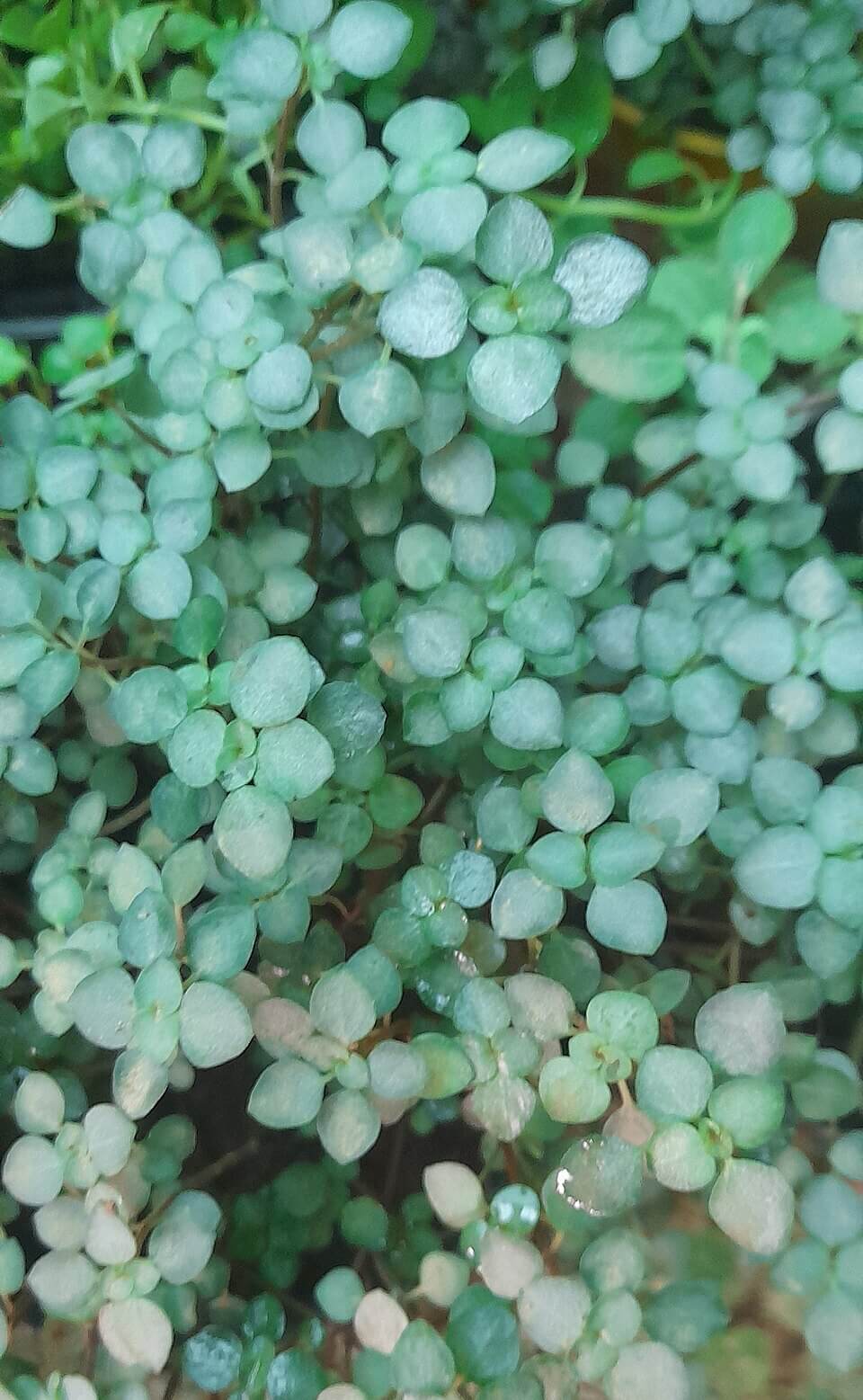
Photo by Yercaud-elango·CC BY-SA 4.0
Care
Prefers high humidity, bright indirect light, with 15–24 °C, and reaches 30 cm at maturity.
Light
Humidity
Temperature
Soil
Moisture
Propagation
Tip cuttings about 8 cm long, with the lower leaves stripped, root in moist compost or in water. In the warm, damp air of a closed terrarium a cutting can simply be pressed into the substrate, where it usually roots on its own.
Native range
Native to Caribbean.
Native range
Appearance
Growth habit
Leaf shape
Leaf texture
Frequently asked
Can Aquamarine Pilea grow in a closed terrarium?
Yes. Aquamarine Pilea prefers high (60–80%) humidity, which is what a closed terrarium provides, and tolerates bright-indirect-light-loving conditions.
Does Aquamarine Pilea need drainage?
Aquamarine Pilea prefers a moist substrate. Drainage is helpful but not critical; consistent moisture matters more.
What humidity does Aquamarine Pilea need?
Aquamarine Pilea does best in high (60–80%) humidity.
Is Aquamarine Pilea pet-safe?
Aquamarine Pilea is considered non-toxic to common household pets.
How tall does Aquamarine Pilea grow?
Aquamarine Pilea typically reaches 15–30 cm at maturity.
How do you propagate Aquamarine Pilea?
Aquamarine Pilea can be propagated by stem cuttings or division.
References
- 1
Kew Plants of the World Online — Pilea libanensis
https://powo.science.kew.org/taxon/urn:lsid:ipni.org:names:196237-2 - 2
WFO Plant List — Pilea libanensis
https://list.worldfloraonline.org/wfo-0000473288 - 3
IPNI — Pilea libanensis Urb. (type from Cuba)
https://www.ipni.org/n/196237-2 - 4
IPNI — Pilea glaucophylla Killip (type from Colombia)
https://www.ipni.org/n/196177-2 - 5
Laidback Gardener — Popular Houseplant Undergoing an Identity Crisis
https://laidbackgardener.blog/2016/11/27/popular-houseplant-undergoing-an-identity-crisis/ - 6
RHS — Pilea glaucophylla
https://www.rhs.org.uk/Plants/247862/wd/Details - 7
RHS — Pilea glaucophylla 'Greyzy'
https://www.rhs.org.uk/plants/536957/pilea-glaucophylla-greyzy/details - 8
Costa Farms — Pilea
https://www.costafarms.com/plants/pilea - 9
Terrarium Tribe — Pilea in Terrariums
https://terrariumtribe.com/pilea-in-terrariums/ - 10
PlantLust — Pilea libanensis
https://plantlust.com/plants/15329/pilea-libanensis/ - 11
Grower's Outlet — Pilea glauca 'Mystifall' grower sheet
https://growersoutlet.com/Plant_Info/Houseplants/Pilea/Pilea_glauca_Mystifall.pdf - 12
UK Houseplants — Pilea glaucophylla / libanensis care guide
https://www.ukhouseplants.com/plants/pilea-glaucaphylla-libanensis - 13
ASPCA — Artillery Plant (Pilea microphylla)
https://www.aspca.org/node/4588