Masdevallia floribunda Lindl.
Easy-Blooming Masdevallia, Floriferous Masdevallia, Tailed Orchid
Masdevallia floribunda is a miniature to small epiphytic orchid and the most northerly member of its genus, native to damp montane forests from southern Mexico through Belize, Guatemala, Honduras, and Costa Rica at 400–1,500 m elevation. Unlike most Masdevallias — which demand cool cloud-forest temperatures — it tolerates intermediate to warm conditions, making it one of the most accessible species in the genus for terrarium keeping. Erect, slender ramicauls carry solitary oblong-lanceolate leaves, and it blooms freely from late spring through early autumn, producing a succession of ~2 cm pale yellow to white flowers densely spotted with brown and purple — the name floribunda, meaning "abundant flowers", is well earned. It does best in a well-ventilated orchidarium or open terrarium in a sphagnum or bark-perlite mix kept continuously moist at 75–80% humidity.
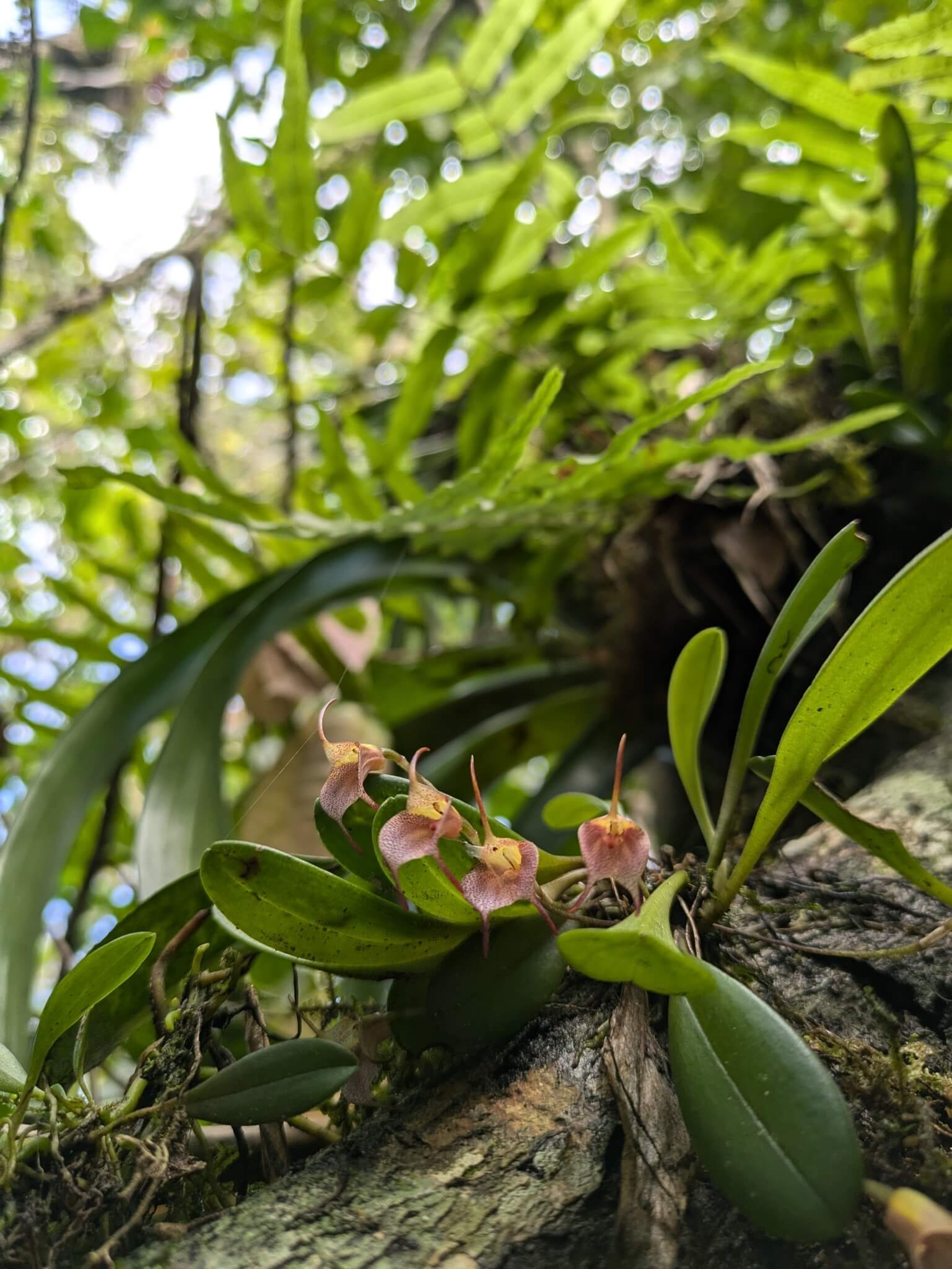
Photo by linnaeacahill·CC BY-NC 4.0
Care
Prefers high humidity, indirect light, with 10–26 °C, and reaches 20 cm at maturity.
Light
Humidity
Temperature
Soil
Moisture
Soil pH
Propagation
Native range
Native to Mexico and Central America.
Appearance
Growth habit
Leaf shape
Leaf texture
Frequently asked
Can Easy-Blooming Masdevallia grow in a closed terrarium?
Yes. Easy-Blooming Masdevallia prefers high (60–80%) humidity, which is what a closed terrarium provides, and tolerates indirect-light-loving conditions.
Does Easy-Blooming Masdevallia need drainage?
Easy-Blooming Masdevallia prefers a moist substrate. Drainage is helpful but not critical; consistent moisture matters more.
What humidity does Easy-Blooming Masdevallia need?
Easy-Blooming Masdevallia does best in high (60–80%) humidity.
Is Easy-Blooming Masdevallia pet-safe?
Easy-Blooming Masdevallia is considered non-toxic to common household pets.
How tall does Easy-Blooming Masdevallia grow?
Easy-Blooming Masdevallia typically reaches 8–20 cm at maturity.
How do you propagate Easy-Blooming Masdevallia?
Easy-Blooming Masdevallia can be propagated by division or seeds.
References
- 1
POWO (Kew) — Masdevallia floribunda Lindl.: accepted name, first published Edwards's Bot. Reg. 29(Misc.): 72 (1843); native distribution Belize, Costa Rica, Guatemala, Honduras, Mexico (Central, Gulf, Southeast, Southwest); 6 synonyms including Acinopetala floribunda (Lindl.) Luer, Masdevallia galeottiana, M. lindeniana, M. myriostigma; epiphyte of wet tropical biome
https://powo.science.kew.org/taxon/urn:lsid:ipni.org:names:323000-2 - 2
IOSPE (orchidspecies.com) — Masdevallia floribunda Lindl. 1843: mini-miniature to small cool-to-hot epiphyte; tufted ramicauls with 2–3 tubular sheaths; solitary oblong-lanceolate petiolate leaf; inflorescence 7.5–13 cm, decumbent to erect, single flower (~2.2 cm) just above leaf height, often followed by a second; distribution Mexico/Guatemala/Belize/Honduras/Costa Rica at 400–1500 m; late spring–early autumn bloom; "grow hot to cool, moderate light, high humidity"
https://www.orchidspecies.com/masfloribunda.htm - 3
Travaldo's blog — Masdevallia floribunda care and culture: night minimum 13°C, day maximum 26°C; humidity 75–80% summer; light 17,000–22,000 lux (70–90% summer shade, 25% shade / full sun winter); substrate 5 parts bark + 5 parts perlite + 1 part fibrous peat OR chopped sphagnum with polystyrene chips; perpetually moist medium; balanced fertiliser ¼ strength every 3–4 waterings; division every 2 years in spring or autumn
https://travaldo.blogspot.com/2019/04/masdevallia-floribunda-care-and-culture.html - 4
American Orchid Society — Masdevallia Culture Sheet: temperature ideal 12.7–22.2°C; humidity 60–90%; light 1,000–2,000 fc (10,750–21,500 lux); substrate tree fern/sphagnum/fine bark in plastic pots or cork-mounted with sphagnum; perpetually moist medium; ¼–½ strength balanced fertiliser during active growth
https://www.aos.org/orchid-care/care-sheets/masdevallia-culture-sheet - 5
ASPCA — Tailed Orchid (Masdevallia spp.): non-toxic to dogs, non-toxic to cats, non-toxic to horses
https://www.aspca.org/pet-care/aspca-poison-control/toxic-and-non-toxic-plants/tailed-orchid - 6
bantam.earth — Masdevallia spp. care guide: substrate pH 5.5–6.5; epiphytic medium (fir bark or LECA); high humidity; bright indirect light; excellent terrarium suitability
https://bantam.earth/masdevallia-orchids-masdevallia-spp/ - 7
NC State Extension — Masdevallia (Kite Orchid, Tailed Orchid): non-toxic to cats, dogs, horses; partial shade; sphagnum/orchid compost substrate; high humidity; cool to intermediate temperatures; division propagation
https://plants.ces.ncsu.edu/plants/masdevallia/ - 8
Cloud Forest Flora — Masdevallia floribunda: "a miniature, but very floriferous species; can put out dozens of flowers at a time; excellent choice for a terrarium given its diminutive size"
https://cloudforestflora.com/products/masdevallia-floribunda - 9
Wikipedia — Masdevallia floribunda: accepted scientific name Masdevallia floribunda Lindl.; found from southern Mexico to Honduras; family Orchidaceae, subfamily Epidendroideae; Section Masdevallia sect. Minutae; synonyms Masdevallia galeottiana, M. lindeniana, M. myriostigma
https://en.wikipedia.org/wiki/Masdevallia_floribunda