Masdevallia bicolor Poepp. & Endl.
Two-Coloured Masdevallia, Bicolor Kite Orchid
Masdevallia bicolor is a mini-miniature to miniature epiphytic orchid from the wet montane cloud forests of the northern and western Andes, growing low on tree trunks at elevations of 400–2,100 m across Venezuela, Colombia, Ecuador, Peru, and Bolivia. It belongs to the subtribe Pleurothallidinae (family Orchidaceae) and forms dense clumps of upright, single-leaved stems — the oblanceolate leaves reaching roughly 8–12 cm. In spring and summer, erect lateral inflorescences up to 10 cm long carry 2–4 flowers, each roughly 2 cm wide, with a striking two-tone pattern: the dorsal sepal is yellow to orange and the fused lateral sepals (synsepal) are deep purple, both drawn into long, thread-like tails characteristic of the genus. It does best grown in a sphagnum or fine bark mix inside a cool, humid closed or semi-open terrarium; temperatures above 25 °C will cause rapid decline.
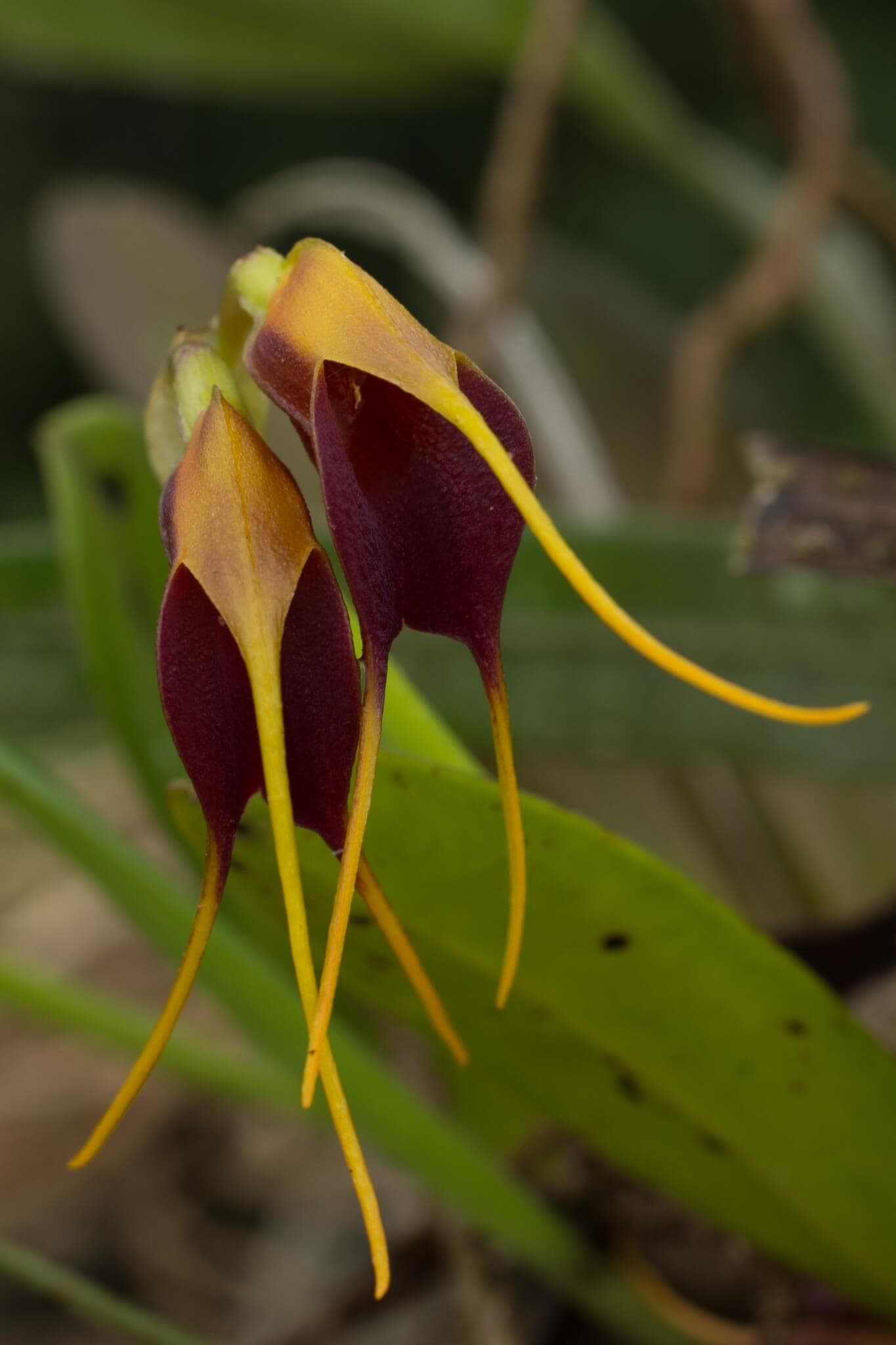
Photo by Josh Allen·CC BY-NC 4.0
Care
Prefers high humidity, indirect light, with 10–25 °C, and reaches 15 cm at maturity.
Light
Humidity
Temperature
Soil
Moisture
Soil pH
Propagation
Native range
Native to Northern South America and Western South America.
Appearance
Growth habit
Leaf shape
Leaf texture
Frequently asked
Can Two-Coloured Masdevallia grow in a closed terrarium?
Yes. Two-Coloured Masdevallia prefers high (60–80%) humidity, which is what a closed terrarium provides, and tolerates indirect-light-loving conditions.
Does Two-Coloured Masdevallia need drainage?
Two-Coloured Masdevallia prefers a moist substrate. Drainage is helpful but not critical; consistent moisture matters more.
What humidity does Two-Coloured Masdevallia need?
Two-Coloured Masdevallia does best in high (60–80%) humidity.
Is Two-Coloured Masdevallia pet-safe?
Two-Coloured Masdevallia is considered non-toxic to common household pets.
How tall does Two-Coloured Masdevallia grow?
Two-Coloured Masdevallia typically reaches 8–15 cm at maturity.
How do you propagate Two-Coloured Masdevallia?
Two-Coloured Masdevallia can be propagated by division or seeds.
References
- 1
POWO (Kew) — Masdevallia bicolor Poepp. & Endl.: accepted name, first published Nov. Gen. Sp. Pl. 2: 6 (1836), native distribution Bolivia/Colombia/Ecuador/Peru/Venezuela, family Orchidaceae, 9 synonyms including Alaticaulia bicolor and Masdevallia auropurpurea
https://powo.science.kew.org/taxon/urn:lsid:ipni.org:names:642685-1 - 2
IOSPE (orchidspecies.com) — Masdevallia bicolor: mini-miniature to miniature caespitose epiphyte; oblanceolate leaf with channeled petiole and bilobed apex; inflorescence 10 cm, 2–4 flowers; flower 2 cm wide, dorsal sepal yellow/orange, synsepal dark purple, long-caudate sepals; elevation 400–2100 m; wet montane forest, low on tree trunks; Venezuela/Colombia/Ecuador/Peru/Bolivia; spring–summer bloom
https://www.orchidspecies.com/masbicolor.htm - 3
Travaldo's blog — Masdevallia bicolor care: light 17,000–22,000 lux (70–90% summer shade, 25% winter shade); temperature winter min 10°C max 13°C, summer optimum 13–20°C, absolute max 25°C; humidity 75–80% summer; substrate 5 parts bark + 5 parts perlite + 1 part fibrous peat, or chopped sphagnum with polystyrene chips; moist but not waterlogged; balanced fertiliser at 1/4 strength every 3–4 waterings; division in autumn or spring
https://travaldo.blogspot.com/2022/02/masdevallia-bicolor-two-colored-masdevallia-care.html - 4
American Orchid Society — Masdevallia Culture Sheet: light 1,000–2,000 fc (10,750–21,500 lux); temperature ideal 12.7–22.2°C; humidity 60–90%; substrate tree fern/sphagnum/fine bark in plastic pots or cork-mounted with sphagnum; perpetually moist; 1/4–1/2 strength balanced fertiliser during active growth
https://www.aos.org/orchid-care/care-sheets/masdevallia-culture-sheet - 5
Masdevallia orchid care and culture — Travaldo's blog: genus-wide care; cool growers 10°C night / 20°C day max; intermediate 13°C night / 23°C day max; warm 16°C night / 26°C day max; humidity 50–65% baseline, 75–80% summer preferred; light 17,000–22,000 lux; bark-perlite-peat substrate; division propagation
https://travaldo.blogspot.com/2019/04/masdevallia-orchid-care-and-culture.html - 6
NC State Extension — Masdevallia (Kite Orchid, Tailed Orchid): non-toxic to cats, dogs, horses; partial shade; sphagnum/orchid compost substrate; high humidity; cool temperatures; division propagation
https://plants.ces.ncsu.edu/plants/masdevallia/ - 7
ASPCA — Phalaenopsis Orchid (Orchidaceae representative entry: non-toxic to cats, dogs, and horses; orchids family-wide considered non-toxic)
https://www.aspca.org/pet-care/aspca-poison-control/toxic-and-non-toxic-plants/phalaenopsis-orchid - 8
bantam.earth — Masdevallia spp. care guide: substrate pH 5.5–6.5; epiphytic medium (fir bark or LECA); high humidity; bright indirect light; excellent terrarium suitability
https://bantam.earth/masdevallia-orchids-masdevallia-spp/