Epiphyllum oxypetalum
Queen of the Night, Night-blooming Cereus, Dutchman's Pipe Cactus, Jungle Cactus, Lady of the Night, Night-blooming Cactus, Orchid Cactus
Epiphyllum oxypetalum is an epiphytic cactus native to the forests of Mexico and Central America, where it grows anchored to tree branches high in the canopy rather than in soil. Its flat, strap-like stem segments — each up to 40 cm long — trail and cascade dramatically once the plant matures, reaching 1–3 metres in height and making it too large for all but the most expansive open containers. It is grown primarily for its flowers: enormous, intensely fragrant, pure white blooms up to 25–30 cm across that open after sunset and wilt by dawn. Inducing blooms requires a specific cool, dry rest period in winter — it rewards patience, not convenience.
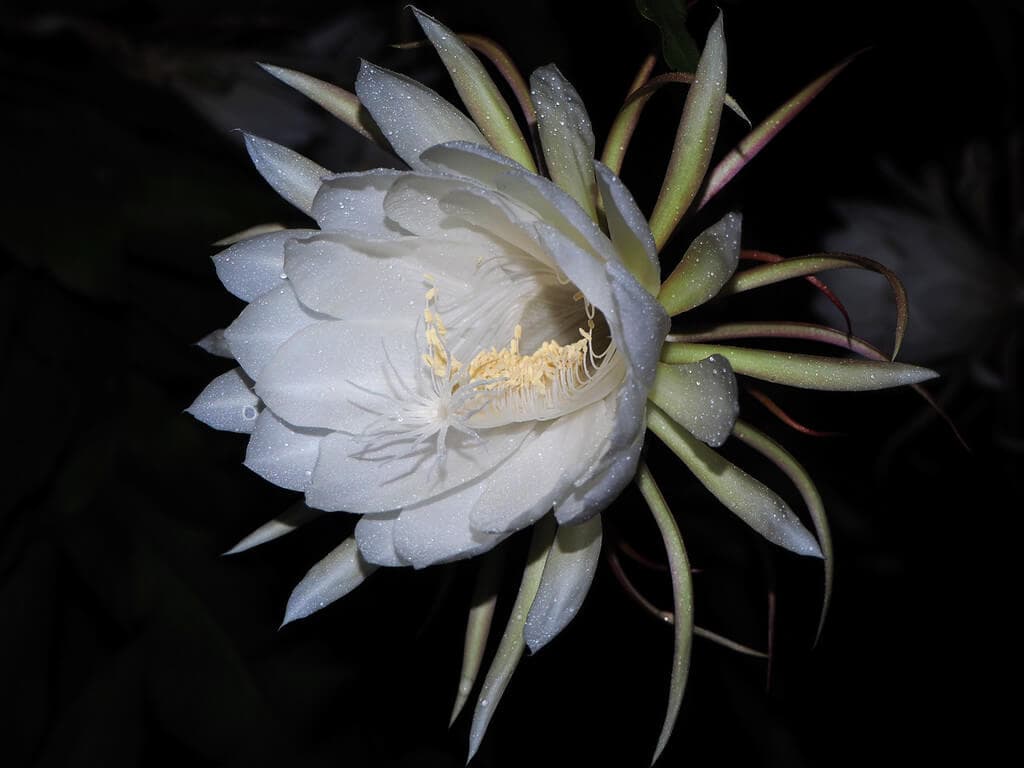
Care
Prefers high humidity, bright indirect light, with 10–32 °C, and reaches 300 cm at maturity.
Light
Humidity
Temperature
Soil
Moisture
Soil pH
Propagation
Native range
Native to Mexico and Central America.
Appearance
Growth habit
Leaf shape
Leaf texture
Frequently asked
Can Queen of the Night grow in a closed terrarium?
Yes. Queen of the Night prefers high (60–80%) humidity, which is what a closed terrarium provides, and tolerates bright-indirect-light-loving conditions.
Does Queen of the Night need drainage?
Queen of the Night prefers a moist substrate. Drainage is helpful but not critical; consistent moisture matters more.
What humidity does Queen of the Night need?
Queen of the Night does best in high (60–80%) humidity.
Is Queen of the Night pet-safe?
Queen of the Night is considered non-toxic to common household pets.
How tall does Queen of the Night grow?
Queen of the Night typically reaches 50–300 cm at maturity.
How do you propagate Queen of the Night?
Queen of the Night can be propagated by stem cuttings or seeds.
References
- 1
Epiphyllum oxypetalum — Plants of the World Online (Kew Science)
https://powo.science.kew.org/taxon/urn:lsid:ipni.org:names:132938-1 - 2
Epiphyllum oxypetalum — RHS Plant Details
https://www.rhs.org.uk/plants/32100/epiphyllum-oxypetalum/details - 3
Epiphyllum oxypetalum — NC State Extension Plant Toolbox
https://plants.ces.ncsu.edu/plants/epiphyllum-oxypetalum/ - 4
Epiphyllum oxypetalum Care Guide — Plantophiles
https://plantophiles.com/plant-care/epiphyllum-oxypetalum/ - 5
Epiphyllum oxypetalum Queen of the Night Care Guide — Succulent Plant Care
https://succulentplantcare.com/epiphyllum-oxypetalum-queen-of-the-night-care-guide/ - 6
How to Propagate Epiphyllum — Brittany Goldwyn
https://www.bybrittanygoldwyn.com/epiphyllum-propagation/ - 7
ASPCA Toxic and Non-Toxic Plants: Night Blooming Cereus
https://www.aspca.org/pet-care/aspca-poison-control/toxic-and-non-toxic-plants/night-blooming-cereus - 8
Epiphyllum in vivarium — Dendroboard forum
https://www.dendroboard.com/threads/epiphyllum.9402/