Epiphyllum hookeri subsp. guatemalense
Guatemalan Orchid Cactus, Orchid Cactus, Curly Locks, Curly Locks Orchid Cactus, Curly Orchid Cactus, Curly Sue, Mini Dragon Fruit Plant
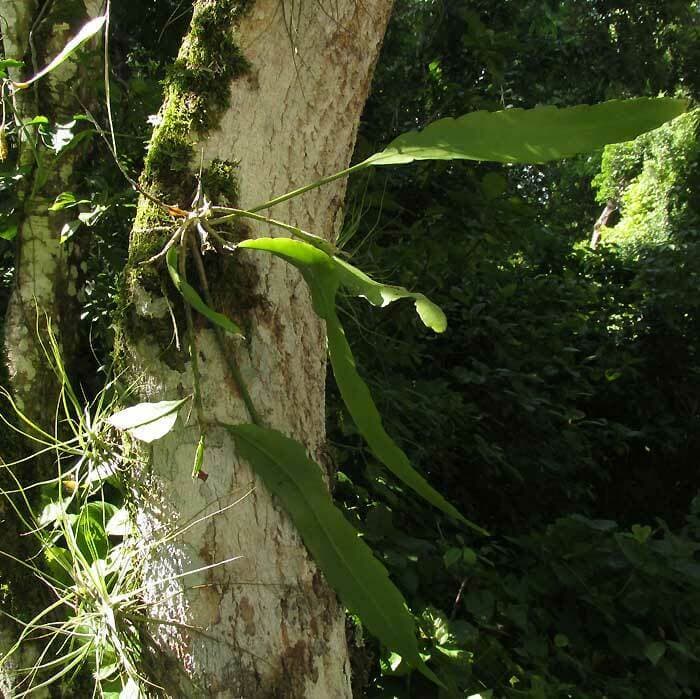
Epiphyllum hookeri subsp. guatemalense is an epiphytic cactus native to the cloud forests of southern Mexico, Guatemala, and Honduras, where it anchors itself to tree trunks and trails its flat, strap-like stem segments through the canopy. The most widely grown form in cultivation is a natural monstrose mutation — sold under the name 'Curly Locks' — in which those stems twist and contort into dense, writhing curls that cascade from a hanging basket. Like E. oxypetalum, it blooms at night: white, funnel-shaped flowers up to 10–15 cm across appear in late spring and summer, and each lasts only until dawn. It does best in bright indirect light with a bark-based, fast-draining mix — closer to an orchid's environment than a desert cactus.
Care
Prefers high humidity, bright indirect light, with 10–28 °C, and reaches 100 cm at maturity.
Light
Humidity
Temperature
Soil
Moisture
Soil pH
Propagation
Native range
Native to Mexico and Central America.
Appearance
Growth habit
Leaf shape
Leaf texture
Frequently asked
Can Guatemalan Orchid Cactus grow in a closed terrarium?
Yes. Guatemalan Orchid Cactus prefers high (60–80%) humidity, which is what a closed terrarium provides, and tolerates bright-indirect-light-loving conditions.
Does Guatemalan Orchid Cactus need drainage?
Guatemalan Orchid Cactus prefers a moist substrate. Drainage is helpful but not critical; consistent moisture matters more.
What humidity does Guatemalan Orchid Cactus need?
Guatemalan Orchid Cactus does best in high (60–80%) humidity.
Is Guatemalan Orchid Cactus pet-safe?
Guatemalan Orchid Cactus is considered non-toxic to common household pets.
How tall does Guatemalan Orchid Cactus grow?
Guatemalan Orchid Cactus typically reaches 60–100 cm at maturity.
How do you propagate Guatemalan Orchid Cactus?
Guatemalan Orchid Cactus can be propagated by stem cuttings.
References
- 1
Epiphyllum hookeri subsp. guatemalense — Plants of the World Online (Kew Science)
https://powo.science.kew.org/taxon/urn:lsid:ipni.org:names:50425944-2 - 2
Epiphyllum guatemalense (synonym) — Plants of the World Online (Kew Science)
https://powo.science.kew.org/taxon/urn:lsid:ipni.org:names:92727-2 - 3
Epiphyllum hookeri (parent species) — Plants of the World Online (Kew Science)
https://powo.science.kew.org/taxon/urn:lsid:ipni.org:names:132926-1 - 4
Epiphyllum hookeri ssp. guatemalense — field account, Chiapas (backyardnature.net)
https://www.backyardnature.net/chiapas/epiphyll.htm - 5
Epiphyllum guatemalense — Chicago Botanic Garden Plant Finder
https://www.chicagobotanic.org/plant-information/plant-finder/epiphyllum-guatemalense-guatemalan-orchid-cactus - 6
Epiphyllum guatemalense var. monstrosa — Top Tropicals
https://toptropicals.com/catalog/uid/epiphyllum_guatemalense.htm - 7
Epiphyllum growing guide — RHS
https://www.rhs.org.uk/plants/epiphyllum/growing-guide - 8
Epiphyllum Society of America — FAQs
https://www.epiphyllums.org/FAQs - 9
Epiphyllum guatemalense — Foliage Factory
https://foliage-factory.com/products/epiphyllum-guatemalense - 10
Epiphyllum guatemalense monstrose — Root Houseplants
https://www.root-houseplants.com/shop/epiphyllum-guatemalense-monstrose/ - 11
Epiphyllum guatemalense var. monstrose — GrowTropicals
https://growtropicals.com/products/epiphyllum-guatemalense-var-monstrose - 12
Epiphyllum hookeri ssp. guatemalense [monstrose] — PlantLust
https://plantlust.com/plants/46123/epiphyllum-hookeri-ssp-guatemalense-monstrose/ - 13
Curly Orchid Cactus care — Brittany Goldwyn
https://www.bybrittanygoldwyn.com/curly-orchid-cactus/ - 14
Epiphyllum propagation — Brittany Goldwyn
https://www.bybrittanygoldwyn.com/epiphyllum-propagation/ - 15
ASPCA Toxic and Non-Toxic Plants — E section
https://www.aspca.org/pet-care/animal-poison-control/toxic-and-non-toxic-plants/e