Anoectochilus formosanus Hayata
Taiwan Jewel Orchid, Formosa Jewel Orchid, Silver-Veined Jewel Orchid
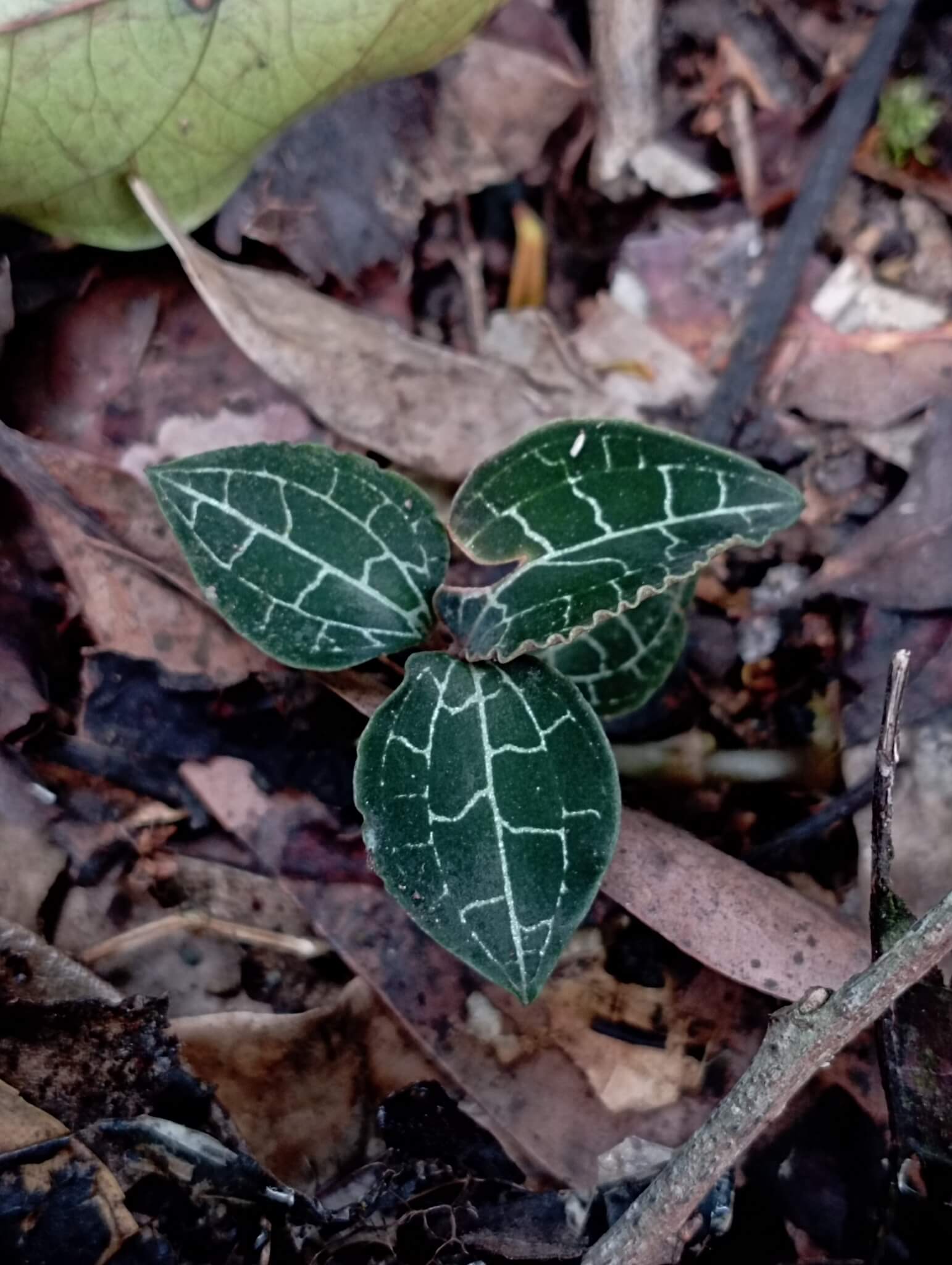
A small terrestrial orchid native to Taiwan and the surrounding islands, where it creeps through the shaded floor of broad-leaved evergreen and bamboo forests at elevations between 400 and 1,000 metres. It is grown almost entirely for its foliage: velvety, dark green oval leaves netted with a fine, luminous lattice of silver-white veins, with deep maroon-red undersides that catch the light when the plant shifts. Compared to its close relative Anoectochilus roxburghii, it is distinctly more compact and miniature, with darker, more uniformly oval leaves and silver rather than gold or copper veining. In a closed terrarium it thrives in the steady warmth and high humidity of a humid enclosure, rooting into moist sphagnum or a fine terrestrial mix; it creeps and branches readily, eventually forming a low, jewelled carpet across the substrate.
Care
Prefers high humidity, low light, with 15–30 °C, and reaches 25 cm at maturity.
Light
Humidity
Temperature
Soil
Moisture
Soil pH
Propagation
Native range
Native to China, Eastern Asia, and Indo-China.
Appearance
Growth habit
Leaf shape
Leaf texture
Frequently asked
Can Taiwan Jewel Orchid grow in a closed terrarium?
Yes. Taiwan Jewel Orchid prefers high (60–80%) humidity, which is what a closed terrarium provides, and tolerates shade-tolerant conditions.
Does Taiwan Jewel Orchid need drainage?
Taiwan Jewel Orchid prefers a moist substrate. Drainage is helpful but not critical; consistent moisture matters more.
What humidity does Taiwan Jewel Orchid need?
Taiwan Jewel Orchid does best in high (60–80%) humidity.
Is Taiwan Jewel Orchid pet-safe?
Taiwan Jewel Orchid is considered non-toxic to common household pets.
How tall does Taiwan Jewel Orchid grow?
Taiwan Jewel Orchid typically reaches 8–25 cm at maturity.
How do you propagate Taiwan Jewel Orchid?
Taiwan Jewel Orchid can be propagated by rhizome division or stem cuttings.
References
- 1
POWO (Kew) — Anoectochilus formosanus Hayata (accepted name; first published Icon. Pl. Formosan. 4: 101, 1914; family Orchidaceae; native distribution: China Southeast, Nansei-shoto, Taiwan, Vietnam; synonym: Anoectochilus tetsuoi Ohwi ex Hatus. & T.Amano nom. nud.)
https://powo.science.kew.org/taxon/urn:lsid:ipni.org:names:616574-1 - 2
Raingreen Tropicals — Culture of Anoectochilus: Deep Forest Jewel Orchids (light ~500 fc / low; formosanus temperature 2–36 °C tolerance, optimal ~22 °C; humidity above 50% minimum, misting controls leaf mites; pH 5.5–6.0; well-drained humus; formosanus: easy grower, creeps and branches, leaves 2 inches / 5 cm, deep green heart-shaped with silver veins and burgundy undersides; flower: white with yellow fimbriated lip; winter bloomer; 8–18,000 lux range for genus)
https://raingreentropicals.com/culture-anoectochilus.htm - 3
Araflora — Anoectochilus formosanus product listing (temperature min 15 °C, max 30 °C; humidity 60–90% daytime, 70–100% nighttime; light: semi-sun, no direct sun; soil open, pH 5–7; adult height ~40 cm, width ~10 cm; white flowers; blooms year-round; altitude 0–1000 m; Northeast Asia; care: normal)
https://www.araflora.com/product/orchid-anoectochilus-formosanus-s/ - 4
J&L Orchids — Anoectochilus formosanus (leaves: velvety dark green spiderwebbed with white, deep maroon undersides; flower: white with yellow fimbriated lip; warm-growing; shady moist conditions; great for frog vivariums)
https://jlorchids.com/anoectochilus-formosanus/ - 5
La Foresta Orchids — Jewel Orchid: Anoectochilus formosanus (velvety dark green leaves with white-gold venation and coppery pink veins; maroon undersides; 8–12 inch spike with white flowers and yellow fimbriated lip; moisture: allow potting mix to approach dryness before watering; sphagnum moss or bark; moderate difficulty; polyploid cultivar)
https://www.laforestaorchids.com/products/anoectochilus-formosanus - 6
OrchidWeb — Anoectochilus formosanus Jewel Orchid (light: low-medium; temperature: intermediate-warm; substrate: sphagnum or bark mix; water when potting mix approaches dryness; bloom: summer; miniature; 8–12 inch spike unique white flowers; copper-pink leaf undersides; thicker leaves from polyploid genetics)
https://www.orchidweb.com/orchids/other-orchids/species/anoectochilus-formosanus-jewel-orchid - 7
Travaldo's Blog — Anoectochilus / Macodes care (light: 8,000–18,000 lux, no direct sun; humidity: 80–90%; temperature: summer 27–29 °C day / 21–22 °C night, winter 26–28 °C day / 18–19 °C night; substrate: loose bark or tree fern with perlite, sphagnum, charcoal; slight drying between waterings in active growth; reduce autumn/winter; stem cuttings for propagation; leaves velvety with white/pink/gold venation)
https://travaldo.blogspot.com/2022/05/anoectochilus-marbled-jewel-orchid-care.html - 8
PictureThis — Taiwan Jewel Orchid Anoectochilus formosanus (native: broad-leaved evergreen and bamboo forests of Eastern Asia; elevation 400–1,000 m subtropical biome; height ~20 cm; leaves dark green with gold and silver venation; flowers white with purple hints, mid to late summer; propagation: rhizome division; care difficulty: moderate; moist well-drained soil)
https://www.picturethisai.com/wiki/Anoectochilus_formosanus.html - 9
NC State Extension — Anoectochilus (Jewel Orchid) genus page (non-toxic to dogs and cats; genus ~50 terrestrial orchid species; native to China, Southeast Asia, Indonesia; dappled sunlight or shade; high humidity; moist to occasionally wet; well-drained mix of sand, bark, perlite, soil; creeping ascending growth; 6–10 inch flowering spikes; large velvety leaves with gold or pale veins)
https://plants.ces.ncsu.edu/plants/anoectochilus/ - 10
ASPCA — Non-Toxic Plants: Jewel Orchid (Haemaria discolor; non-toxic to dogs, cats, and horses; family Orchidaceae)
https://www.aspca.org/pet-care/aspca-poison-control/toxic-and-non-toxic-plants/jewel-orchid - 11
Black Jungle Terrarium Supply — Jewel Orchids (most Anoectochilus require added humidity of a cloche or terrarium; closed terrarium recommended; take lid off periodically for fresh air; tissue culture propagated; robust when acclimated)
https://www.blackjungleterrariumsupply.com/Jewel-Orchids_c_19.html