Adiantum raddianum
Delta Maidenhair Fern, Maidenhair Fern, Delta Maidenhair, Roseate Maidenhair Fern
Adiantum raddianum, the delta maidenhair fern, grows wild across tropical America from Mexico and the Caribbean south to northern Argentina and Uruguay, on forest floors, in rock crevices, and along stream banks and coastal cliffs. Herbarium collections span sea level to about 3,000 m, with most between roughly 500 and 2,100 m. Its triangular fronds, up to about 45 cm long, are divided three or four times into small, fan-shaped leaflets held on wiry, shiny black stalks — the hair-like stalks behind the name maidenhair. New fronds open pale green and darken as they age. The genus name comes from the Greek adiantos, 'unwetted', because water runs straight off the leaflets, and the spores form in small clusters tucked under their folded-over edges rather than on the open surface. It is one of the most popular ferns grown indoors and a famously demanding one: it does best in bright, indirect light, steady high humidity and 18–24 °C, in neutral to slightly alkaline soil that never dries out. Missouri Botanical Garden notes that the fronds die back quickly if the roots dry, scorch in direct sun and lose their vigour in deep shade. A closed terrarium supplies the constant humidity that open rooms lack, though a mature clump spreads 30–60 cm and needs a large vessel. It has naturalised in Hawaii, French Polynesia and the London area.
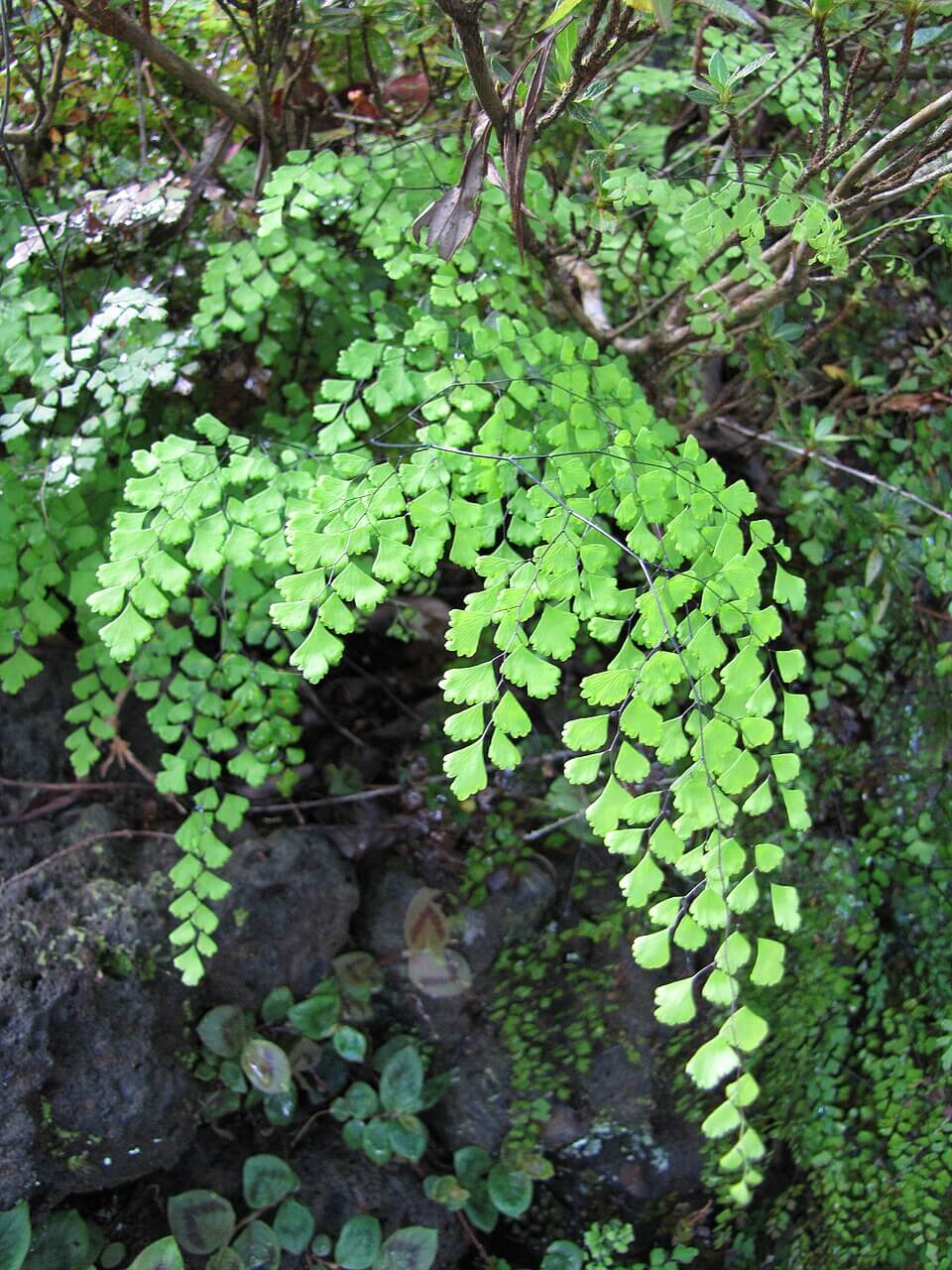
Photo by Photo by Forest & Kim Starr·CC BY 3.0 US
Care
Prefers high humidity, bright indirect light, with 10–24 °C, and reaches 50 cm at maturity.
Light
Humidity
Temperature
Soil
Moisture
Soil pH
Propagation
The fronds rise from a dense mass of short, branching rhizomes — creeping underground stems — which can be cut into sections that each keep some roots and a few fronds. The RHS recommends dividing in early spring.
Native range
Native to Northern South America, Mexico, Central America, Caribbean, Western South America, Brazil, and Southern South America.
Native range
Appearance
Growth habit
Leaf shape
Leaf texture
Frequently asked
Can Delta Maidenhair Fern grow in a closed terrarium?
Yes. Delta Maidenhair Fern prefers high (60–80%) humidity, which is what a closed terrarium provides, and tolerates bright-indirect-light-loving conditions.
Does Delta Maidenhair Fern need drainage?
Delta Maidenhair Fern prefers a moist substrate. Drainage is helpful but not critical; consistent moisture matters more.
What humidity does Delta Maidenhair Fern need?
Delta Maidenhair Fern does best in high (60–80%) humidity.
Is Delta Maidenhair Fern pet-safe?
Delta Maidenhair Fern is considered non-toxic to common household pets.
How tall does Delta Maidenhair Fern grow?
Delta Maidenhair Fern typically reaches 20–50 cm at maturity.
How do you propagate Delta Maidenhair Fern?
Delta Maidenhair Fern can be propagated by rhizome division or spores.
References
- 1
Kew Plants of the World Online — Adiantum raddianum
https://powo.science.kew.org/taxon/urn:lsid:ipni.org:names:17012580-1 - 2
GBIF — World Checklist of Vascular Plants distribution and synonyms for Adiantum raddianum
https://www.gbif.org/species/207644564 - 3
GBIF — herbarium specimen records for Adiantum raddianum (elevation and habitat)
https://www.gbif.org/occurrence/search?taxon_key=2651826&basis_of_record=PRESERVED_SPECIMEN - 4
Catálogo de Plantas y Líquenes de Colombia — Adiantum raddianum (via GBIF)
https://www.gbif.org/species/166181014 - 5
Watson & Dallwitz, Ferns of Britain and Ireland (DELTA) — Adiantum raddianum
https://www.delta-intkey.com/britfe/www/adiaradi.htm - 6
RHS — Adiantum raddianum
https://www.rhs.org.uk/plants/20650/adiantum-raddianum/details - 7
Missouri Botanical Garden Plant Finder — Adiantum raddianum
https://www.missouribotanicalgarden.org/PlantFinder/PlantFinderDetails.aspx?taxonid=285805 - 8
NC State Extension — Adiantum raddianum
https://plants.ces.ncsu.edu/plants/adiantum-raddianum/ - 9
Wikipedia — Adiantum raddianum
https://en.wikipedia.org/wiki/Adiantum_raddianum - 10
Aquasabi — Adiantum raddianum
https://www.aquasabi.com/Adiantum-raddianum - 11
The Home Depot — Maidenhair Fern (availability)
https://www.homedepot.com/p/Maidenhair-Fern-Adiantum-Plant-in-4-in-Grower-Pot-4-FERN-MAIDENHAIR/317501809 - 12
UC ANR Publication 8560 — Toxic Plants in California (Adiantum not listed)
https://class.ucanr.edu/sites/default/files/2020-08/331780.pdf