Build diary · 2026-08-25
The Bear Cave
A small bear steps out of a cork-bark cave into a mossy, small-leaved world built around a rare jewel orchid — a study in scale in a tall glass cylinder.
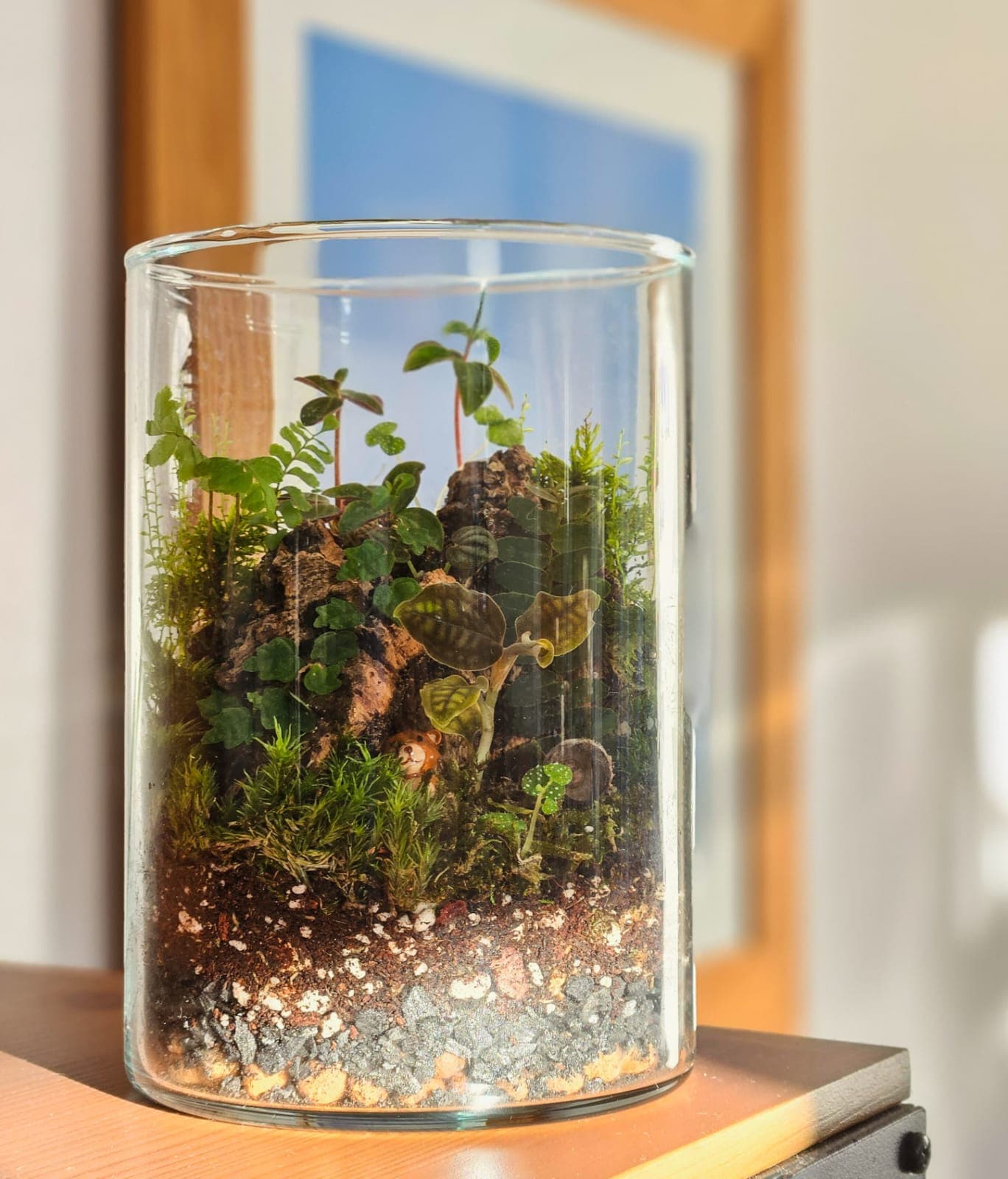
I built this one around a story. A small bear steps out of its cave at the end of a long sleep, blinking into a garden that grew while it dozed. The cave is two pieces of cork bark leaned into an arch, and the bear is a figurine barely taller than the moss.
The plant I built around sits just outside the cave mouth, where the bear would notice it first: a jewel orchid Cystorchis variegata Blume. Jewel orchids are grown for their leaves rather than their flowers - this one carries dark, near-black foliage traced with pale veins that catch the light. It's a slow, particular rainforest orchid, so the whole build is really a life-support system arranged around it.
The vessel is a tall, narrow IKEA glass cylinder, typically closed, opened for the picture. Humid air settles low, around the orchid and the moss, while the taller stems near the rim get more airflow.
The layering
From the bottom up, the jar is built in bands.
A drainage layer of LECA clay pebbles goes down first - lightweight expanded clay that holds spare water below the roots, so the substrate never sits waterlogged. Over it lies a fine mesh net, which stops the soil washing down into the clay and clogging that reservoir. Then a thin scatter of activated charcoal, to help keep the damp, enclosed air from turning stale. The planting substrate sits on top, banked higher toward the back so the ground climbs rather than lies flat.
The hardscape is the point of the piece. Two slabs of cork bark lean together into a low arch — the cave — with substrate packed behind them so roots can take hold against the wood. Cork is light, slow to rot, and covered in ridges, which gives climbing plants something to grip.
From there I planted in rough zones: a canopy at the back, vines on the bark, and a low, fine-textured floor out front where the bear stands.
The plants and the sense of scale
Every plant here earns its place by staying small. One oversized leaf beside a thumb-high bear and the whole scene reads as a houseplant in a vase, so the set leans entirely on fine textures and tiny foliage.
At the back sits the canopy. Red Trailing Peperomia (Peperomia verticillata) sends up the tallest stems, its little leaves arranged in whorls - neat rings of three or four around each node — with a scarlet flush on the undersides. Its stems lean gently toward the window, reaching for the light. Beside it, a Button Fern (Pellaea rotundifolia) arches wiry fronds of round leaflets that soften the hard edge of the cork.
On the bark itself grow two shingling vines. Marcgravia umbellata presses its young leaves flat against the cork as it climbs - shingling is exactly that, leaves lying tight like roof tiles. The String of Frogs (Ficus sarmentosa var. thunbergii) does the same with tiny oak-shaped leaves, tracing the grain of the wood. In the gap between the two I've planted a small stem cutting of Watermelon Peperomia (Peperomia argyreia).
Out front is the floor, the bear's own garden. The jewel orchid stands just clear of the cave mouth, the plant the eye lands on first. shows off silver-striped leaves, and a Hispid Peperomia (Peperomia hispidula) creeps low, its tiny round leaves covered in fine hairs. The ground is moss: upright tufts of Juniper Haircap Moss (Polytrichum juniperinum) stand in for meadow grass, over a smoother base of Carpet moss (Hypnum cupressiforme).
Living with it
Most of the plants - the orchid, the vines, the mosses - lean toward high humidity, while the Watermelon Peperomia is the easy-going one, happy anywhere from medium up. What they all share is a preference for low, indirect light and comfortable room temperature, roughly 18–24 °C. The still, humid air that pools near the base keeps everyone content.
The jewel orchid is the one to watch. It sulks if the air dries out or the roots stay soggy, so I keep the substrate lightly moist rather than wet, and the cylinder out of direct sun — the dark leaves scorch easily. I tend to open it once a week, so the humid pocket needs topping up now and then; a quick mist down the inside of the glass is usually enough. If the moss starts to pale, or the fern's leaflets crisp at the edges, the air has drifted too dry.
So far it's settling in well. I'll add dated notes below as the moss knits together and the vines begin to travel.