Vriesea hieroglyphica
King of Bromeliads, King of the Bromeliads, Hieroglyphic Bromeliad
Endemic to the Atlantic Forest of southeastern Brazil, Vriesea hieroglyphica is an epiphytic bromeliad that earns its common name through sheer presence — a broad, open rosette of glossy strap leaves marked with irregular dark cross-banding that resembles ancient script. Like all tank bromeliads, it collects water in the central cup formed by its tightly packed leaf bases, and this is where most of its moisture intake happens. It grows at low altitudes beneath the rainforest canopy, where it receives bright but filtered light and consistent warmth throughout the year. Mature plants are large — the rosette can reach 90–150 cm across — so it suits open terrariums and paludariums best, or vivarium setups as a statement centrepiece when young.
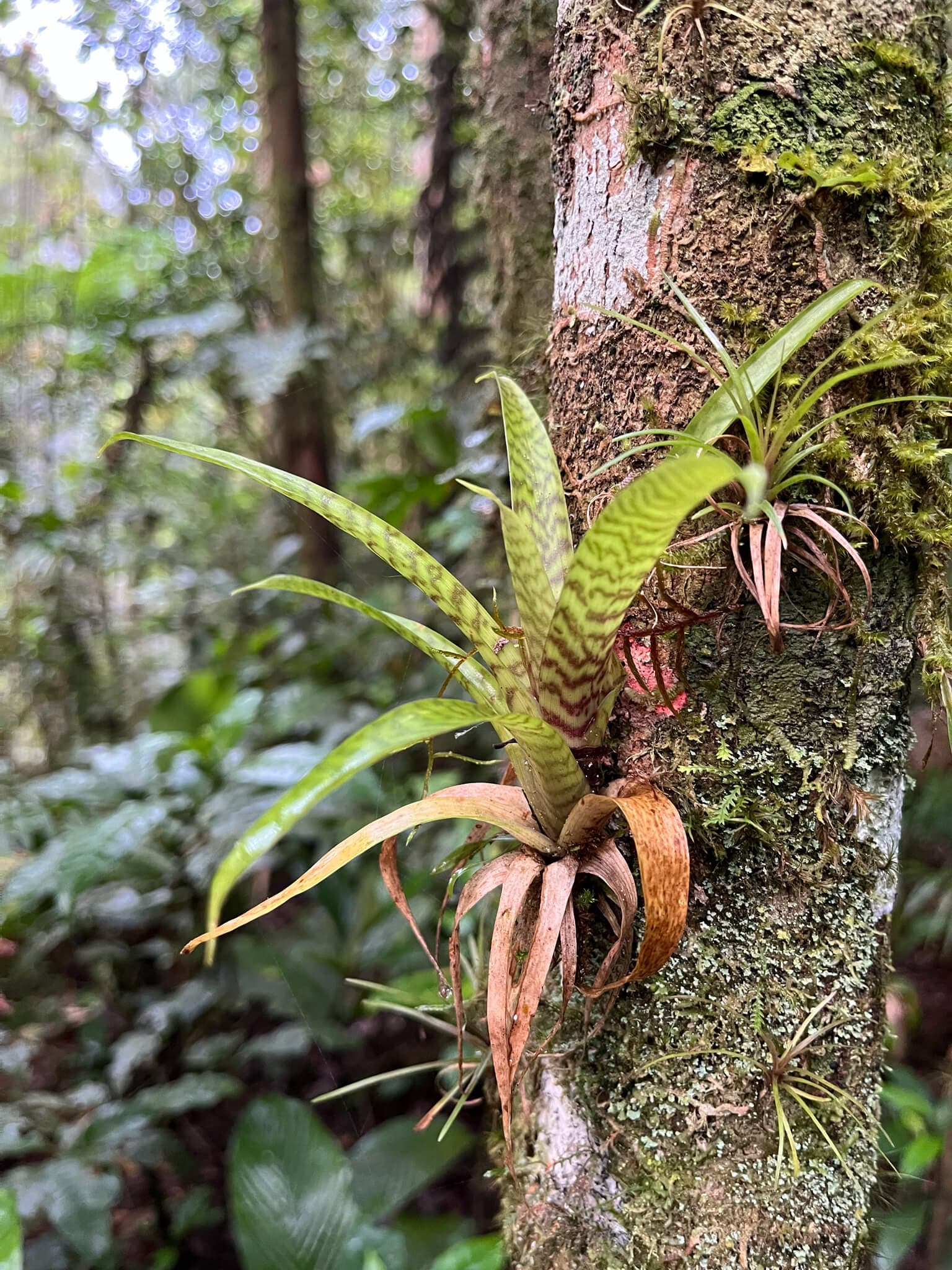
Photo by renatabeco·CC BY-NC 4.0
Care
Prefers high humidity, bright indirect light, with 15–27 °C, and reaches 100 cm at maturity.
Light
Humidity
Temperature
Soil
Moisture
Soil pH
Propagation
Frequently asked
Can King of Bromeliads grow in a closed terrarium?
Yes. King of Bromeliads prefers high (60–80%) humidity, which is what a closed terrarium provides, and tolerates bright-indirect-light-loving conditions.
Does King of Bromeliads need drainage?
King of Bromeliads prefers a moist substrate. Drainage is helpful but not critical; consistent moisture matters more.
What humidity does King of Bromeliads need?
King of Bromeliads does best in high (60–80%) humidity.
Is King of Bromeliads pet-safe?
King of Bromeliads is considered non-toxic to common household pets.
How tall does King of Bromeliads grow?
King of Bromeliads typically reaches 45–100 cm at maturity.
How do you propagate King of Bromeliads?
King of Bromeliads can be propagated by offsets or seeds.
References
- 1
Kew Plants of the World Online — Vriesea hieroglyphica
https://powo.science.kew.org/taxon/urn:lsid:ipni.org:names:126163-1 - 2
Wikipedia — Vriesea hieroglyphica
https://en.wikipedia.org/wiki/Vriesea_hieroglyphica - 3
RHS Plant Finder — Vriesea hieroglyphica
https://www.rhs.org.uk/plants/68843/vriesea-hieroglyphica/details - 4
Highland Moss — Vriesea hieroglyphica King of Bromeliad
https://highlandmoss.com/house-plants/vriesea-hieroglyphica-king-of-bromeliad/ - 5
Bromeliads.info — Getting to Know Vriesea
https://www.bromeliads.info/bromeliad-vriesea/ - 6
Bromeliads.info — Bromeliad Terrarium Growing
https://www.bromeliads.info/growing-bromeliads-in-terrariums/ - 7
Bromeliads.info — Potting Soil for Bromeliads
https://www.bromeliads.info/bromeliad-potting-soil/ - 8
Dave's Garden — Vriesea hieroglyphica
https://davesgarden.com/guides/pf/go/102871 - 9
GardensOnline — Vriesea hieroglyphica
https://www.gardensonline.com.au/gardenshed/plantfinder/show_4122.aspx - 10
Garden.org — King of the Bromeliads (Vriesea hieroglyphica)
https://garden.org/plants/view/147183/King-of-the-Bromeliads-Vriesea-hieroglyphica/ - 11
Plant Lust — Vriesea hieroglyphica
https://plantlust.com/plants/15523/vriesea-hieroglyphica/ - 12
Monaco Nature Encyclopedia — Vriesea hieroglyphica
https://www.monaconatureencyclopedia.com/vriesea-hieroglyphica/?lang=en - 13
Denver Botanic Gardens — King of Bromeliads
https://www.botanicgardens.org/blog/king-bromeliads-vriesea-hieroglyphica - 14
Dendroboard — Terrarium Suitable Vriesea Bromeliads
https://www.dendroboard.com/threads/terrarium-suitable-vrisea-bromeliads.358156/ - 15
Marriedtoplants — Vriesea Propagation Step-by-Step
https://www.marriedtoplants.com/hodgepodge/vriesea-propagation/ - 16
PubMed — Increased Multiplication Rates of Vriesea hieroglyphica Through a Temporary Immersion System
https://pubmed.ncbi.nlm.nih.gov/38285145/ - 17
ASPCA — Blushing Bromeliad (Bromeliaceae) Non-Toxic Plants
https://www.aspca.org/pet-care/aspca-poison-control/toxic-and-non-toxic-plants/blushing-bromeliad