Rhaphidophora pachyphylla K.Krause
Shingle Vine, Shingle Plant, Mini Shingle Plant
A shingling climbing aroid from the lowland rainforests of New Guinea, Rhaphidophora pachyphylla grows by pressing its thick, leathery leaves flat against tree bark — each one laid down like a roof shingle as the stem climbs upward. In a terrarium or vivarium it will cover a cork bark background or timber plank with a tight mosaic of small, oval green leaves, making it one of the most architectural shingling plants available at a compact size. Leaves in cultivation stay under 2 cm wide as juveniles and expand gradually with height and maturity. Long confused with the closely related Rhaphidophora hayi, it is distinguished by its narrowly ovate-elliptic leaf shape and a differently structured stigma. Like all members of the Araceae family, its tissues contain insoluble calcium oxalate crystals that cause mouth and throat irritation if ingested.
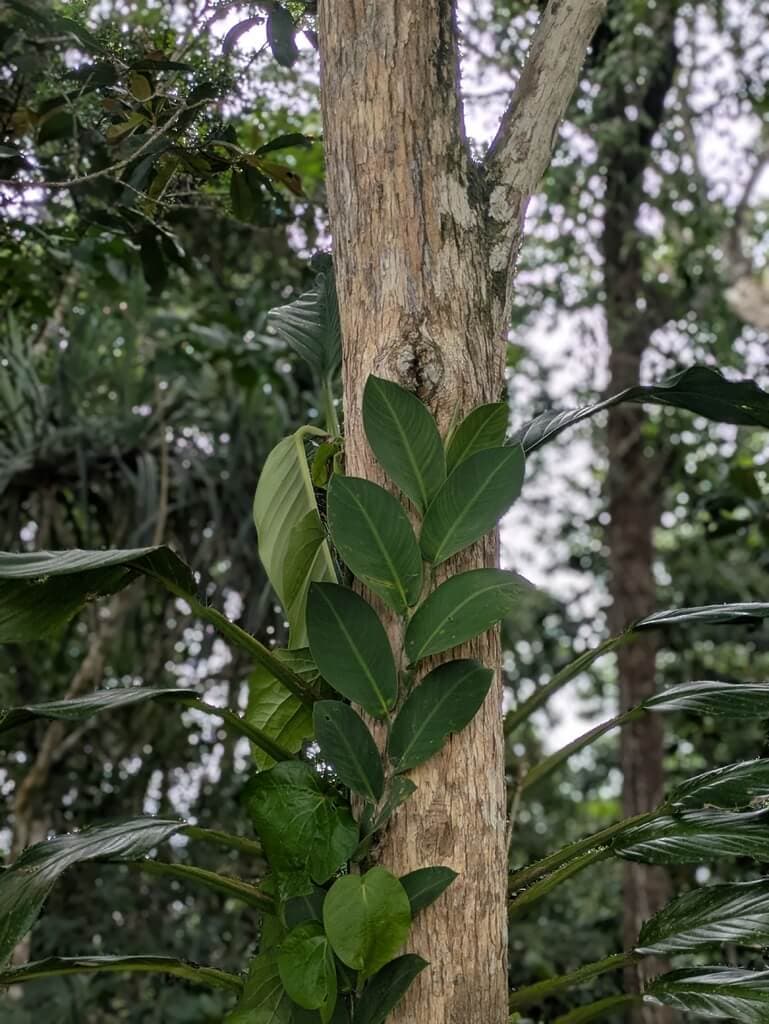
Photo by Hakim·CC BY-NC 4.0
Care
Prefers high humidity, indirect light, with 13–29 °C, and reaches 250 cm at maturity.
Light
Humidity
Temperature
Soil
Moisture
Soil pH
Propagation
Native range
Native to Papuasia.
Appearance
Growth habit
Leaf shape
Leaf texture
Frequently asked
Can Shingle Vine grow in a closed terrarium?
Yes. Shingle Vine prefers high (60–80%) humidity, which is what a closed terrarium provides, and tolerates indirect-light-loving conditions.
Does Shingle Vine need drainage?
Shingle Vine prefers a moist substrate. Drainage is helpful but not critical; consistent moisture matters more.
What humidity does Shingle Vine need?
Shingle Vine does best in high (60–80%) humidity.
Is Shingle Vine pet-safe?
Shingle Vine is moderately toxic if ingested — keep out of reach of pets and children.
How tall does Shingle Vine grow?
Shingle Vine typically reaches 30–250 cm at maturity.
How do you propagate Shingle Vine?
Shingle Vine can be propagated by stem cuttings or air layering.
References
- 1
POWO (Kew) — Rhaphidophora pachyphylla K.Krause (accepted name; first published in Bot. Jahrb. Syst. 49: 92 (1912); family Araceae; native range: Indonesian Papua and Papua New Guinea; climber in wet tropical biome; long confused with R. hayi; differs in leaf shape and stigma structure; lacks disarticulating and foraging shoots; semi-epiphytic liane in lowland monsoon or rain forest)
https://powo.science.kew.org/taxon/urn:lsid:ipni.org:names:88556-1/general-information - 2
Homes Pursuit — Rhaphidophora pachyphylla care guide (light: bright indirect for ~12 h; humidity: min 50%; temperature: 12.8–29 °C / 55–85 °F; soil pH 6.1–6.5, chunky well-draining organic mix; water when top 1–2 inches dry; toxic to humans and pets — calcium oxalate crystals; propagation: stem cuttings, seeds, or air layering, spring/early summer; USDA zone 11+; height 6–8 ft indoors, up to 16 ft wild; aggressive shingling liana; leaves narrowly oval-elliptic, stiffly leathery)
https://homespursuit.com/rhaphidophora-pachyphylla/ - 3
Greg App — Rhaphidophora pachyphylla overview (height: 6–10 ft indoors, 20+ ft outdoors; spread: 3–5 ft; light: bright indirect; humidity above 60%; temperature 20–30 °C; well-draining organic soil, pH 6.0–7.0; USDA zones 10a–12b; growth rate 1–2 ft/year; propagation by stem cuttings or division)
https://greg.app/rhaphidophora-pachyphylla-overview/ - 4
Greg App — Rhaphidophora pachyphylla plant care (soil: well-draining with coco coir and perlite; water 0.5 cups every 9 days in 5" pot; prefers drying between waterings; toxic — not safe to consume; USDA zones 10a–12b)
https://greg.app/plant-care/rhaphidophora-pachyphylla - 5
FrogDaddy — Rhaphidophora pachyphylla product listing (small shingling species from New Guinea; aggressive shingler; adheres to backgrounds; will grow downward after reaching top of vivarium; grown in high humidity in terrariums and greenhouses; adventitious roots root easily in moist sphagnum moss; suitable for all terrarium sizes)
https://frogdaddy.net/products/rhaphidophora-pachyphylla - 6
Black Jungle Terrarium Supply — Rhaphidophora pachyphylla (tiny green leaves no bigger than a thumbnail; clasps vertical surfaces; leaves expand with maturity; small enough for any size terrarium)
https://www.blackjungleterrariumsupply.com/Rhaphidophora-pachyphylla_p_1810.html - 7
Frog and Frond — Rhaphidophora pachyphylla (extremely easy to root; propagate by pressing underside of vine against damp sphagnum moss; plant is brittle; leaves reach up to 3/4" long with interesting texture; does best with vertical climbing surface; native New Guinea)
https://frogandfrond.com/product/rhaphidophora-pachyphylla/ - 8
ASPCA Toxic and Non-Toxic Plants — Rhaphidophora (genus listed as toxic to dogs, cats, and horses; calcium oxalate crystals; systemic and gastrointestinal effects)
https://www.aspca.org/pet-care/animal-poison-control/toxic-and-non-toxic-plants/rhaphidophora - 9
MicroExotics — Rhaphidophora pachyphylla (shingling/climbing aroid; thick leathery juvenile leaves pressed against vertical surfaces; moderate care — needs consistent humidity; temperature 20–26 °C; bright indirect light; moisture-retentive well-draining substrate; suitable for terrariums and paludariums)
https://www.microexotics.co.uk/store/Rhaphidophora-pachyphylla-p477343305