Restrepia falkenbergii Rchb.f.
Falkenberg's Restrepia
Restrepia falkenbergii is a medium-sized epiphytic orchid native to the cloud forests of Antioquia, Colombia, where it grows on mossy tree branches at elevations between 1,000 and 2,000 m in the cool, mist-drenched Andean cordillera. Each plant consists of stout erect ramicauls — the single-leafed stems characteristic of Pleurothallid orchids — bearing an oval, leathery leaf from whose base slim 4–6 cm inflorescences emerge, each carrying a single intricate flower with a yellow dorsal sepal striped with brown and a narrow-waisted, fiddle-shaped lip; flowers emerge from the back of the leaf, a distinctive feature of the Restrepia genus. Blooms arrive primarily in spring and autumn, and in good conditions the plant flowers repeatedly. It does best in cool, consistently humid conditions (10–20 °C, 70–100% humidity) with filtered shade — making it a natural fit for a closed terrarium or orchidarium.
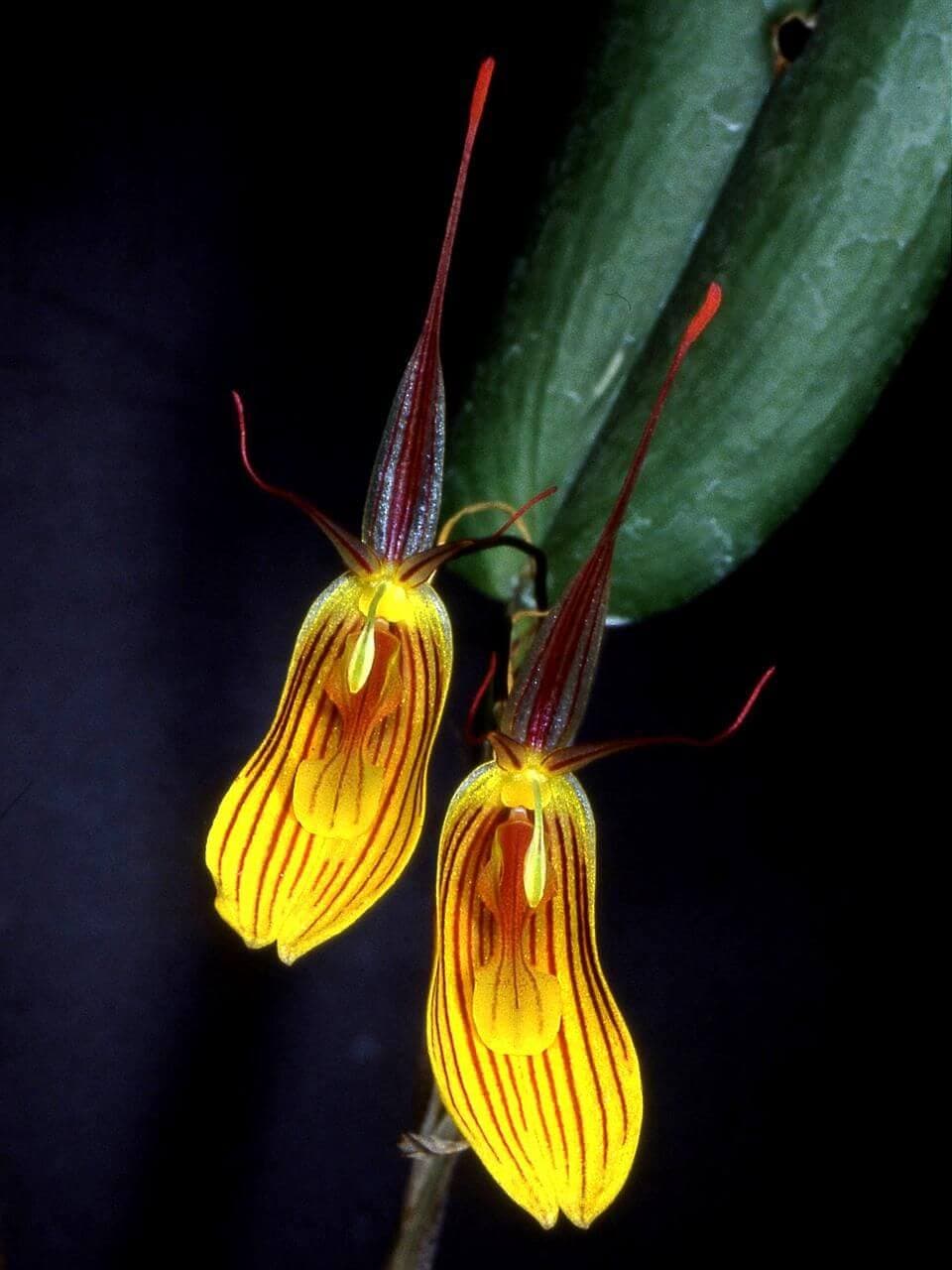
Photo by Orchi·CC BY-SA 3.0
Care
Prefers very high humidity, low light, with 10–20 °C, and reaches 25 cm at maturity.
Light
Humidity
Temperature
Soil
Moisture
Propagation
Native range
Native to Northern South America.
Appearance
Growth habit
Leaf shape
Leaf texture
Frequently asked
Can Falkenberg's Restrepia grow in a closed terrarium?
Yes. Falkenberg's Restrepia prefers very high (above 80%) humidity, which is what a closed terrarium provides, and tolerates shade-tolerant conditions.
Does Falkenberg's Restrepia need drainage?
Falkenberg's Restrepia prefers a moist substrate. Drainage is helpful but not critical; consistent moisture matters more.
What humidity does Falkenberg's Restrepia need?
Falkenberg's Restrepia does best in very high (above 80%) humidity.
Is Falkenberg's Restrepia pet-safe?
Falkenberg's Restrepia is considered non-toxic to common household pets.
How tall does Falkenberg's Restrepia grow?
Falkenberg's Restrepia typically reaches 15–25 cm at maturity.
How do you propagate Falkenberg's Restrepia?
Falkenberg's Restrepia can be propagated by offsets or seeds.
References
- 1
POWO (Kew) — Restrepia falkenbergii Rchb.f. (accepted name, first published Gard. Chron., n.s., 13: 232 (1880); family Orchidaceae; native range Colombia; epiphyte; wet tropical biome)
https://powo.science.kew.org/taxon/urn:lsid:ipni.org:names:655535-1 - 2
IOSPE (orchidspecies.com) — Restrepia falkenbergii Rchb.f. 1880 (common name: Falkenberg's Restrepia; distribution: Colombia, Antioquia, central cordillera at 1,000–2,000 m; medium-sized epiphyte; stout erect ramicauls; single apical ovate leaf; inflorescence 4–6 cm; flower ~2 cm; yellow dorsal sepal with brown stripes; narrow-waisted pandurate lip; bloom season spring and fall; cool-growing)
https://www.orchidspecies.com/resfalkenbergii.htm - 3
Orchid Care Tips — Restrepias (genus care: daytime max 18–20 °C, night 10–13 °C; humidity 70–100%; light 500–1,500 fc shaded; medium-fine fir bark mixed with NZ sphagnum; consistently moist; bi-weekly half-strength fertiliser; keikis form at leaf base; orchidarium/terrarium ideal)
https://www.orchid-care-tips.com/restrepias.html - 4
Oak Hill Gardens — Restrepias (genus care: cool Andean cloud forest plants; daytime 18–20 °C max, night 10–13 °C; 70–100% humidity; shade preferred; fir bark + sphagnum; moist year-round; repot every two years in early spring)
https://www.oakhillgardens.com/blog/restrepias - 5
ASPCA Toxic and Non-Toxic Plants — Phalaenopsis Orchid (Orchidaceae family confirmed non-toxic to cats, dogs, and horses; Restrepia not individually listed; orchids broadly non-toxic within the family)
https://www.aspca.org/pet-care/aspca-poison-control/toxic-and-non-toxic-plants/phalaenopsis-orchid