Maranta leuconeura
Prayer Plant, Herringbone Plant, Red Prayer Plant
Best known for its nightly leaf-folding behaviour, which resembles hands held in prayer. The oblong-elliptic leaves display a herringbone pattern of red veins against dark green, with lighter central variegation and purple-red undersides. A low-growing, spreading species that does well in closed terrariums, where high humidity and warmth mirror its native Brazilian rainforest floor.
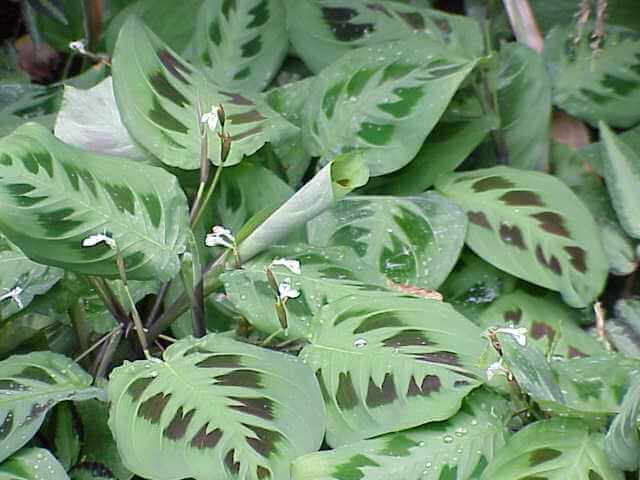
Photo by Kurt Stüber·CC BY-SA 3.0
Care
Prefers high humidity, indirect light, with 15–27 °C, and reaches 30 cm at maturity.
Light
Humidity
Temperature
Soil
Moisture
Soil pH
Propagation
Native range
Native to Brazil.
Appearance
Growth habit
Leaf shape
Leaf texture
Frequently asked
Can Prayer Plant grow in a closed terrarium?
Yes. Prayer Plant prefers high (60–80%) humidity, which is what a closed terrarium provides, and tolerates indirect-light-loving conditions.
Does Prayer Plant need drainage?
Prayer Plant prefers a moist substrate. Drainage is helpful but not critical; consistent moisture matters more.
What humidity does Prayer Plant need?
Prayer Plant does best in high (60–80%) humidity.
Is Prayer Plant pet-safe?
Prayer Plant is considered non-toxic to common household pets.
How tall does Prayer Plant grow?
Prayer Plant typically reaches 15–30 cm at maturity.
How do you propagate Prayer Plant?
Prayer Plant can be propagated by stem cuttings or division.
References
- 1
Kew Plants of the World Online
https://powo.science.kew.org/taxon/urn:lsid:ipni.org:names:797361-1/ - 2
NC State Extension Gardener Plant Toolbox
https://plants.ces.ncsu.edu/plants/maranta-leuconeura/ - 3
ASPCA Toxic and Non-Toxic Plants
https://www.aspca.org/pet-care/aspca-poison-control/toxic-and-non-toxic-plants/prayer-plant - 4
- 5
Wikimedia Commons
https://commons.wikimedia.org/wiki/File:Maranta_leuconeura3.jpg