Drosera aliciae
Alice's Sundew, Alice Sundew, Shepherd's Crook Sundew, Sondou
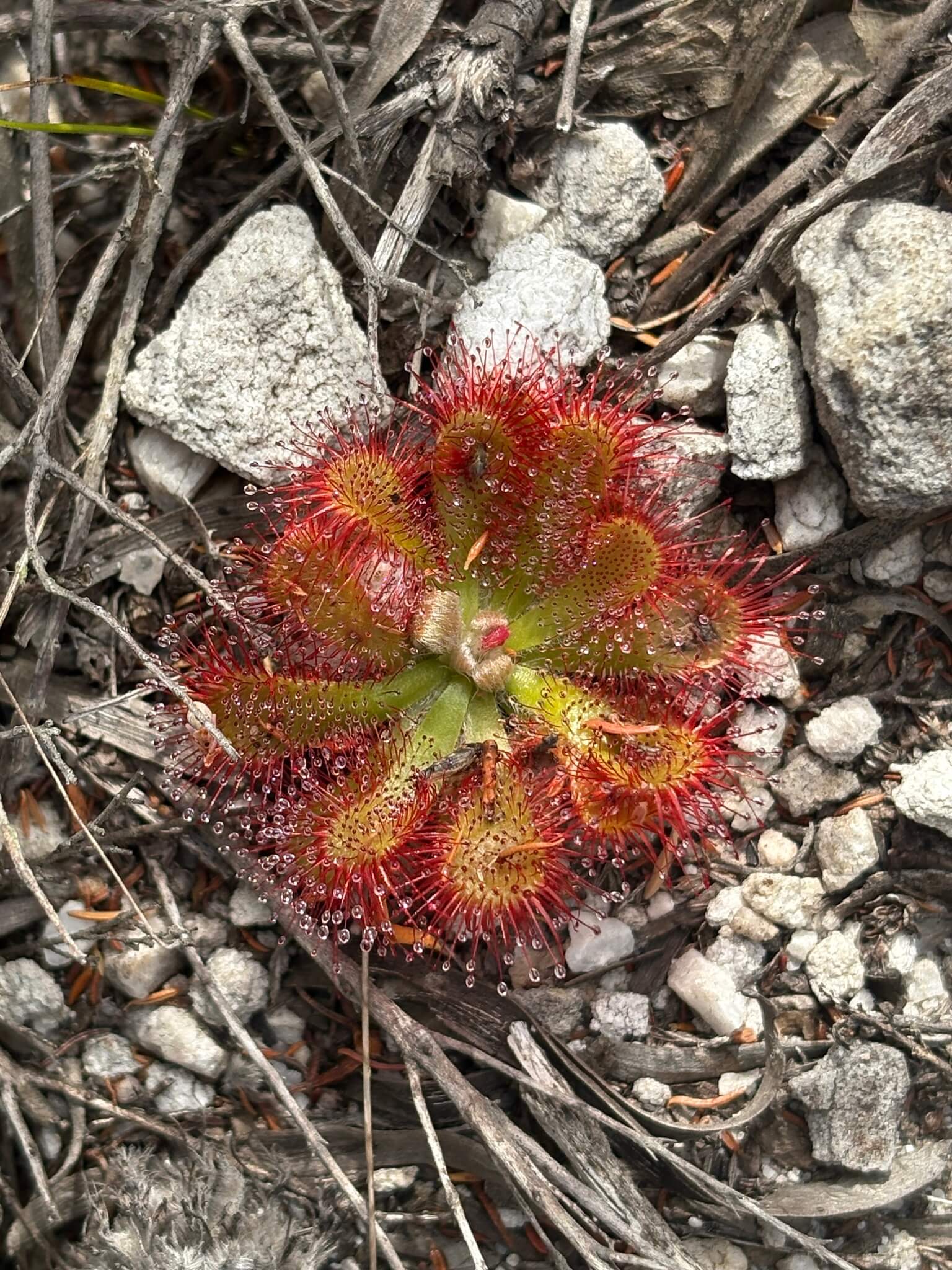
A compact carnivorous plant endemic to the fynbos bogs and seepages of South Africa's Cape Provinces, where it traps and digests small insects to supplement the nutrient-poor, waterlogged soils it grows in. Each wedge-shaped leaf is densely covered in stalked glandular hairs — called tentacles — tipped with sticky mucilage that sparkles in bright light and deepens to vivid red as light intensity increases. The rosette stays tight and small, rarely exceeding 5 cm across, which makes it one of the most space-efficient carnivorous plants for a bog dish or open terrarium. It is widely regarded as one of the easiest sundews to grow, tolerating a broad temperature window and requiring no dormancy period — just constant moisture, bright light, and mineral-free water.
Care
Prefers high humidity, bright indirect light, with 5–30 °C, and reaches 40 cm at maturity.
Light
Humidity
Temperature
Soil
Moisture
Soil pH
Propagation
Native range
Native to Southern Africa.
Appearance
Growth habit
Leaf shape
Leaf texture
Frequently asked
Can Alice's Sundew grow in a closed terrarium?
Yes. Alice's Sundew prefers high (60–80%) humidity, which is what a closed terrarium provides, and tolerates bright-indirect-light-loving conditions.
Does Alice's Sundew need drainage?
Alice's Sundew prefers a wet substrate. Drainage is helpful but not critical; consistent moisture matters more.
What humidity does Alice's Sundew need?
Alice's Sundew does best in high (60–80%) humidity.
Is Alice's Sundew pet-safe?
Alice's Sundew is considered non-toxic to common household pets.
How tall does Alice's Sundew grow?
Alice's Sundew typically reaches 5–40 cm at maturity.
How do you propagate Alice's Sundew?
Alice's Sundew can be propagated by leaf cuttings or division or seeds.
References
- 1
Kew Plants of the World Online — Drosera aliciae (accepted name)
https://powo.science.kew.org/taxon/321775-1 - 2
Wikipedia — Drosera aliciae
https://en.wikipedia.org/wiki/Drosera_aliciae - 3
PlantZAfrica (SANBI) — Drosera aliciae
https://pza.sanbi.org/drosera-aliciae - 4
RHS — Drosera aliciae (Princess Alice's Sundew)
https://www.rhs.org.uk/plants/6131/drosera-aliciae/details - 5
Carnivorous Plants Guide — Drosera aliciae care
https://www.carnivorousplantsguide.com/drosera-aliciae-care-alice-sundews/ - 6
ICPS — Growing Subtropical Drosera
https://www.carnivorousplants.org/grow/guides/SubtropicalDrosera - 7
ICPS — Drosera Leaf Cuttings propagation guide
https://www.carnivorousplants.org/grow/guides/DroseraLeafCuttings - 8
Terrarium Creations — Drosera sundews terrarium care
https://terrariumcreations.com/how-to-grow-and-care-for-drosera-sundews-carnivorous-plants-in-terrariums/ - 9
Karnivores — Drosera aliciae terrarium guide
https://www.karnivores.com/gb/to-keep/6447-drosera-aliciae-en-terrarium-3760384031553.html - 10
Highland Moss — Carnivorous Sundew Drosera aliciae (non-toxic confirmation)
https://highlandmoss.com/shop-2/house-plants/pet-friendly/carnivorous-sundew-drosera-aliciae/ - 11
ASPCA Toxic Plant List — D listing (Drosera not listed; confirmed non-toxic for genus)
https://www.aspca.org/pet-care/animal-poison-control/toxic-and-non-toxic-plants/d - 12
Greg App — Sundew hardiness zones (9a–11b general range)
https://greg.app/sundew-hardiness-zone/ - 13
Growplants.org — Drosera aliciae care
https://www.growplants.org/growing/drosera-aliciae