Codiaeum variegatum
Croton, Garden Croton, Variegated Croton, Fire Croton, Joseph's Coat, Variegated Laurel
Codiaeum variegatum is an evergreen shrub from the wet tropical forests of Malesia, New Guinea, the Solomon Islands, Queensland and the islands of the south-west Pacific, where it grows up to 3 m tall. The wild form has plain green leaves; the plants sold as houseplants belong to more than 300 cultivars bred for thick, glossy leaves 5–30 cm long, patterned in yellow, orange, red, pink and purple, and shaped anything from broad ovals to narrow, twisted ribbons or deeply lobed blades. Linnaeus first named it Croton variegatus in 1753, and the old name stuck as its common name, although it now sits in a separate genus within the spurge family. Like many spurges it bleeds a milky latex when cut: the sap irritates skin and eyes, and every part of the plant is poisonous if eaten. Its colours are strongest in bright light kept out of hot midday sun, and too little light lets new leaves come in mostly green. It does best at 18–28 °C with steady, high humidity, and drops leaves readily when moved, chilled below about 15 °C or left to dry out — so it suits a large, stable terrarium better than a small one, with a spring trim to keep it compact.
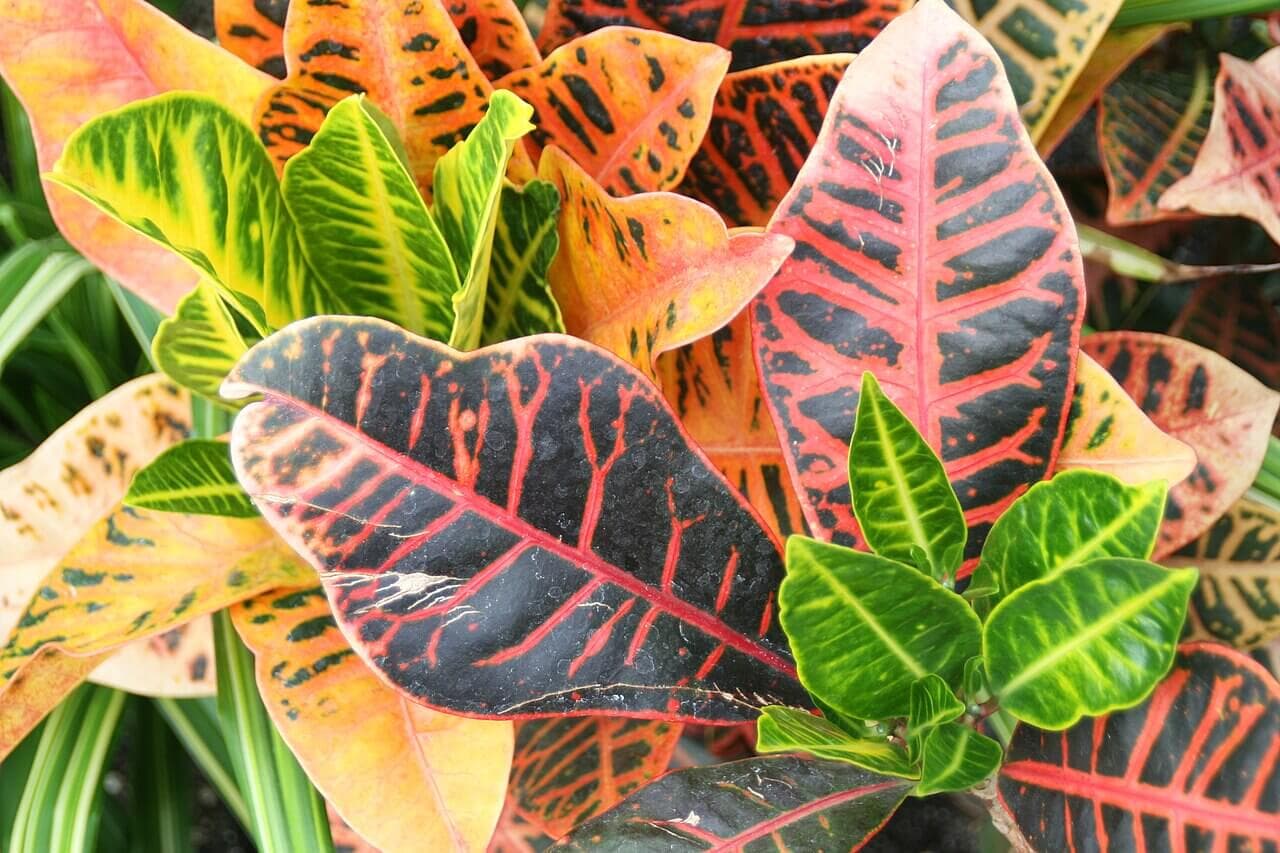
Photo by Photo by David J. Stang·CC BY-SA 4.0
Care
Prefers high humidity, bright indirect light, with 15–35 °C, and reaches 150 cm at maturity.
Light
Humidity
Temperature
Soil
Moisture
Soil pH
Propagation
Tip cuttings 7–15 cm long, carrying three to five leaves, root in about four weeks in a sterile, free-draining mix. The cut ends bleed milky latex, which growers stop by dipping them in powdered charcoal, and gentle bottom heat in early summer speeds rooting. Gloves help, since the sap irritates skin.
Native range
Native to Malesia, Papuasia, Australia, and Southwestern Pacific.
Native range
Appearance
Growth habit
Leaf shape
Leaf texture
Max leaf size
Frequently asked
Can Croton grow in a closed terrarium?
Yes. Croton prefers high (60–80%) humidity, which is what a closed terrarium provides, and tolerates bright-indirect-light-loving conditions.
Does Croton need drainage?
Croton prefers a moist substrate. Drainage is helpful but not critical; consistent moisture matters more.
What humidity does Croton need?
Croton does best in high (60–80%) humidity.
Is Croton pet-safe?
Croton is moderately toxic if ingested — keep out of reach of pets and children.
How tall does Croton grow?
Croton typically reaches 60–150 cm at maturity.
How do you propagate Croton?
Croton can be propagated by stem cuttings or air layering.
References
- 1
Kew Plants of the World Online — Codiaeum variegatum
https://powo.science.kew.org/taxon/urn:lsid:ipni.org:names:85073-3 - 2
NParks Flora & Fauna Web — Codiaeum variegatum
https://www.nparks.gov.sg/florafaunaweb/flora/1/8/1833 - 3
RHS — Codiaeum variegatum var. pictum
https://www.rhs.org.uk/plants/43307/codiaeum-variegatum-var-pictum-v/details - 4
RHS — How to grow codiaeum
https://www.rhs.org.uk/plants/codiaeum/how-to-grow-codiaeum - 5
NC State Extension Plant Toolbox — Codiaeum variegatum
https://plants.ces.ncsu.edu/plants/codiaeum-variegatum/ - 6
UF/IFAS Extension Charlotte County — Crotons, a living paint palette of color
https://blogs.ifas.ufl.edu/charlotteco/2022/04/01/crotons-a-living-paint-palette-of-color - 7
Aquasabi — Codiaeum variegatum 'Bush on Fire' (terrarium plant)
https://www.aquasabi.com/Codiaeum-variegatum-Bush-on-Fire - 8
- 9
Wikipedia — Codiaeum variegatum
https://en.wikipedia.org/wiki/Codiaeum_variegatum