Begonia pavonina
Peacock Begonia, Blue Begonia
Known as the Peacock Begonia, Begonia pavonina is native to the cool, shaded hillside forests of Peninsular Malaysia, where it creeps low across the ground in deep forest shade. Its leaves appear an ordinary dark green under normal light but shift to a vivid iridescent blue at certain angles in dim conditions — an effect produced by specialised chloroplast structures called iridoplasts, which scatter short-wavelength light rather than absorb it. It is among the most demanding begonias to keep: very low light is needed to preserve the iridescence, humidity should stay above 60%, and the plant does best with a consistent drop of around 8 °C between day and night temperatures.
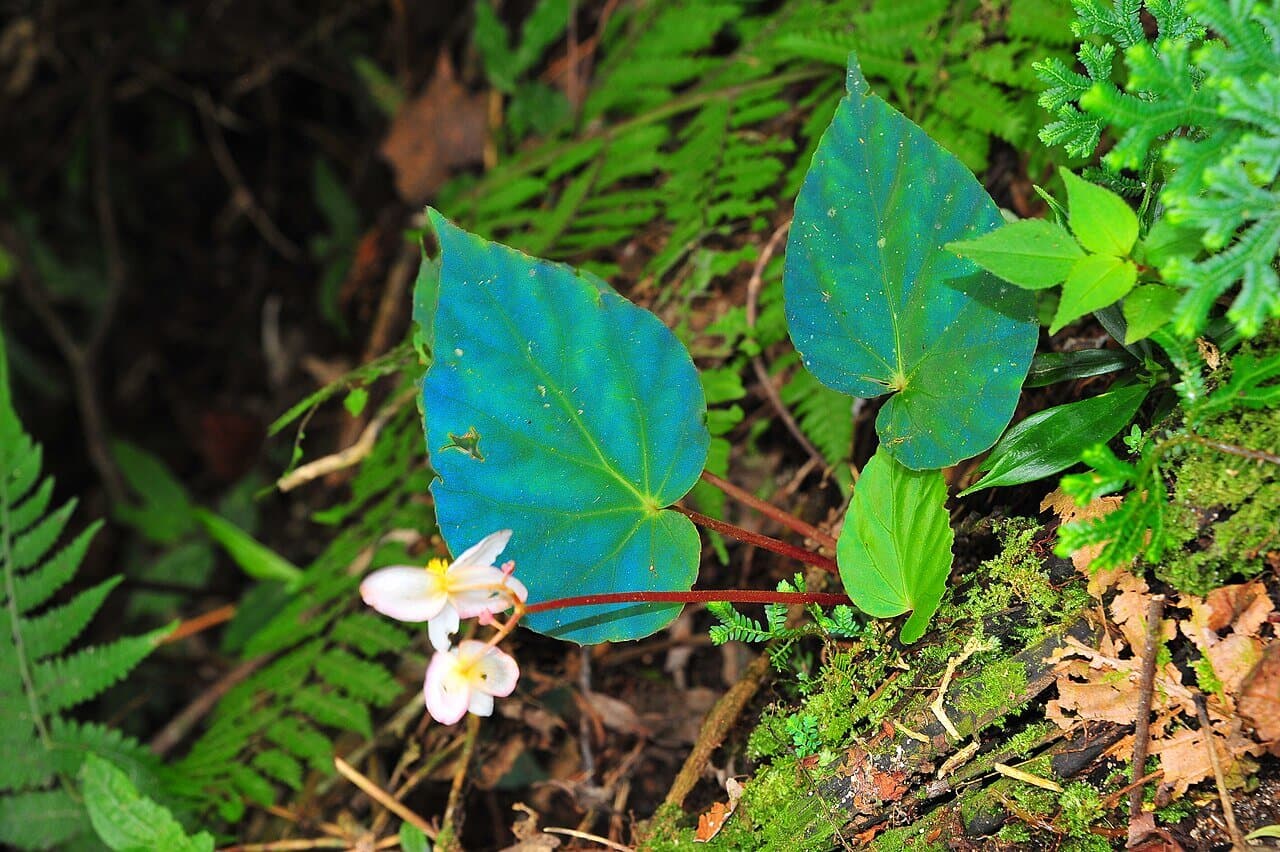
Photo by 彭鏡毅 (Peng Jingyi)·CC BY-SA 3.0
Care
Prefers high humidity, low light, with 12–27 °C, and reaches 40 cm at maturity.
Light
Humidity
Temperature
Soil
Moisture
Propagation
Frequently asked
Can Peacock Begonia grow in a closed terrarium?
Yes. Peacock Begonia prefers high (60–80%) humidity, which is what a closed terrarium provides, and tolerates shade-tolerant conditions.
Does Peacock Begonia need drainage?
Peacock Begonia prefers a moist substrate. Drainage is helpful but not critical; consistent moisture matters more.
What humidity does Peacock Begonia need?
Peacock Begonia does best in high (60–80%) humidity.
Is Peacock Begonia pet-safe?
Peacock Begonia is mildly toxic if ingested — keep out of reach of pets and children.
How tall does Peacock Begonia grow?
Peacock Begonia typically reaches 10–40 cm at maturity.
How do you propagate Peacock Begonia?
Peacock Begonia can be propagated by stem cuttings or rhizome division.
References
- 1
POWO — Begonia pavonina
https://powo.science.kew.org/taxon/urn:lsid:ipni.org:names:105382-1 - 2
Here But Not — Begonia pavonina Care & Culture
https://herebutnot.com/begonia-pavonina-care-culture/ - 3
Plantophiles — Begonia Pavonina Care
https://plantophiles.com/plant-care/begonia-pavonina/ - 4
Strange Wonderful Things — Begonia pavonina
https://www.strangewonderfulthings.com/318.htm - 5
ASPCA — Begonia Toxicity
https://www.aspca.org/pet-care/aspca-poison-control/toxic-and-non-toxic-plants/begonia