Begonia chlorosticta
Spotted Begonia
Native to the rainforests of Sarawak on the island of Borneo, Begonia chlorosticta takes its name from the Greek for 'green-spotted' — its olive-green leaves are dusted with pale spots and threaded with red veins that extend into the stem. It grows on the forest floor as an understory plant, making it well-suited to low or medium indirect light and the steady humidity of a closed terrarium. It comes in two colour forms: the standard green variety and a rarer reddish-brown form, both sharing the same spotted patterning and red-flushed stems.
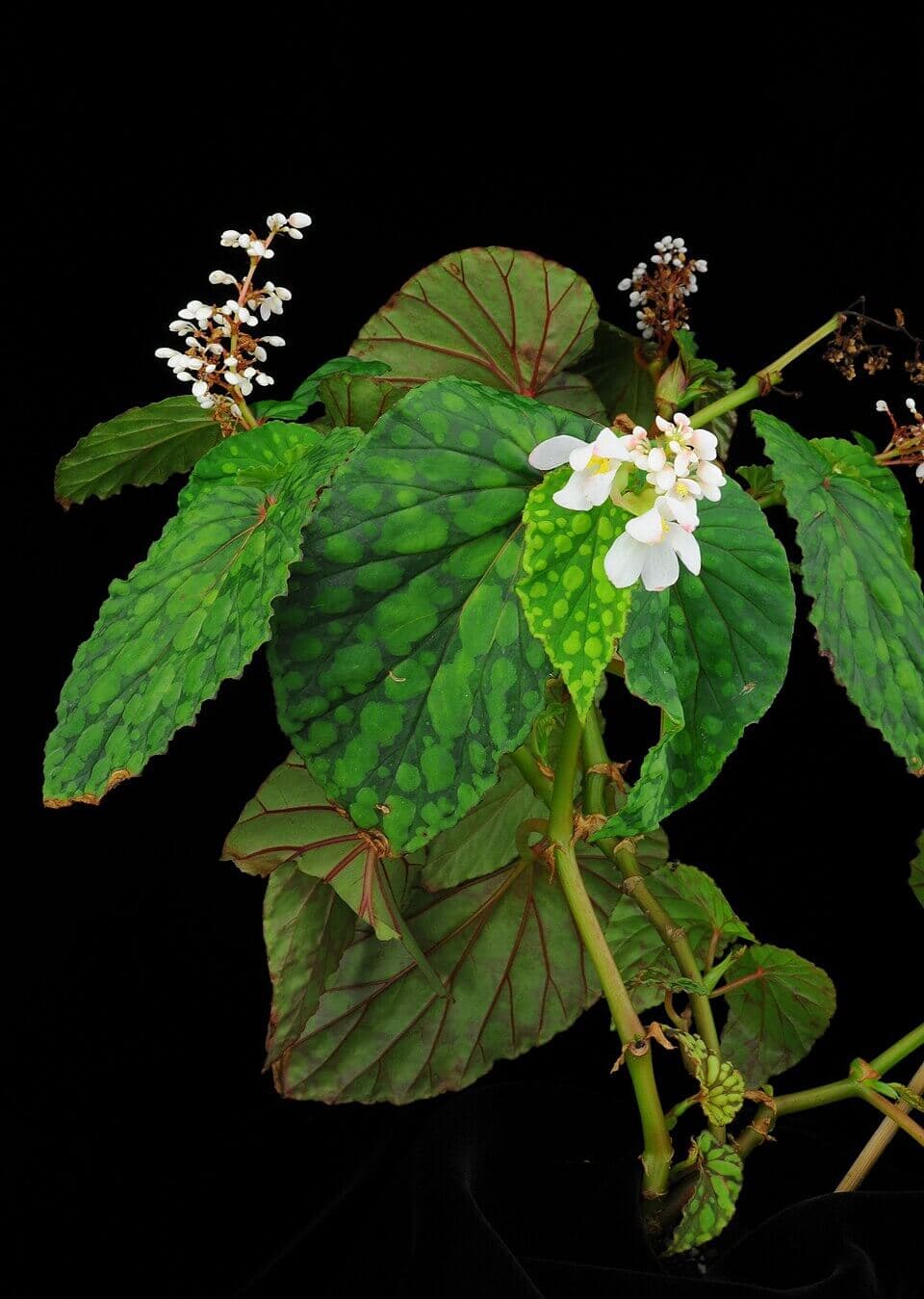
Photo by 彭鏡毅 (Peng Jingyi)·CC BY-SA 3.0
Care
Prefers high humidity, indirect light, with 18–35 °C, and reaches 40 cm at maturity.
Light
Humidity
Temperature
Soil
Moisture
Soil pH
Propagation
Frequently asked
Can Spotted Begonia grow in a closed terrarium?
Yes. Spotted Begonia prefers high (60–80%) humidity, which is what a closed terrarium provides, and tolerates indirect-light-loving conditions.
Does Spotted Begonia need drainage?
Spotted Begonia prefers a moist substrate. Drainage is helpful but not critical; consistent moisture matters more.
What humidity does Spotted Begonia need?
Spotted Begonia does best in high (60–80%) humidity.
Is Spotted Begonia pet-safe?
Spotted Begonia is mildly toxic if ingested — keep out of reach of pets and children.
How tall does Spotted Begonia grow?
Spotted Begonia typically reaches 10–40 cm at maturity.
How do you propagate Spotted Begonia?
Spotted Begonia can be propagated by stem cuttings or seeds.
References
- 1
POWO — Begonia chlorosticta
https://powo.science.kew.org/taxon/urn:lsid:ipni.org:names:899311-1 - 2
Bloom and Bumble — Begonia Chlorosticta Complete Care Guide
https://bloomandbumble.com/begonia-chlorosticta-complete-care-guide/ - 3
Plant That Plant — Begonia Chlorosticta
https://www.plantthatplant.com/products/begonia-chlorosticta - 4
FrogDaddy — Begonia chlorosticta Red Form
https://frogdaddy.net/products/begonia-chlorosticta-red-form - 5
ASPCA — Begonia Toxicity
https://www.aspca.org/pet-care/aspca-poison-control/toxic-and-non-toxic-plants/begonia