Asparagus setaceus
Asparagus Fern, Lace Fern, Plumosa Fern, Climbing Asparagus, Ferny Asparagus, Asparagus Grass, Common Asparagus Fern
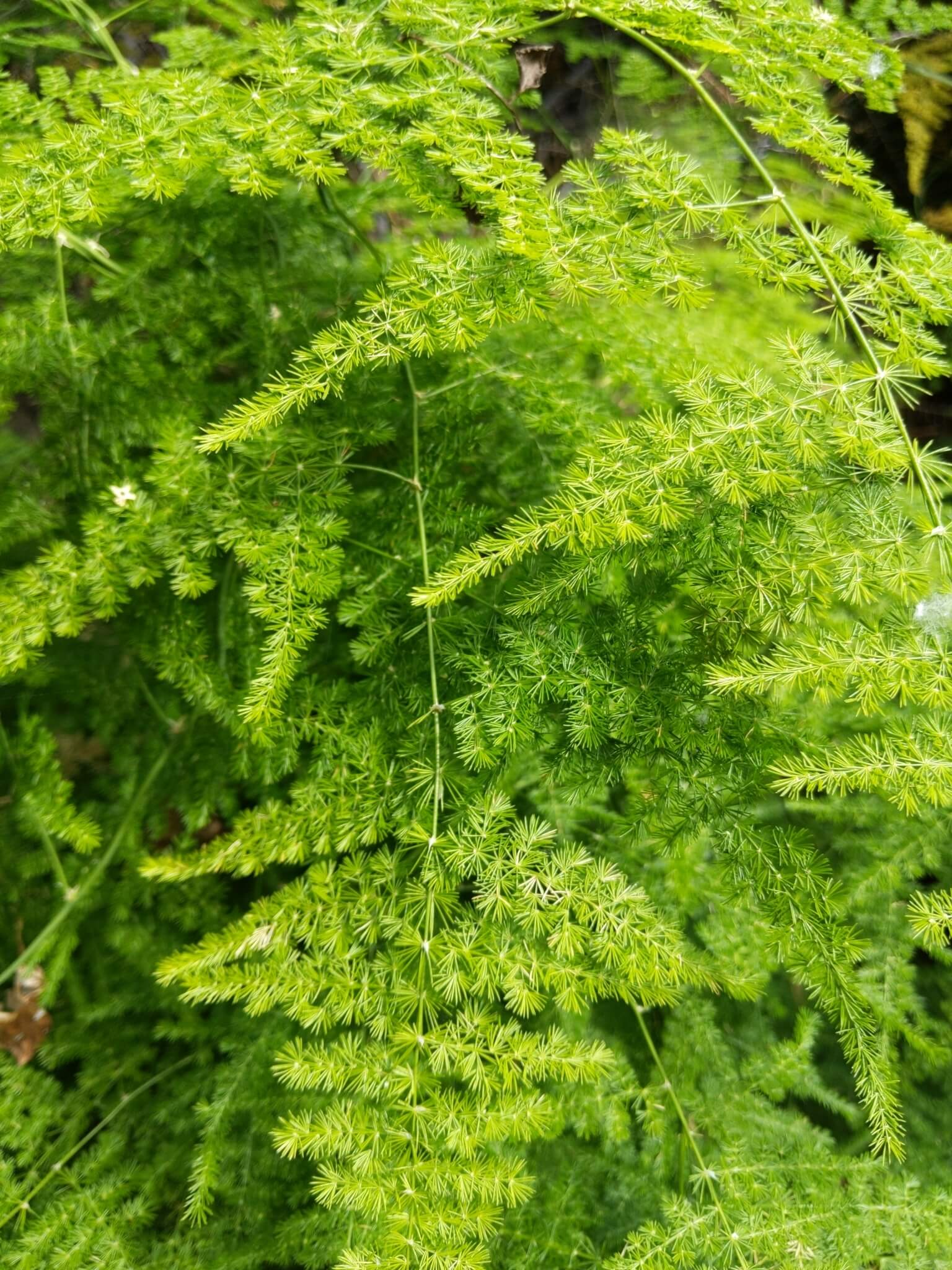
Asparagus setaceus is a scrambling climber from eastern and southern Africa, native from central Ethiopia to South Africa and the Comoros, where it grows in forests in regions with alternating wet and dry seasons. Despite the common name it is not a fern but a relative of edible asparagus: its soft, needle-like 'leaves' are cladodes — flattened stem branches up to 8 mm long, held in tufts of 10–20 — while the true leaves are reduced to tiny scales and small spines on the wiry stems. As a houseplant it usually reaches 60–90 cm, and outdoors it twines up to 2.5 m, storing water in thick, tuberous roots that carry it through dry spells. In a terrarium it works best as a small division set among broad-leaved plants, since it grows quickly, its roots can crowd the glass, and the needles it sheds can rot on the substrate. It does best in bright, filtered light with steady humidity at 13–27 °C; the berries are toxic to people and pets, and the sap can irritate skin.
Care
Prefers high humidity, bright indirect light, with 13–27 °C, and reaches 90 cm at maturity.
Light
Humidity
Temperature
Soil
Moisture
Soil pH
Propagation
The root system is a dense mass of thick, tuberous storage roots, so a crowded clump can be cut into sections that each keep some roots and a few stems. Early spring, as new growth starts, is the usual time; gloves help, since the stems carry small spines and the sap can irritate skin.
Native range
Native to Northeast Tropical Africa, East Tropical Africa, South Tropical Africa, Southern Africa, and Western Indian Ocean.
Native range
Appearance
Growth habit
Leaf shape
Leaf texture
Frequently asked
Can Asparagus Fern grow in a closed terrarium?
Yes. Asparagus Fern prefers high (60–80%) humidity, which is what a closed terrarium provides, and tolerates bright-indirect-light-loving conditions.
Does Asparagus Fern need drainage?
Asparagus Fern prefers a moist substrate. Drainage is helpful but not critical; consistent moisture matters more.
What humidity does Asparagus Fern need?
Asparagus Fern does best in high (60–80%) humidity.
Is Asparagus Fern pet-safe?
Asparagus Fern is moderately toxic if ingested — keep out of reach of pets and children.
How tall does Asparagus Fern grow?
Asparagus Fern typically reaches 15–90 cm at maturity.
How do you propagate Asparagus Fern?
Asparagus Fern can be propagated by division or seeds.
References
- 1
Kew Plants of the World Online — Asparagus setaceus
https://powo.science.kew.org/taxon/urn:lsid:ipni.org:names:531312-1 - 2
GBIF — World Checklist of Vascular Plants distribution for Asparagus setaceus
https://www.gbif.org/species/2768686 - 3
RHS — Asparagus setaceus
https://www.rhs.org.uk/plants/27185/wd/details - 4
NC State Extension — Asparagus setaceus
https://plants.ces.ncsu.edu/plants/asparagus-setaceus - 5
Gardenia.net — Asparagus setaceus
https://www.gardenia.net/plant/asparagus-setaceus-asparagus-fern-grow-care-tips - 6
Terrarium Tribe — Ferns that work in terrariums (asparagus fern verdict)
https://terrariumtribe.com/ferns-that-work-in-terrariums/ - 7
UF/IFAS Plant Directory — Asparagus setaceus
https://plant-directory.ifas.ufl.edu/plant-directory/asparagus-setaceus - 8
Wikipedia — Asparagus setaceus
https://en.wikipedia.org/wiki/Asparagus_setaceus - 9
Levy Preserve — Asparagus setaceus
https://levypreserve.org/plant-listings/asparagus-setaceus/ - 10
Aquasabi — Asparagus setaceus (terrarium plant)
https://www.aquasabi.com/Asparagus-setaceus - 11
Homes & Gardens — How to care for asparagus fern
https://www.homesandgardens.com/gardens/how-to-care-for-asparagus-fern - 12
Healthy Houseplants — Asparagus fern care guide
https://www.healthyhouseplants.com/indoor-houseplants/asparagus-fern-a-complete-care-guide/ - 13
Bantam Earth — Asparagus fern vivarium guide
https://bantam.earth/asparagus-fern-asparagus-setaceus/ - 14
ASPCA — Plumosa Fern (lists A. densiflorus 'Sprengeri'; 'Lace Fern' among its names)
https://www.aspca.org/pet-care/aspca-poison-control/toxic-and-non-toxic-plants/plumosa-fern