Anthurium andraeanum
Flamingo Flower, Flamingo Lily, Laceleaf, Painter's Palette, Tail Flower, Oilcloth Flower
A semi-epiphytic perennial from the cloud forests of Colombia and Ecuador. It produces glossy, heart-shaped leaves and long-lasting waxy spathes — typically vivid red — around a slender yellow spadix. It does best in warm, humid conditions with bright indirect light and a free-draining, bark-based substrate that suits its aerial roots. All parts contain calcium oxalate crystals and are toxic to pets and humans if ingested.
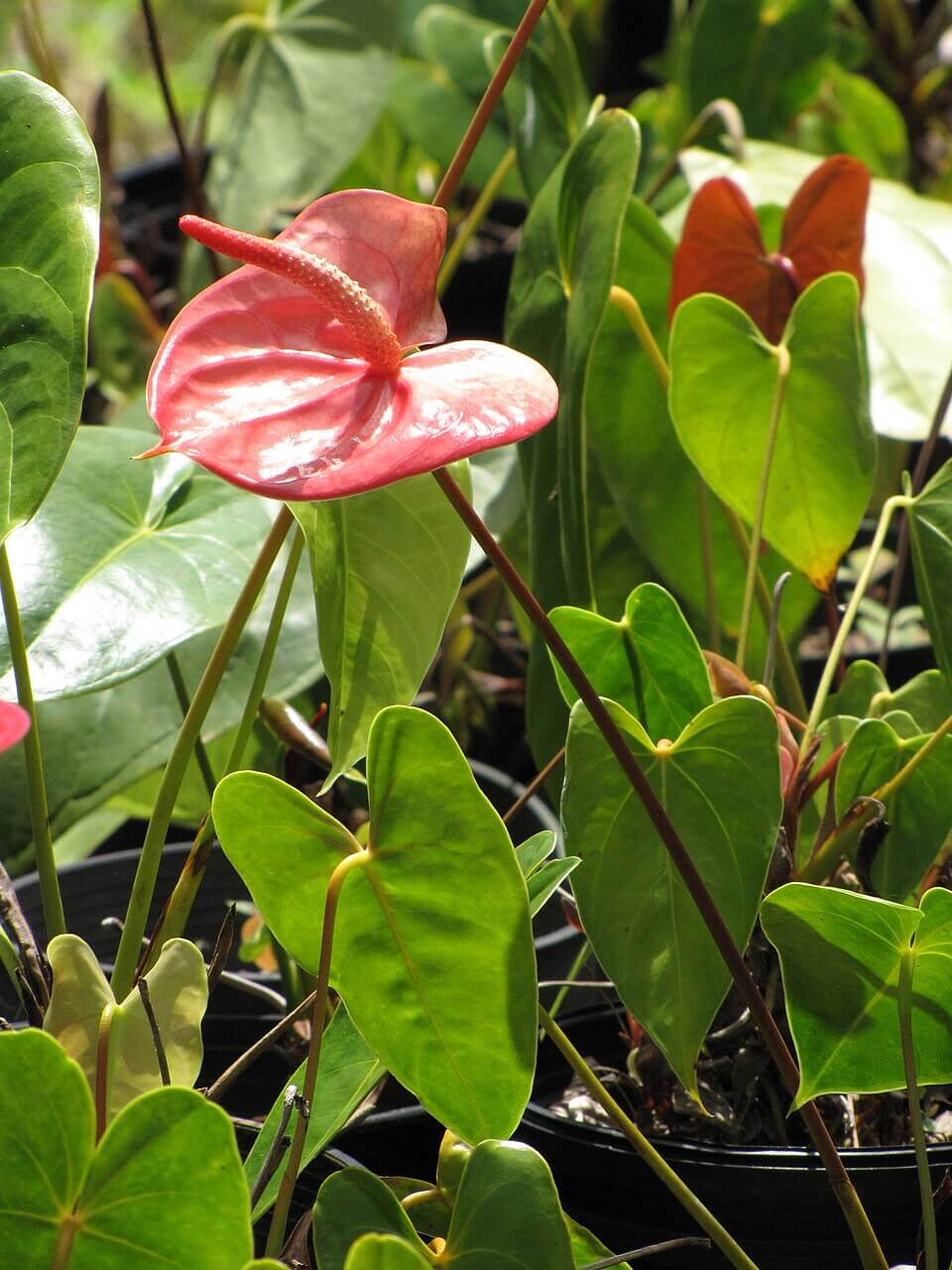
Photo by Forest & Kim Starr·CC BY 3.0 US
Care
Prefers high humidity, bright indirect light, with 15–32 °C, and reaches 60 cm at maturity.
Light
Humidity
Temperature
Soil
Moisture
Soil pH
Propagation
Native range
Native to Western South America.
Appearance
Growth habit
Leaf shape
Leaf texture
Frequently asked
Can Flamingo Flower grow in a closed terrarium?
Yes. Flamingo Flower prefers high (60–80%) humidity, which is what a closed terrarium provides, and tolerates bright-indirect-light-loving conditions.
Does Flamingo Flower need drainage?
Flamingo Flower prefers a moist substrate. Drainage is helpful but not critical; consistent moisture matters more.
What humidity does Flamingo Flower need?
Flamingo Flower does best in high (60–80%) humidity.
Is Flamingo Flower pet-safe?
Flamingo Flower is moderately toxic if ingested — keep out of reach of pets and children.
How tall does Flamingo Flower grow?
Flamingo Flower typically reaches 30–60 cm at maturity.
How do you propagate Flamingo Flower?
Flamingo Flower can be propagated by division or stem cuttings or seeds.
References
- 1
Kew Plants of the World Online — Anthurium andraeanum
https://powo.science.kew.org/taxon/urn:lsid:ipni.org:names:84549-1 - 2
RHS — How to grow anthuriums
https://www.rhs.org.uk/plants/anthuriums/how-to-grow-anthuriums - 3
RHS — Anthurium andraeanum plant details
https://www.rhs.org.uk/plants/1349/anthurium-andraeanum/details - 4
NC State Extension — Anthurium andraeanum
https://plants.ces.ncsu.edu/plants/anthurium-andraeanum/ - 5
Missouri Botanical Garden Plant Finder
https://www.missouribotanicalgarden.org/PlantFinder/PlantFinderDetails.aspx?kempercode=b575 - 6
ASPCA — Flamingo Flower (toxic plant listing)
https://www.aspca.org/pet-care/aspca-poison-control/toxic-and-non-toxic-plants/flamingo-flower - 7
BBC Gardeners' World — How to grow anthurium
https://www.gardenersworld.com/house-plants/how-to-grow-anthurium/ - 8
Monaco Nature Encyclopedia — Anthurium andraeanum
https://www.monaconatureencyclopedia.com/anthurium-andraeanum/?lang=en - 9
Lively Root — Anthurium propagation guide
https://www.livelyroot.com/blogs/plant-care/anthurium-propagation - 10
Plantophiles — Anthurium humidity requirements
https://plantophiles.com/plant-care/anthurium-humidity/