Wallisia cyanea
Pink Quill, Pink Quill Plant, Blue-Flowered Torch
Pink Quill is a compact epiphytic bromeliad from the rainforests of western Ecuador, instantly recognisable for its striking flat, paddle-shaped inflorescence — a dense spike of bright pink-magenta bracts from which small violet flowers emerge one or two at a time, each lasting only a day or two. The bract itself can persist for up to four months, making it one of the longest-lasting ornamental features of any bromeliad. Like all bromeliads, the plant absorbs water and nutrients primarily through its leaves rather than its roots; the roots serve mainly to anchor it to bark or substrate. It forms a stemless rosette of slender, arching, mid-green leaves with fine reddish-brown striations at the base, reaching about 18 cm tall without the flower spike and up to 30 cm in bloom. It does best in bright indirect light with temperatures between 15 and 24 °C and humidity above 50%. After flowering, the central rosette slowly dies back, but the plant produces three to twelve offsets (pups) around the base that can be separated and grown on. It can be grown mounted on cork bark or tree fern slab, or potted in a loose, fast-draining orchid or bromeliad mix — never in a dense, moisture-retentive compost. In an open terrarium with good ventilation, it thrives in the warm, humid microclimate while still getting the air circulation it needs to prevent crown rot.
Build a terrarium with this plant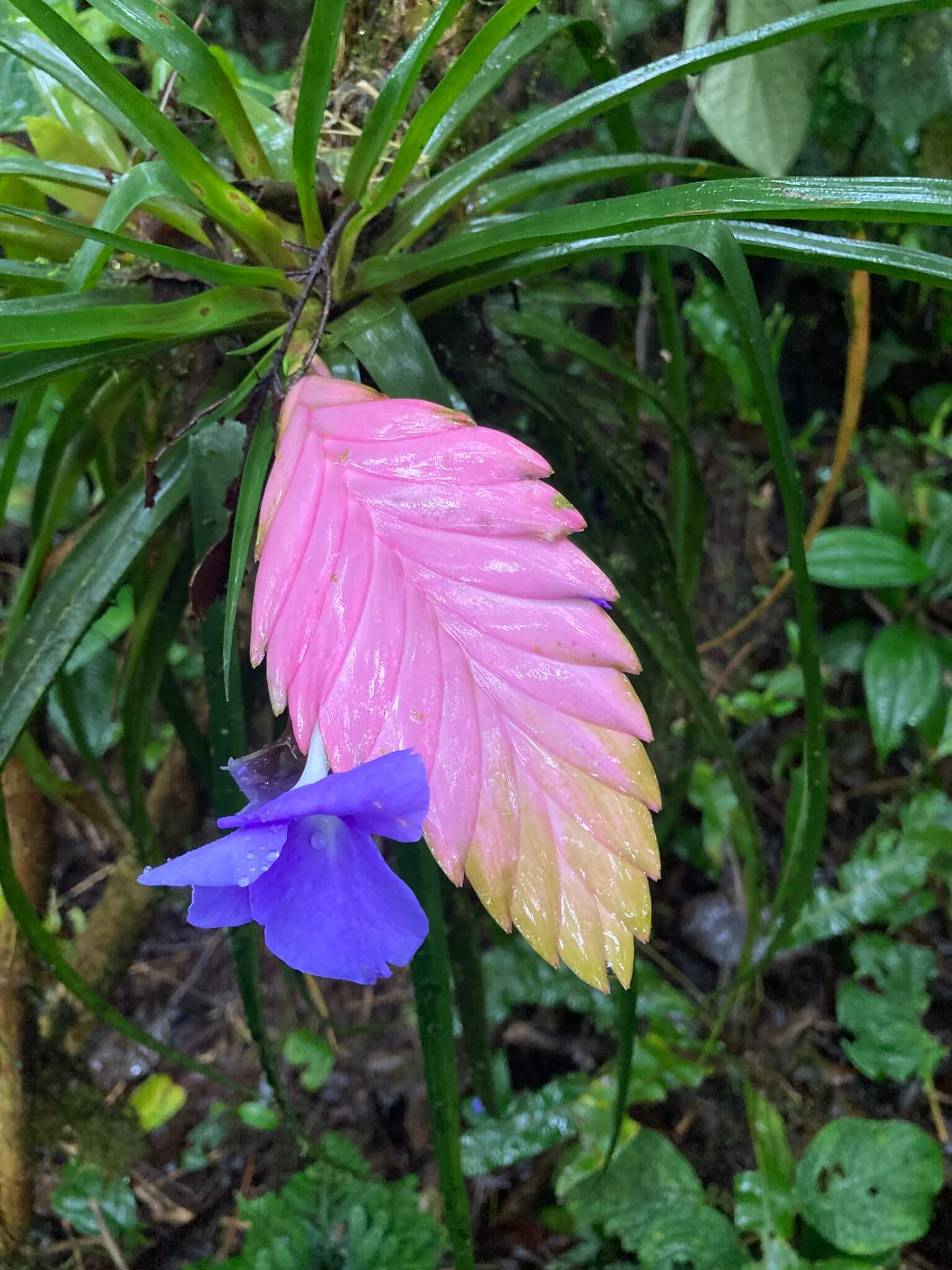
Photo by Francisco Sánchez Karste·CC BY 4.0
Care
Light
Humidity
Temperature
Soil
Moisture
Soil pH
Appearance
Growth habit
Leaf shape
Leaf texture
Distribution
Propagation
References
- 1
Air Plant Design Studio — Are Tillandsia air plants toxic to pets?
https://www.air-plants.com/blogs/air-plant-encyclopedia/are-air-plants-toxic - 2
Rainforest Flora — Notes from Tillandsia II: Tillandsia cyanea (cultivation and morphology)
https://rainforestflora.com/blogs/news/notes-from-tillandsia-ii-tillandsia-cyanea - 3
Wikipedia — Wallisia cyanea
https://en.wikipedia.org/wiki/Wallisia_cyanea - 4
RHS — Tillandsia cyanea (Pink Quill) plant details
https://www.rhs.org.uk/plants/63998/tillandsia-cyanea/details - 5
Guide to Houseplants — Pink Quill (Tillandsia cyanea) care guide
https://www.guide-to-houseplants.com/pink-quill.html - 6
Our House Plants — Pink Quill / Blue Flowered Torch (Tillandsia cyanea / lindenii) care guide
https://www.ourhouseplants.com/plants/tillandsia-cyanea-lindenii - 7
Kew Plants of the World Online — Wallisia cyanea Barfuss & W.Till (accepted name)
https://powo.science.kew.org/taxon/urn:lsid:ipni.org:names:77158962-1 - 8
Kew Plants of the World Online — Tillandsia cyanea L.B.Sm. (synonym)
https://powo.science.kew.org/taxon/urn:lsid:ipni.org:names:125038-1 - 9
GardenersHQ — Tillandsia cyanea Pink Quill Plant Growing Guide
https://www.gardenershq.com/inthegarden/pink-quill-plant-tillandsia-cyanea/ - 10
ASPCA — Toxic and Non-Toxic Plants list (Tillandsia — non-toxic to dogs, cats, horses)
https://www.aspca.org/pet-care/animal-poison-control/toxic-and-non-toxic-plants