Spirodela polyrhiza
Greater Duckweed, Giant Duckweed, Common Duckmeat, Great Duckweed
One of the world's most widely distributed aquatic plants, Greater Duckweed floats on still and slow-moving water across nearly every continent. Its round, dark-green fronds — 2–10 mm across — grow in a flat, overlapping mat on the water surface, distinguished from other duckweeds by the 7–21 roots that trail from each frond like fine threads. The underside is typically a rich reddish-purple, a detail that becomes visible whenever fronds are disturbed. Under warm conditions it can double its colony in as little as two days, making it an efficient nutrient exporter for paludariums and aquariums; in autumn it forms dense turions — starchy, compact resting buds — that sink to the bottom and re-sprout in spring.
Build a terrarium with this plant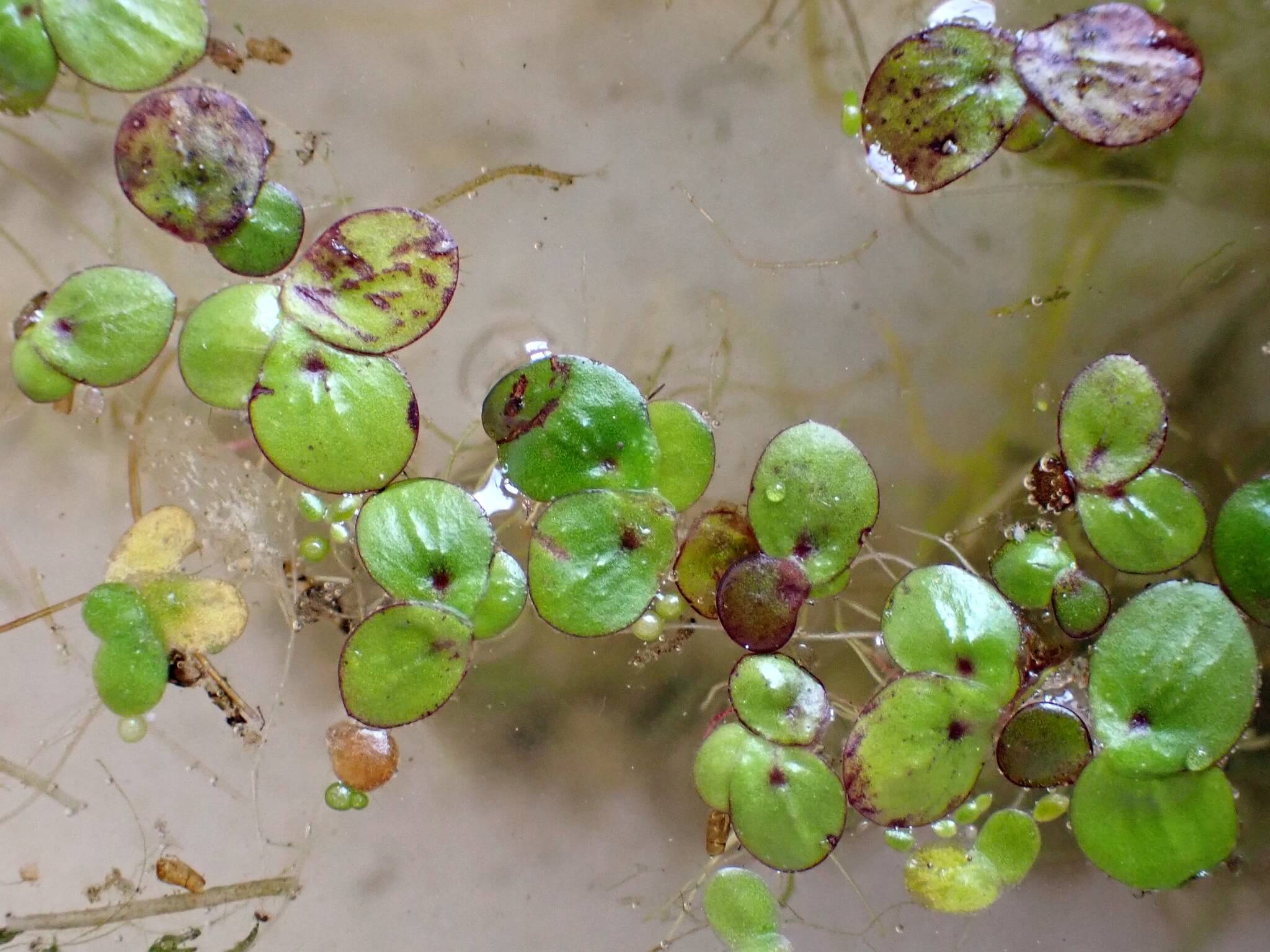
Care
Light
Humidity
Temperature
Soil
Moisture
Soil pH
Appearance
Growth habit
Leaf shape
Leaf texture
Distribution
Propagation
References
- 1
Plants of the World Online (Kew) — Spirodela polyrhiza
https://powo.science.kew.org/taxon/urn:lsid:ipni.org:names:526250-1 - 2
PFAF Plant Database — Spirodela polyrrhiza
https://pfaf.org/user/Plant.aspx?LatinName=Spirodela+polyrrhiza - 3
NC State Extension Gardener Plant Toolbox — Spirodela polyrhiza
https://plants.ces.ncsu.edu/plants/spirodela-polyrhiza/ - 4
Go Botany — Spirodela polyrrhiza
https://gobotany.nativeplanttrust.org/species/spirodela/polyrrhiza/ - 5
Plantiary — Giant Duckweed
https://plantiary.com/plant/spirodela-polyrrhiza_6007.html - 6
AquariumLesson — Spirodela polyrhiza Profile
https://aquariumlesson.com/plants/608-spirodela-polyrhiza/ - 7
Tropica — Spirodela polyrrhiza
https://tropica.com/en/plants/plantdetails/Spirodelapolyrrhiza(131TC)/30048 - 8
MDPI Plants — Turion developmental cycle in Spirodela polyrhiza
https://pmc.ncbi.nlm.nih.gov/articles/PMC11548384/