Soleirolia soleirolii
Baby's Tears, Angel's Tears, Mind-Your-Own-Business, Paddy's Wig, Corsican Carpet, Irish Moss, Pollyanna Vine, Peace-in-the-Home
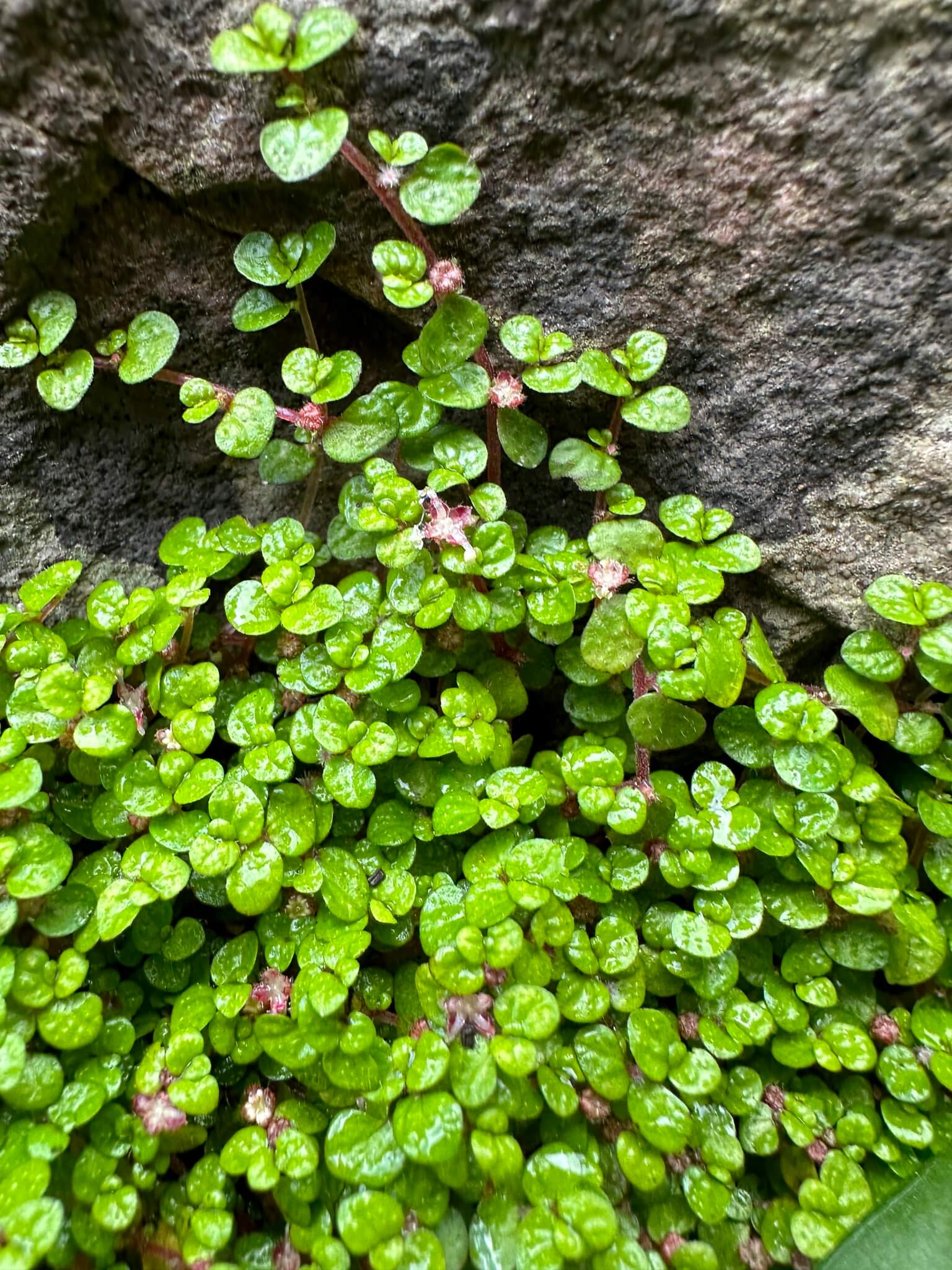
Soleirolia soleirolii is a creeping perennial from the shaded rock crevices and damp walls of the western Mediterranean — Corsica, Sardinia, Elba, and the Balearic Islands — where it forms soft mats of tiny round leaves no more than a few millimetres across. Despite belonging to the nettle family (Urticaceae), it has no sting; the threadlike stems root at every node as they spread, so a single sprig can carpet a substrate within months. Its many common names — Baby's Tears, Angel's Tears, Mind-Your-Own-Business, Paddy's Wig — all describe the same dense green cushion. In a terrarium it does best in steady high humidity with bright indirect light, but the closed-jar setting needs some airflow: without it the lower stems mat down and rot, and the plant will smother slower-growing neighbours if left unchecked.
Care
Prefers high humidity, indirect light, with 10–24 °C, and reaches 10 cm at maturity.
Light
Humidity
Temperature
Soil
Moisture
Soil pH
Propagation
Native range
Native to Southwestern Europe.
Appearance
Growth habit
Leaf shape
Leaf texture
Frequently asked
Can Baby's Tears grow in a closed terrarium?
Yes. Baby's Tears prefers high (60–80%) humidity, which is what a closed terrarium provides, and tolerates indirect-light-loving conditions.
Does Baby's Tears need drainage?
Baby's Tears prefers a moist substrate. Drainage is helpful but not critical; consistent moisture matters more.
What humidity does Baby's Tears need?
Baby's Tears does best in high (60–80%) humidity.
Is Baby's Tears pet-safe?
Baby's Tears is considered non-toxic to common household pets.
How tall does Baby's Tears grow?
Baby's Tears typically reaches 2–10 cm at maturity.
How do you propagate Baby's Tears?
Baby's Tears can be propagated by stem cuttings or division.
References
- 1
Plants of the World Online — Soleirolia soleirolii (Req.) Dandy
https://powo.science.kew.org/taxon/urn:lsid:ipni.org:names:856545-1 - 2
Missouri Botanical Garden — Soleirolia soleirolii
https://www.missouribotanicalgarden.org/PlantFinder/PlantFinderDetails.aspx?taxonid=287425 - 3
NC State Extension — Soleirolia soleirolii
https://plants.ces.ncsu.edu/plants/soleirolia-soleirolii/ - 4
Gardenia.net — Baby's Tears (Soleirolia soleirolii): All You Need To Know
https://www.gardenia.net/plant/soleirolia-soleirolii-baby-tears-grow-care-tips - 5
Bantam Earth — Soleirolia Soleirolii 'Baby Tears Plant' Care Guide (Vivarium Plants)
https://bantam.earth/baby-tears-plant-soleirolia-soleirolii/ - 6
Plantophiles — Baby's Tears (Soleirolia soleirolii) Plant Care 101
https://plantophiles.com/plant-care/babys-tears-soleirolia-soleirolii/ - 7
Epic Gardening — How to Plant, Grow, and Care for Baby Tears
https://www.epicgardening.com/baby-tears-plant/ - 8
ASPCA — Baby's Tears: Toxic and Non-Toxic Plants
https://www.aspca.org/pet-care/aspca-poison-control/toxic-and-non-toxic-plants/babys-tears - 9
ASPCA — Paddy's Wig: Toxic and Non-Toxic Plants
https://www.aspca.org/pet-care/aspca-poison-control/toxic-and-non-toxic-plants/paddys-wig