Pleurothallis costaricensis Rolfe
Costa Rican Pleurothallis
Pleurothallis costaricensis is a mini-miniature warm-growing epiphytic orchid native to the wet tropical forests of Costa Rica, Panama, Colombia, and Ecuador, found at 650–1,800 m on shaded, moss-covered branches. It belongs to the subtribe Pleurothallidinae (family Orchidaceae) and produces single narrowly strap-like, leathery leaves roughly 5 cm long on thread-thin ramicauls — caespitose clumps slowly spreading into trailing mats that suit background planting in a vivarium. In spring, summer, and fall it sends up compressed racemes carrying up to 12 simultaneous bright yellow flowers, each barely 5 mm across, which are eye-catching despite their size. It does best mounted on cork bark with a thin backing of New Zealand sphagnum kept consistently moist, inside a warm, high-humidity closed or semi-closed enclosure; it is one of the more forgiving pleurothallids in cultivation and tolerates a wider temperature range than most relatives.
Build a terrarium with this plant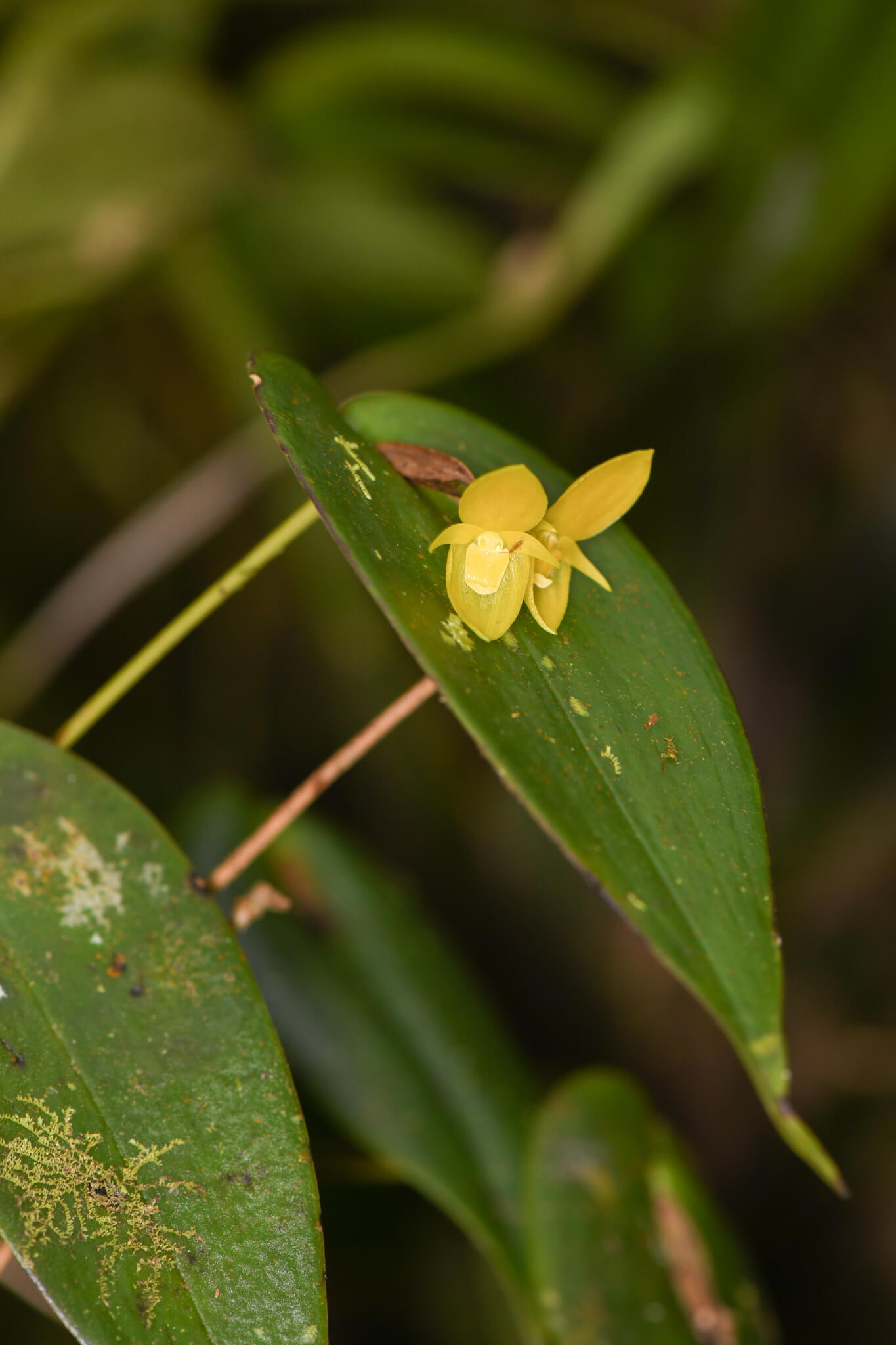
Photo by Trevor Van Loon·CC BY 4.0
Care
Light
Humidity
Temperature
Soil
Moisture
Appearance
Growth habit
Leaf shape
Leaf texture
Distribution
Propagation
References
- 1
IOSPE (orchidspecies.com) — Pleurothallis costaricensis Rolfe 1917 (distribution: Costa Rica Cartago province and Panama at 650–1800 m; common name: The Costa Rican Pleurothallis; mini-miniature hot to warm growing epiphyte; narrowly ligulate coriaceous leaf; simultaneous 6–12 flowered distichous raceme on compressed peduncle; synonyms: Pleurothallis ehrhartiiflora Schltr. 1923, Specklinia costaricensis (Rolfe) Pridgeon & M.W.Chase 2001)
https://www.orchidspecies.com/pleurcostaricensis.htm - 2
POWO (Kew) — Specklinia costaricensis (Rolfe) Pridgeon & M.W.Chase (accepted name per POWO; native range Costa Rica to W. Ecuador; distribution: Colombia, Costa Rica, Ecuador, Panamá; epiphyte, wet tropical biome; published Lindleyana 16: 257 (2001))
https://powo.science.kew.org/taxon/urn:lsid:ipni.org:names:1193873-2 - 3
Glass Box Tropicals — Pleurothallis (Specklinia) costaricensis (warm to hot growing; trailing habit; leaves 1–2" narrow; bright yellow flowers; blooms several times per year; easier-growing species; mount with NZ sphagnum; tolerates terrarium conditions)
https://glassboxtropicals.com/pleurothallis-specklinia-costaricensis/ - 4
Orchidee.de — Specklinia costaricensis (leaves ~5 cm, very narrow; up to 12 bright yellow flowers per inflorescence; flowers mm-sized; lava granulate or sphagnum substrate; pot kept consistently moist; not particularly light-hungry; night temps 10–15 °C, day up to 30 °C; habitat: continuously moist wet tropics)
https://orchidee.de/en/specklinia-costaricensis/ - 5
ColPlanta — Specklinia costaricensis (Rolfe) Pridgeon & M.W.Chase (Colombian Plants: distribution confirmed Colombia; epiphyte, wet tropical biome)
https://colplanta.org/taxon/urn:lsid:ipni.org:names:1193873-2 - 6
Seattle Orchid — Pleurothallis costaricensis product page (origin: Costa Rica, Panama; warm to hot growing; low light; moist conditions)
https://www.seattleorchid.com/Pleurothallis-costaricensis-p/tspleu-costaricensis.htm - 7
OrchidWeb — Pleurothallidinae Orchid Care (day temps 18–24 °C, night temps 5–16 °C; humidity ~70%; thin-leaved species: 1200 fc light; NZ sphagnum substrate; media kept evening-damp; water mornings)
https://www.orchidweb.com/orchid-care/pleurothallidinae-orchid-care - 8
Orchid Care Tips — Pleurothallis genus (humidity minimum 70%; most species prefer below 21 °C but warm-growing species tolerate more; 700–1500 fc; fine-grade bark or NZ sphagnum; hate to dry out)
https://www.orchid-care-tips.com/pleurothallis.html - 9
AOS — Pleurothallis genus (high humidity essential; low-medium light; grow in seedling-grade epiphyte mix or mounted; water regularly, roots must not dry out; cool to warm depending on species; USDA zones 10–12)
https://www.aos.org/orchids/orchids-a-to-z/letter-p/pleurothallis.aspx - 10
ASPCA Toxic and Non-Toxic Plants — Orchidaceae (Phalaenopsis and Jewel Orchid confirmed non-toxic to cats, dogs, and horses; orchids family-wide considered non-toxic)
https://www.aspca.org/pet-care/aspca-poison-control/toxic-and-non-toxic-plants/phalaenopsis-orchid