Platystele aurea Garay
Ruby Pleurothallis
A miniature epiphytic orchid from the cloud forests of Panama and Colombia, where it grows on moss-covered branches at elevations of 1,100–1,400 m. It belongs to the subtribe Pleurothallidinae (family Orchidaceae) and forms slow-spreading caespitose mats — clusters of tiny ramicauls, each carrying a single leathery elliptic leaf — that rarely exceed 8 cm in height. In autumn it sends up single-flowered spikes bearing tiny 3 mm blooms in warm yellow-orange tones with a contrasting red lip; a well-grown clump in flower is striking despite its size. It does best mounted on cork bark with a thin backing of sphagnum moss kept consistently moist, inside a warm, high-humidity closed enclosure. Widely sold in the terrarium hobby under the synonym Pleurothallis rubella.
Build a terrarium with this plant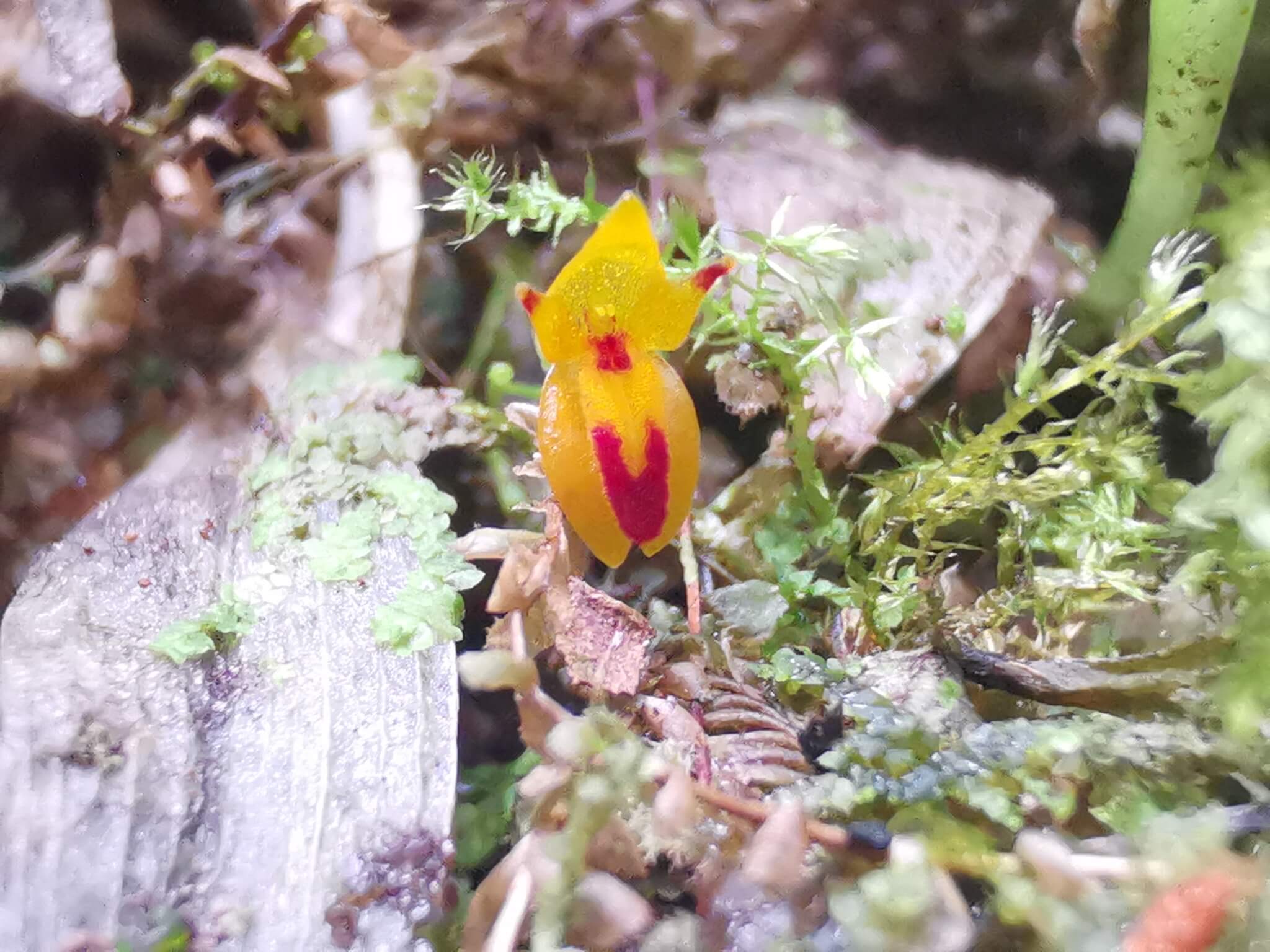
Care
Light
Humidity
Temperature
Soil
Moisture
Appearance
Growth habit
Leaf shape
Leaf texture
Distribution
Propagation
References
- 1
POWO (Kew) — Platystele aurea Garay (accepted name; synonym Pleurothallis rubella Luer; native distribution: Panama and Colombia; epiphyte, wet tropical biome; published Orquideologia 8: 182 (1973))
https://powo.science.kew.org/taxon/urn:lsid:ipni.org:names:201829-2 - 2
J&L Orchids — Pleurothallis rubella (trade listing; warm growing; single-flowered spike; yellow-orange flowers with red lip; cork mount with sphagnum; Bolivia listed as origin in trade description)
https://jlorchids.com/pleurothallis-rubella/ - 3
Orchids.org — Pleurothallis rubella (inflorescence ~5.6 cm; miniature warm-growing epiphyte; Pleurothallidinae)
https://www.orchids.org/grexes/pleurothallis-rubella - 4
AOS — Pleurothallis genus (high humidity essential; low-medium light; grow in seedling-grade epiphyte mix or mounted; water regularly, roots must not dry out; cool to warm depending on species)
https://www.aos.org/orchids/orchids-a-to-z/letter-p/pleurothallis.aspx - 5
Orchid Care Tips — Pleurothallis genus (humidity minimum 70%; warm-growing species 21–30 °C; 700–1500 fc; fine-grade bark or NZ sphagnum; hate to dry out)
https://www.orchid-care-tips.com/pleurothallis.html - 6
ASPCA Toxic and Non-Toxic Plants — Orchidaceae (Phalaenopsis and Jewel Orchid confirmed non-toxic to cats, dogs, and horses; orchids family-wide considered non-toxic)
https://www.aspca.org/pet-care/aspca-poison-control/toxic-and-non-toxic-plants/phalaenopsis-orchid