Monstera adansonii Schott
Swiss Cheese Vine, Adanson's Monstera, Five Holes Plant, Monkey Mask Plant
Native to the tropical forests of Central and South America, Monstera adansonii climbs trees as a hemi-epiphyte — rooting in the soil but sending stems upward in search of light, clinging to bark with aerial roots as it goes. Its heart-shaped leaves are perforated with distinctive oval holes called fenestrations, which develop even on relatively young plants; in low light or in a terrarium without a tall climbing surface, leaves tend to stay smaller with fewer holes. It grows vigorously and does well in the steady warmth and high humidity of a large enclosed setup, though it will need regular pruning to stay contained. Like all aroids, its tissues contain insoluble calcium oxalate crystals — confirmed toxic to cats and dogs by the ASPCA.
Build a terrarium with this plant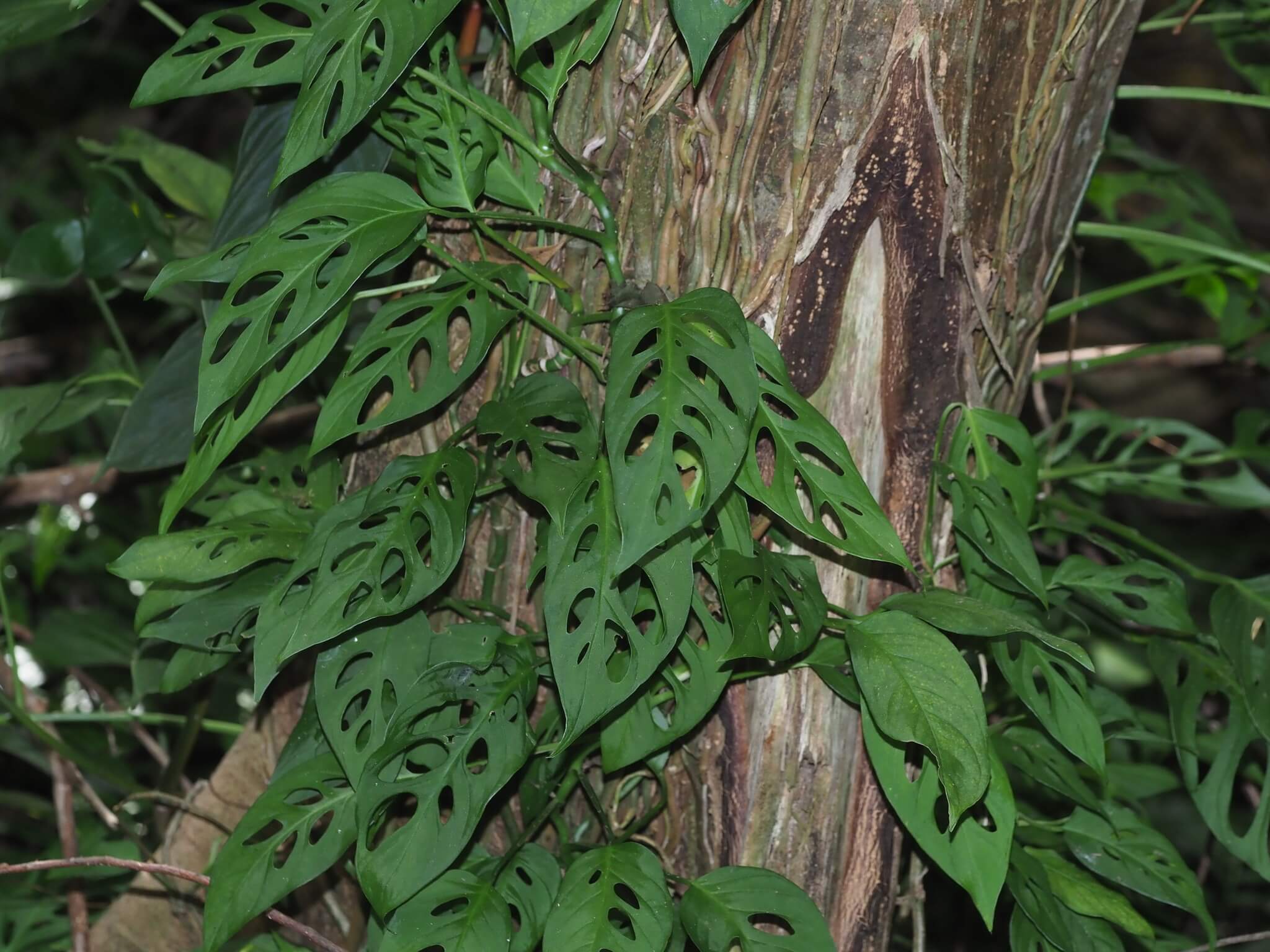
Photo by Kevin Faccenda·CC BY 4.0
Care
Light
Humidity
Temperature
Soil
Moisture
Soil pH
Appearance
Growth habit
Leaf shape
Leaf texture
Distribution
Propagation
References
- 1
POWO (Kew) — Monstera adansonii Schott (accepted name; first published in Wiener Z. Kunst 4: 1028 (1830); family Araceae; native range: Bolivia, Brazil North, Brazil Northeast, Brazil South, Brazil Southeast, Brazil West-Central, Colombia, Costa Rica, Ecuador, French Guiana, Guyana, Leeward Islands, Netherlands Antilles, Nicaragua, Panama, Peru, Suriname, Trinidad-Tobago, Venezuela, Windward Islands; climbing plant in wet tropical biome; four recognised subspecies: adansonii, blanchetii, klotzschiana, laniata; synonyms include Monstera pertusa (L.) de Vriese, Dracontium pertusum L., Calla dracontium G.Mey., Calla pertusa (L.) Kunth)
https://powo.science.kew.org/taxon/urn:lsid:ipni.org:names:87464-1 - 2
NC State Extension Gardener Plant Toolbox — Monstera adansonii (common names: Adanson's Monstera, Cheese Plant, Five Hole Plant, Swiss Cheese Plant, Swiss Cheese Vine; family Araceae; native origin: Southern Mexico to Tropical America including Belize, Bolivia, Brazil, Colombia, Costa Rica, Ecuador, Guyana, Honduras, Mexico, Nicaragua, Panama, Peru, Suriname, Trinidad-Tobago, Venezuela, Windward Islands; USDA zones 10a–12b; light: partial shade 2–6 hours direct; soil: loam/silt, acid to neutral pH, good drainage, moist; toxicity: low severity — calcium oxalate crystals; symptoms: mouth/throat inflammation, vomiting, drooling, loss of appetite; propagation: stem cutting; height 3–8 ft indoors, 10–13 ft outdoors; width 1–3 ft; medium to dark green glossy heart-shaped perforated leaves)
https://plants.ces.ncsu.edu/plants/monstera-adansonii/ - 3
PlantCareToday — Monstera adansonii care guide (light: bright indirect, avoid prolonged direct sun; humidity: high, use humidifier in winter; temperature: 18–24 °C ideal, minimum 10 °C; soil: peat-based with orchid bark, well-draining; pH 5.5–7.0; water when top inch dry, approx. weekly indoors; care level: easy; toxicity: toxic to cats and dogs — swallowing issues, vomiting, mouth irritation; propagation: stem cuttings 4–8 inches with two nodes in water, also air-layering; leaves: heart-shaped with oval fenestrations, glossy; vine length up to 13 ft trellised, mature leaves 20–30 inches)
https://plantcaretoday.com/monstera-adansonii.html - 4
ASPCA Toxic and Non-Toxic Plants — Swiss Cheese Plant / Monstera (toxic to dogs and cats; toxic principle: insoluble calcium oxalates; clinical signs: oral irritation, intense burning and irritation of mouth, tongue and lips, excessive drooling, vomiting, difficulty swallowing)
https://www.aspca.org/pet-care/aspca-poison-control/toxic-and-non-toxic-plants/swiss-cheese-plant - 5
Terrarium Tribe — Which Monstera Actually Work in a Terrarium? (Monstera adansonii suitable for tall tropical terrariums with vertical space; climbing behaviour requires cork bark or wood for support; fast growth — regular pruning needed; best in larger, looser setups; fenestrations develop with maturity; not ideal for small terrariums due to size)
https://terrariumtribe.com/terrarium-plants/monstera-adansonii-swiss-cheese-plant/ - 6
Wikipedia — Monstera adansonii (scientific name Monstera adansonii Schott; family Araceae; native to South and Central America and West Indies; hemi-epiphyte vine; heart-shaped leaves with somewhat thick waxy texture and large oval perforations; grows 3–5 ft as houseplant, up to 13 ft as vine; four subspecies recognised)
https://en.wikipedia.org/wiki/Monstera_adansonii