Masdevallia bicolor Poepp. & Endl.
Two-Coloured Masdevallia, Bicolor Kite Orchid
Masdevallia bicolor is a mini-miniature to miniature epiphytic orchid from the wet montane cloud forests of the northern and western Andes, growing low on tree trunks at elevations of 400–2,100 m across Venezuela, Colombia, Ecuador, Peru, and Bolivia. It belongs to the subtribe Pleurothallidinae (family Orchidaceae) and forms dense clumps of upright, single-leaved stems — the oblanceolate leaves reaching roughly 8–12 cm. In spring and summer, erect lateral inflorescences up to 10 cm long carry 2–4 flowers, each roughly 2 cm wide, with a striking two-tone pattern: the dorsal sepal is yellow to orange and the fused lateral sepals (synsepal) are deep purple, both drawn into long, thread-like tails characteristic of the genus. It does best grown in a sphagnum or fine bark mix inside a cool, humid closed or semi-open terrarium; temperatures above 25 °C will cause rapid decline.
Build a terrarium with this plant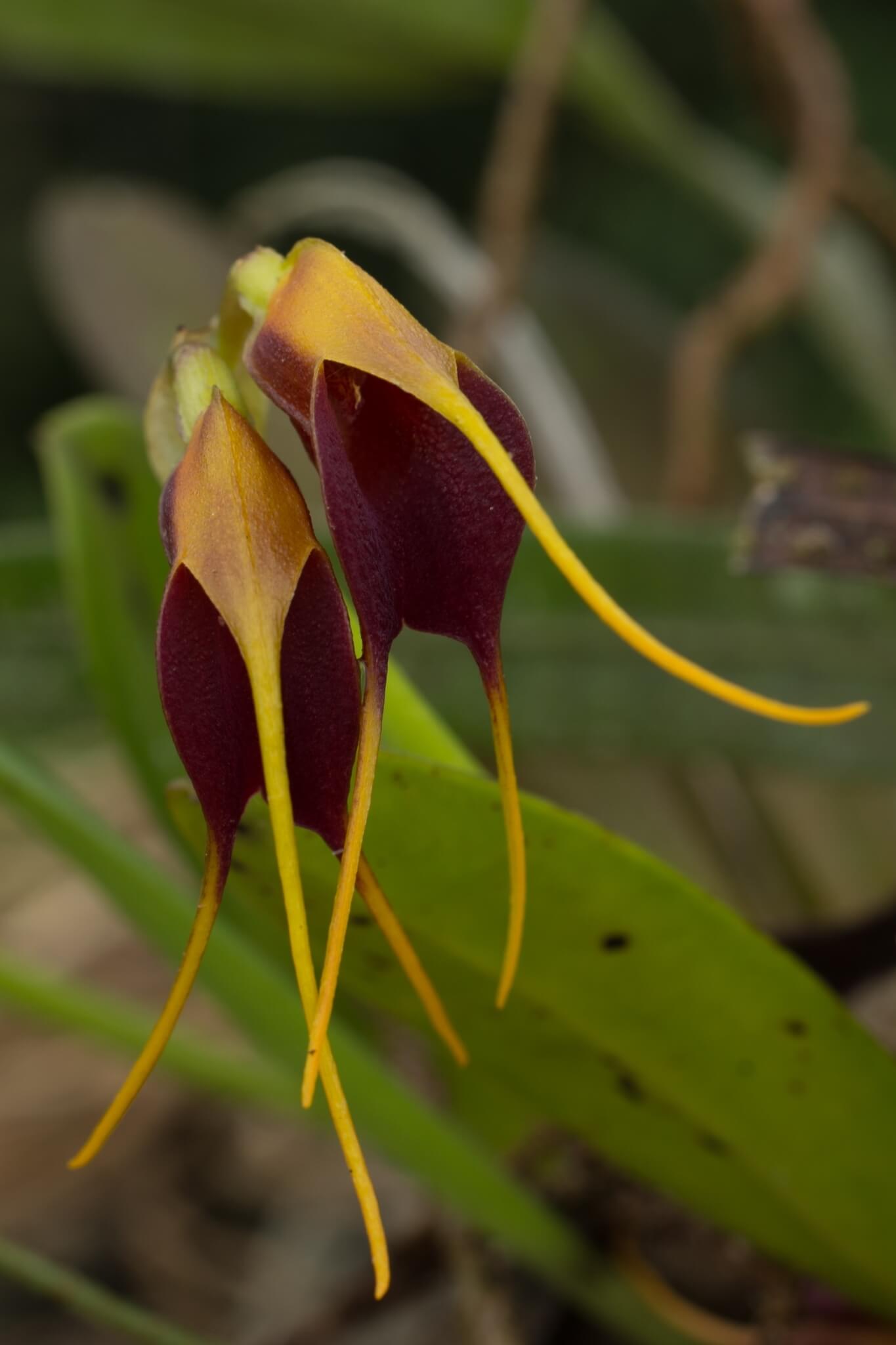
Photo by Josh Allen·CC BY-NC 4.0
Care
Light
Humidity
Temperature
Soil
Moisture
Soil pH
Appearance
Growth habit
Leaf shape
Leaf texture
Distribution
Propagation
References
- 1
POWO (Kew) — Masdevallia bicolor Poepp. & Endl.: accepted name, first published Nov. Gen. Sp. Pl. 2: 6 (1836), native distribution Bolivia/Colombia/Ecuador/Peru/Venezuela, family Orchidaceae, 9 synonyms including Alaticaulia bicolor and Masdevallia auropurpurea
https://powo.science.kew.org/taxon/urn:lsid:ipni.org:names:642685-1 - 2
IOSPE (orchidspecies.com) — Masdevallia bicolor: mini-miniature to miniature caespitose epiphyte; oblanceolate leaf with channeled petiole and bilobed apex; inflorescence 10 cm, 2–4 flowers; flower 2 cm wide, dorsal sepal yellow/orange, synsepal dark purple, long-caudate sepals; elevation 400–2100 m; wet montane forest, low on tree trunks; Venezuela/Colombia/Ecuador/Peru/Bolivia; spring–summer bloom
https://www.orchidspecies.com/masbicolor.htm - 3
Travaldo's blog — Masdevallia bicolor care: light 17,000–22,000 lux (70–90% summer shade, 25% winter shade); temperature winter min 10°C max 13°C, summer optimum 13–20°C, absolute max 25°C; humidity 75–80% summer; substrate 5 parts bark + 5 parts perlite + 1 part fibrous peat, or chopped sphagnum with polystyrene chips; moist but not waterlogged; balanced fertiliser at 1/4 strength every 3–4 waterings; division in autumn or spring
https://travaldo.blogspot.com/2022/02/masdevallia-bicolor-two-colored-masdevallia-care.html - 4
American Orchid Society — Masdevallia Culture Sheet: light 1,000–2,000 fc (10,750–21,500 lux); temperature ideal 12.7–22.2°C; humidity 60–90%; substrate tree fern/sphagnum/fine bark in plastic pots or cork-mounted with sphagnum; perpetually moist; 1/4–1/2 strength balanced fertiliser during active growth
https://www.aos.org/orchid-care/care-sheets/masdevallia-culture-sheet - 5
Masdevallia orchid care and culture — Travaldo's blog: genus-wide care; cool growers 10°C night / 20°C day max; intermediate 13°C night / 23°C day max; warm 16°C night / 26°C day max; humidity 50–65% baseline, 75–80% summer preferred; light 17,000–22,000 lux; bark-perlite-peat substrate; division propagation
https://travaldo.blogspot.com/2019/04/masdevallia-orchid-care-and-culture.html - 6
NC State Extension — Masdevallia (Kite Orchid, Tailed Orchid): non-toxic to cats, dogs, horses; partial shade; sphagnum/orchid compost substrate; high humidity; cool temperatures; division propagation
https://plants.ces.ncsu.edu/plants/masdevallia/ - 7
ASPCA — Phalaenopsis Orchid (Orchidaceae representative entry: non-toxic to cats, dogs, and horses; orchids family-wide considered non-toxic)
https://www.aspca.org/pet-care/aspca-poison-control/toxic-and-non-toxic-plants/phalaenopsis-orchid - 8
bantam.earth — Masdevallia spp. care guide: substrate pH 5.5–6.5; epiphytic medium (fir bark or LECA); high humidity; bright indirect light; excellent terrarium suitability
https://bantam.earth/masdevallia-orchids-masdevallia-spp/