Macodes sanderiana (Kraenzl.) Rolfe
Sander's Jewel Orchid, Jewel Orchid
A terrestrial orchid from the rainforests of New Guinea, the Lesser Sunda Islands, and Vanuatu, where it creeps along the forest floor and over rocks in deep shade at elevations between 350 and 850 metres. It produces what are arguably the largest leaves in the jewel orchid group — dark, velvety ovals often exceeding 16 cm, covered in a luminous lattice of gold-copper veins that appear to shift colour as the viewing angle changes. Its leaf margins are distinctly scalloped, and a pale streak runs the length of the midrib — features that set it apart from the more commonly grown Macodes petola. In a closed terrarium with steady warmth, high humidity, and low indirect light, it is considered one of the more forgiving jewel orchids to keep, forming a slow but rewarding spreading mat of iridescent foliage.
Build a terrarium with this plant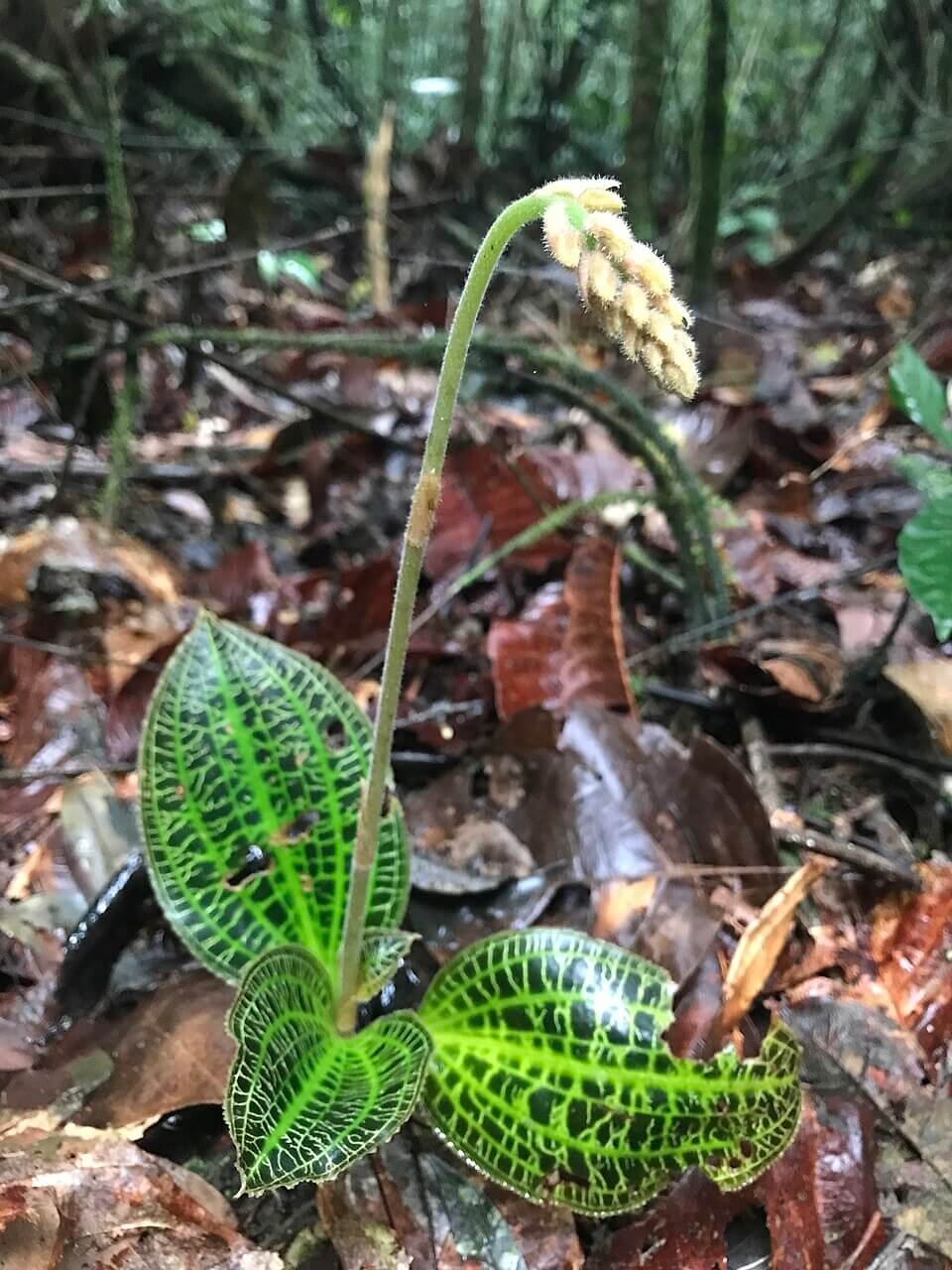
Photo by anguspritchard·CC BY 4.0
Care
Light
Humidity
Temperature
Soil
Moisture
Soil pH
Appearance
Growth habit
Leaf shape
Leaf texture
Distribution
Propagation
References
- 1
POWO (Kew) — Macodes sanderiana (Kraenzl.) Rolfe (accepted name; IPNI LSID: urn:lsid:ipni.org:names:642007-1; family Orchidaceae; published Bulletin of Miscellaneous Information, Kew 1896(110): 47; synonym: Anoectochilus sanderianus Kraenzl.; native distribution: New Guinea to Vanuatu — Sumatra, Lesser Sunda Islands, Papua New Guinea, Solomon Islands, Vanuatu; terrestrial in wet tropical biome, 350–850 m)
https://powo.science.kew.org/taxon/urn:lsid:ipni.org:names:642007-1 - 2
Wikipedia — Macodes sanderiana (largest leaves in the genus, >16 cm; crenated leaf margins; wide pale-green midrib streak; veins shift from golden to orange shades with age; erect reddish inflorescence 25–30 cm; 10–20 flowers; blooms July in natural habitat; pale green underside with pinkish patches; chatoyant vein iridescence; native New Guinea, Lesser Sundas, Solomons, Vanuatu; grows on leaf-litter over rocks)
https://en.wikipedia.org/wiki/Macodes_sanderiana - 3
Orchid Species (orchidspecies.com) — Macodes sanderiana [Kraenzl.] Rolfe 1896 (miniature to small terrestrial; altitude 350–850 m; leaves 10–16 cm × 6–8 cm, dark green with gold-copper venation; hot to warm growing; blooms fall–winter; distribution: Sumatra, Lesser Sunda Islands, Papuasia, Solomons, Vanuatu)
https://www.orchidspecies.com/macsanderiana.htm - 4
Glass Box Tropicals — Macodes sanderiana (care overview: low light 500–800 lux; humidity 75–90%; temperature 22–28 °C; sphagnum or bark mix; moderate care; terrarium recommended; sold as terrarium plant; avoid water on leaves; airflow important to prevent rot)
https://glassboxtropicals.com/macodes-sanderiana/ - 5
Raingreen Tropicals — Culture of Macodes: Diamonds of the Jewel Orchids (humus substrate; pH 5.5–6.5; temperature 18–29 °C; easiest Macodes to grow; consistent moisture; avoid standing water; airflow critical; closed terrarium or cloche recommended)
https://raingreentropicals.com/culture-macodes.htm - 6
Black Jungle Terrarium Supply — Macodes sanderiana (sold as terrarium/vivarium plant; high humidity essential; closed terrarium recommended; moist airy substrate; iridescent foliage; non-toxic; suitable for dart frog vivariums)
https://www.blackjungleterrariumsupply.com/Macodes-sanderiana-Jewel-Orchid_p_2622.html - 7
ASPCA — Non-Toxic Plants: Jewel Orchid (Haemaria discolor; non-toxic to dogs, cats, and horses; family Orchidaceae — covers the jewel orchid group)
https://www.aspca.org/pet-care/aspca-poison-control/toxic-and-non-toxic-plants/jewel-orchid - 8
Terrarium Tribe — Macodes petola: How to Grow the Lightning Jewel Orchid (genus-level care reference: high humidity; low light; closed terrarium ideal; moist airy substrate; stem cutting and rhizome division propagation; airflow prevents rot; water at substrate level only)
https://terrariumtribe.com/terrarium-plants/macodes-petola-lightning-jewel-orchid/ - 9
Smart Garden Guide — Macodes petola Care (genus-level reference: temperature 18–29 °C; humidity 60–90%; light: 500–800 lux; pH 5.5–6.5; substrate: sphagnum/bark/perlite mix; stem cutting propagation: 4–8 weeks to root; rhizome division preferred)
https://smartgardenguide.com/macodes-petola-care-jewel-orchid-guide/ - 10
Orchid Bliss — Jewel Orchid Care: The Complete Guide (humidity 50–70%; temperature 16–25 °C; minimum ~10 °C; pH 5.5–6.5; low light; consistent moisture; stem cutting propagation for genus)
https://orchidbliss.com/jewel-orchid-care-the-complete-guide/