Lepanthes telipogoniflora Schuit. & A.de Wilde
The Telipogon-Like Lepanthes
Lepanthes telipogoniflora is a mini-miniature epiphytic orchid endemic to the Risaralda department of Colombia, where it grows at around 500 m elevation in warm, humid cloud forest — clinging to mossy bark with leaves barely 1 cm long. What makes it remarkable is the flower: a broad, almost disk-shaped bloom up to 2 cm across with an iridescent orange and yellow surface that appears to shimmer under light, making it disproportionately large and vivid against the plant's modest foliage. It blooms repeatedly from the same point on the stem over many months, making it one of the more continuously flowering miniature orchids available. In cultivation it does best mounted or in sphagnum-perlite mix at warm-intermediate temperatures (19–26 °C) with high humidity and no direct sun — conditions a closed terrarium or orchidarium replicates naturally.
Build a terrarium with this plant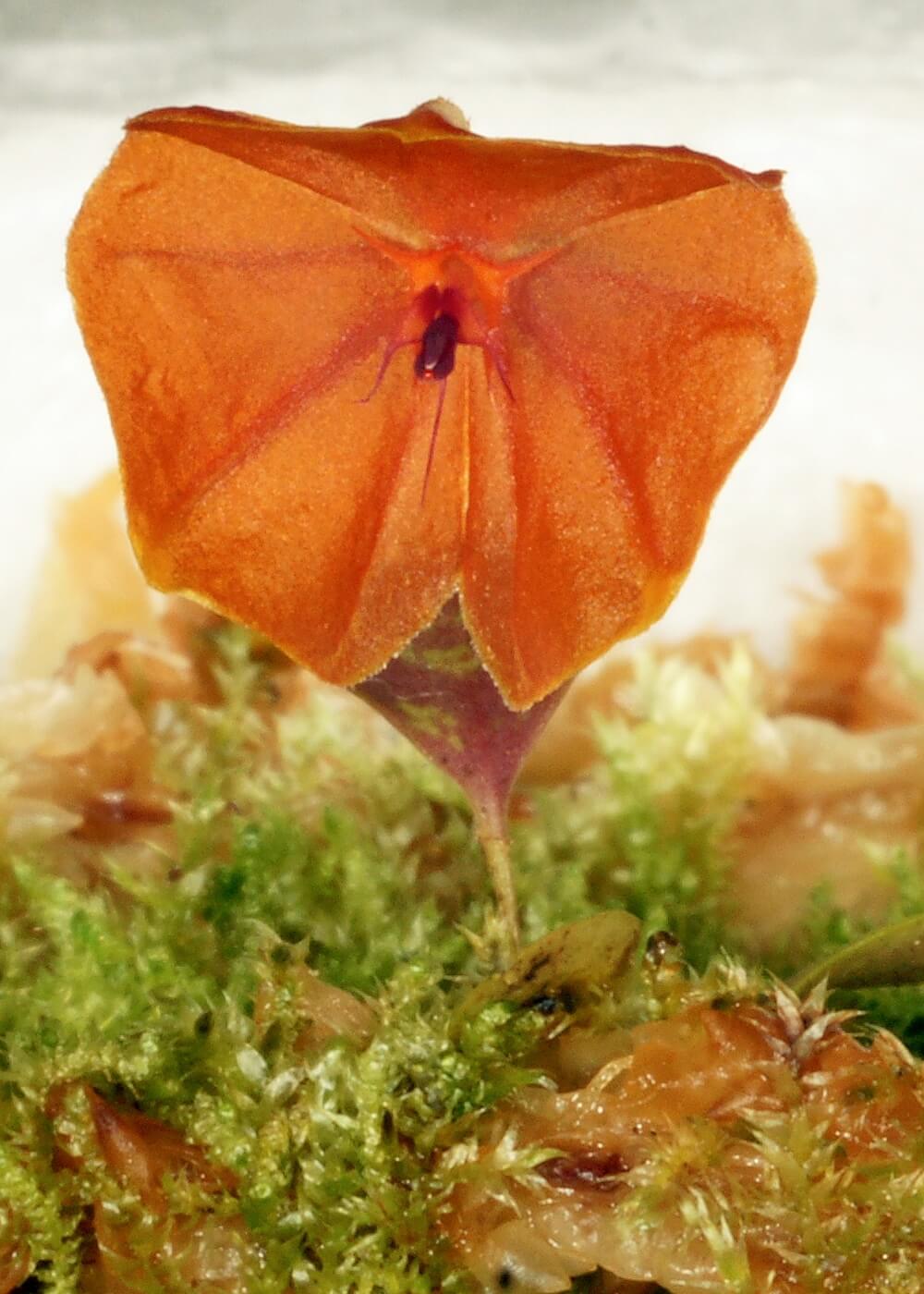
Photo by Orchi·CC BY-SA 3.0
Care
Light
Humidity
Temperature
Soil
Moisture
Appearance
Growth habit
Leaf shape
Leaf texture
Distribution
Propagation
References
- 1
POWO (Kew) — Lepanthes telipogoniflora Schuit. & A.de Wilde (accepted name, first published Orquideologia 20: 28 (1996); family Orchidaceae; native range Colombia (Risaralda); epiphyte; wet tropical biome)
https://powo.science.kew.org/taxon/urn:lsid:ipni.org:names:303699-2 - 2
IOSPE (orchidspecies.com) — Lepanthes telipogoniflora Schuit. & A. de Wilde 1996 (common name: The Telipogon-Like Lepanthes; distribution: Risaralda, Colombia at ~500 m; mini-miniature epiphyte; slender erect stems with single apical leaf; flower ~1.25 cm, oversized disc-shaped; hot to warm growing; bloom season spring)
https://orchidspecies.com/leptelipogoniflora.htm - 3
Travaldo's Blog — Lepanthes telipogoniflora care and culture (temperature: day 24–26 °C, night 19–20 °C; intermediate-hot; humidity 80–85% on raft, 65–70% in pot; light 16,000–22,000 lux, no direct sun; sphagnum + perlite 1:1 or raft-mounted; never let dry completely; quarter-strength fertiliser every 3 waterings; blooms any season)
https://travaldo.blogspot.com/2018/05/lepanthes-telipogoniflora-care-and-culture.html - 4
Glass Box Tropicals — Lepanthes telipogoniflora (care rating 7/10; warm to hot growing; very high humidity; prefers little to no air movement; epiphytic; iridescent orange and yellow flowers ~1.25 cm, shimmer under LED/fluorescent light; mundane green leaves contrast with vivid blooms; suitable for high-humidity terrariums)
https://glassboxtropicals.com/lepanthes-telipogoniflora/ - 5
Pumpkin Beth — Lepanthes telipogoniflora (mini-miniature orchid; endemic to Colombia; closed terrarium highly suitable; indirect low light; very high humidity; frequent misting essential; must never dry out; flowers 2 cm across, umbrella-like, orange to clear orange; leaves max ~1 cm)
https://www.pumpkinbeth.com/plants/lepanthes-telipogoniflora/ - 6
ASPCA Toxic and Non-Toxic Plants — Phalaenopsis Orchid (Orchidaceae family confirmed non-toxic to cats, dogs, and horses; Lepanthes not individually listed; orchids broadly non-toxic within the family)
https://www.aspca.org/pet-care/aspca-poison-control/toxic-and-non-toxic-plants/phalaenopsis-orchid