Goodyera schlechtendaliana Rchb.f.
Schlechtendal's Jewel Orchid, Deep Mountain Quail Orchid, Miyama-uzura
A small terrestrial orchid native to the cool forests of Japan, China, and the Himalayas, where it creeps through shaded leaf litter and mossy rocks at elevations up to 3,000 metres. Its velvety dark green leaves are marked with a pale cream to white net of veins — not the iridescent metallic sheen of tropical jewel orchids, but a quieter, more intricate patterning that resembles quail feather markings. Unlike its tropical relatives, this species is surprisingly cold-hardy, tolerating temperatures well below freezing in its natural mountain habitat, which makes it one of the few jewel orchids suited to cool or unheated terrariums. In late summer it produces slender, fragrant flower spikes of small white flowers, all facing one direction along the stem.
Build a terrarium with this plant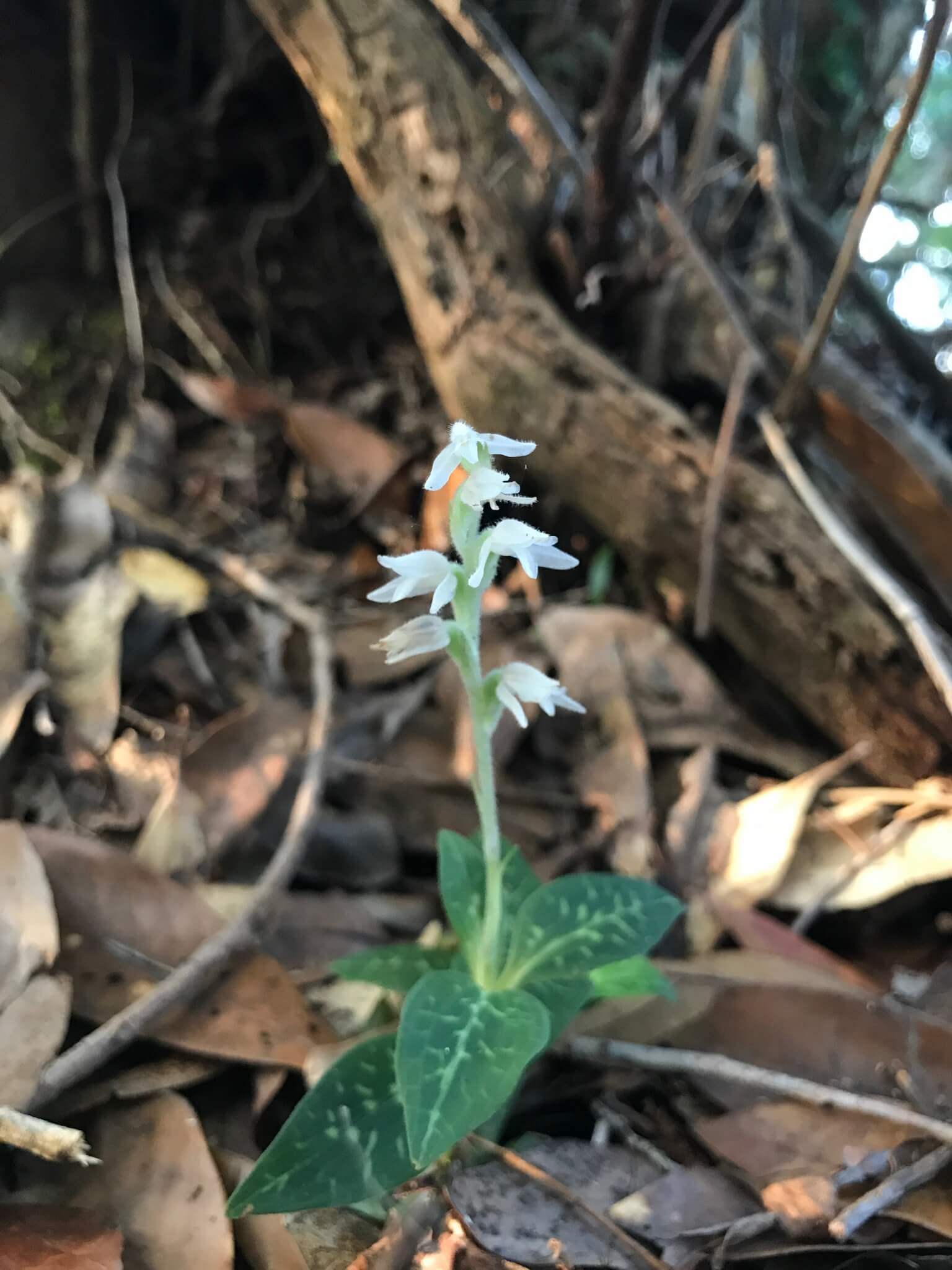
Care
Light
Humidity
Temperature
Soil
Moisture
Soil pH
Appearance
Growth habit
Leaf shape
Leaf texture
Distribution
Propagation
References
- 1
POWO (Kew) — Goodyera schlechtendaliana Rchb.f. (accepted name; IPNI LSID: urn:lsid:ipni.org:names:636203-1; published Linnaea 22: 861, 1850; family Orchidaceae; synonyms include Goodyera japonica, G. kwangtungensis, G. labiata, G. melinostele, G. secundiflora; native: Assam, Bangladesh, China, East Himalaya, Hainan, Japan, Korea, Kuril Islands, Myanmar, Nansei-shoto, Nepal, Sumatra, Taiwan, Thailand, Tibet, Vietnam; rhizomatous geophyte / lithophyte; subtropical biome)
https://powo.science.kew.org/taxon/urn:lsid:ipni.org:names:636203-1 - 2
Orchid Species (orchidspecies.com) — Goodyera schlechtendaliana (miniature terrestrial; altitude 1,000–3,000 m; leaves ovate-acute, shiny dark green with cream/white net-veining; up to 8 leaves per plant; inflorescence 12–19 cm, flowers all facing one direction; white flowers; cool to warm growing; grows in damp crevasses with rich humus; native to Japan, Korea, China, Himalayas, SE Asia, Sumatra)
https://www.orchidspecies.com/goodschlechtendahl.htm - 3
Raingreen Tropicals — Culture of Goodyera (genus temperature: −1 to 30 °C, G. schlechtendaliana tolerates below −7 °C in natural Japanese habitats; humidity above 60%; low light; humus-rich substrate; keep moist but not waterlogged; light air movement important; NOT iridescent unlike some Goodyera species; common Japanese name Miyama-uzura; used in traditional Asian medicine)
https://raingreentropicals.com/culture-goodyera.htm - 4
Andy's Orchids — Goodyera schlechtendaliana (shade 500–1,500 footcandles; temperature: 4 °C min / 35 °C max, favouring cool; tagged EasyGrower, Fragrant, Vivarium, Free Flowering; watering 2–3×/week allowing slight drying; substrate: sand, fir bark, perlite, soil)
https://andysorchids.com/pictureframe.asp?picid=8053 - 5
Black Jungle Terrarium Supply — Goodyera schlechtendaliana (sold as terrarium/vivarium plant; described as focal point for the tropical vivarium; high humidity; low light; creeping ground cover habit; dark green leaves with white net-veining; cool temperature preference noted)
https://www.blackjungleterrariumsupply.com/Goodyera-schlechtendaliana-JEWEL-ORCHID_p_2958.html - 6
ASPCA — Non-Toxic Plants: Jewel Orchid (Haemaria discolor; non-toxic to dogs, cats, and horses; family Orchidaceae; covers the jewel orchid group including Goodyera)
https://www.aspca.org/pet-care/aspca-poison-control/toxic-and-non-toxic-plants/jewel-orchid - 7
Greg.app — Goodyera schlechtendaliana overview (pH 6.0–7.0; consistently moist substrate; low maintenance once established; non-toxic to humans, dogs, cats)
https://greg.app/goodyera-schlechtendaliana-overview/ - 8
Orchid Bliss — Jewel Orchid Care: The Complete Guide (genus-level reference: humidity 50–70%; pH 5.5–6.5; low light; consistent moisture; stem cutting and division propagation for jewel orchids)
https://orchidbliss.com/jewel-orchid-care-the-complete-guide/