Cystorchis variegata Blume
Variegated Leaf Jewel Orchid, Variegated Leaf Cystorchis
A small terrestrial orchid from the rainforests of Southeast Asia, Cystorchis variegata creeps along the forest floor with a low, rooting stem before sending up a short ascending shoot bearing a rosette of oval, velvety leaves. The foliage is deep green with a network of paler veins — the iridescent quality typical of jewel orchids, caused by a specialised structure in the leaf cells that scatters light. In the wild it grows at elevations of 200–1,500 m in shaded, humid forest understory, which explains why it thrives in the steady warmth and high humidity of a closed terrarium. Flowers are small and held on an erect spike — creamy white petals with yellowish-pink sepals and a white-and-orange labellum — but the foliage is the main attraction.
Build a terrarium with this plant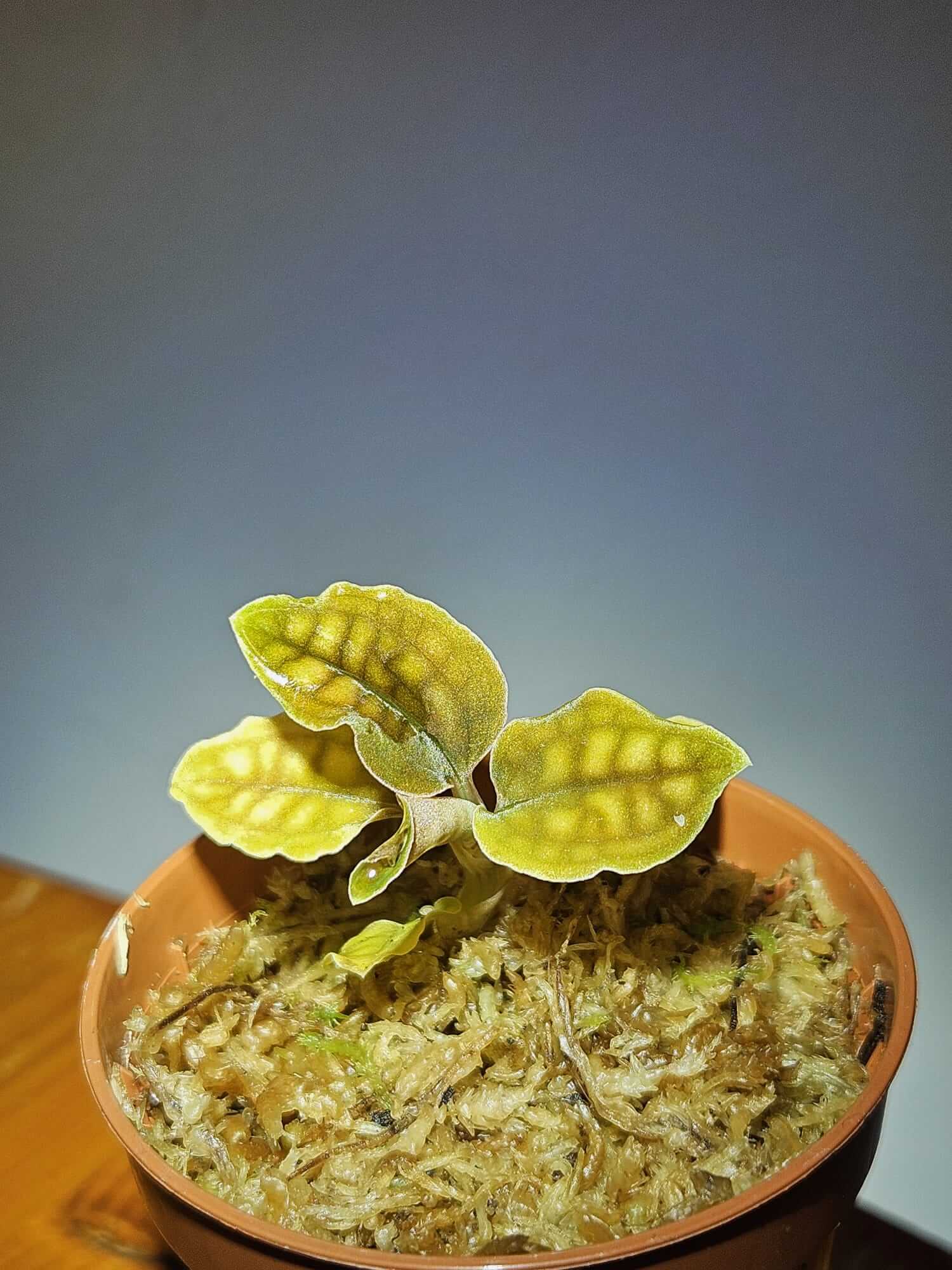
Photo by Jacek Dabkiewicz·CC BY-SA 4.0
Care
Light
Humidity
Temperature
Soil
Moisture
Soil pH
Appearance
Growth habit
Leaf shape
Leaf texture
Distribution
Propagation
References
- 1
POWO (Kew) — Cystorchis variegata Blume (accepted name; family Orchidaceae; synonym: Hetaeria variegata (Blume) Miq.; native distribution: Borneo, Java, Malaya, Sumatra, Vanuatu; rhizomatous geophyte in wet tropical biome)
https://powo.science.kew.org/taxon/urn:lsid:ipni.org:names:626491-1 - 2
Wikipedia — Cystorchis variegata (height 15–25 cm; 5–6 elliptic leaves up to 7 × 2.8 cm with wavy edges; dark green with lighter green patches between veins; inflorescence 7–12 flowers ~6 mm long; sepals yellowish at base, pinkish/reddish-brown in middle, cream at tip; petals white lance-shaped; labellum white and orange; damp shady forests at 600–1,100 m in Java; CITES Appendix II)
https://en.wikipedia.org/wiki/Cystorchis_variegata - 3
Orchid Species (IOSPE) — Cystorchis variegata Blume 1859 var variegata (common name: The Variegated Leaf Cystorchis; found in Borneo, Malaysia, Sumatra, Java, Philippines and Vanuatu at 200–1,500 m; decumbent rooting stem ascending 1–2 inches; 5–6 obliquely ovate leaves with acute tips and undulate margins; green with paler veins in var. variegata; inflorescence erect with 10–12 flowers; hot to cool growing; synonyms: Aetheria javanica (Bl.) Lindl. 1840; Hetaeria variegata (Blume) Miq. 1859)
https://www.orchidspecies.com/cystovariegata.htm - 4
Dart Frog Connection — Cystorchis variegata care (light: moderate; temperature: 20–28 °C / 70–80 °F; substrate: sphagnum moss or well-draining potting soil; keep soil slightly moist but never soggy; size: 4–7 inches / 10–18 cm tall; suitable for vivariums; terrestrial forest floor orchid from Southeast Asia)
https://dartfrogconnection.com/cyschortis-variegata.html - 5
Black Jungle Terrarium Supply — Cystorchis variegata (warm temperatures and humid atmosphere without frequent misting; good drainage and aeration around roots; consistent moisture; ideal candidates for closed terrariums; may not acclimate outside terrarium without time and care; propagated by tissue culture)
https://www.blackjungleterrariumsupply.com/Cystorchis-variegata-Jewel-Orchid_p_2630.html - 6
NE Herpetoculture — Live Jewel Orchids for Terrariums & Vivariums (low-light plants; optimal temperature 65–75 °F / 18–24 °C; can die quickly above 78 °F / 26 °C; quick-draining orchid substrate or loose sphagnum; humidity-holding enclosure required; forest humus species)
https://www.neherpetoculture.com/jewelorchids - 7
Clan Orchids — Jewel Orchid Culture (light: low to medium; temperature: 24–30 °C day, 13–16 °C night, tolerates 10–38 °C briefly; substrate: sphagnum moss with perlite or African Violet mix; keep evenly moist; propagation by stem cuttings — allow to harden off a day or two then pot in terrestrial medium; dip in rooting hormone for higher success; relatively difficult to grow)
https://www.clanorchids.com/culture/jewel.html - 8
Orchid Bliss — Jewel Orchid Care: The Complete Guide (humidity 50–70%; temperature 16–25 °C / 61–78 °F; minimum threshold ~10 °C; avoid direct sun; stem cutting propagation — signs of growth in a few months)
https://orchidbliss.com/jewel-orchid-care-the-complete-guide/ - 9
ASPCA — Non-Toxic Plants: Jewel Orchid (Haemaria discolor; non-toxic to dogs, cats, and horses; no toxic principles listed; family Orchidaceae)
https://www.aspca.org/pet-care/aspca-poison-control/toxic-and-non-toxic-plants/jewel-orchid