Anoectochilus geniculatus Ridl.
Bent-lip Jewel Orchid, Jewel Orchid
A small terrestrial orchid from the humid forests of Myanmar, Thailand, and the Malay Archipelago, where it creeps along the shaded forest floor at elevations between 600 and 1,100 metres. It is grown primarily for its foliage: dark greenish-brown, velvety oval leaves laced with a luminous network of gold and copper-red veins — the signature iridescent quality that gives jewel orchids their name. The species name geniculatus refers to the distinctively angled, knee-like base of the flower lip, which sets it apart from close relatives such as A. formosanus. In a closed terrarium, with stable warmth, high humidity, and low indirect light, it creeps readily across the substrate and gradually forms a low, bejewelled mat.
Build a terrarium with this plant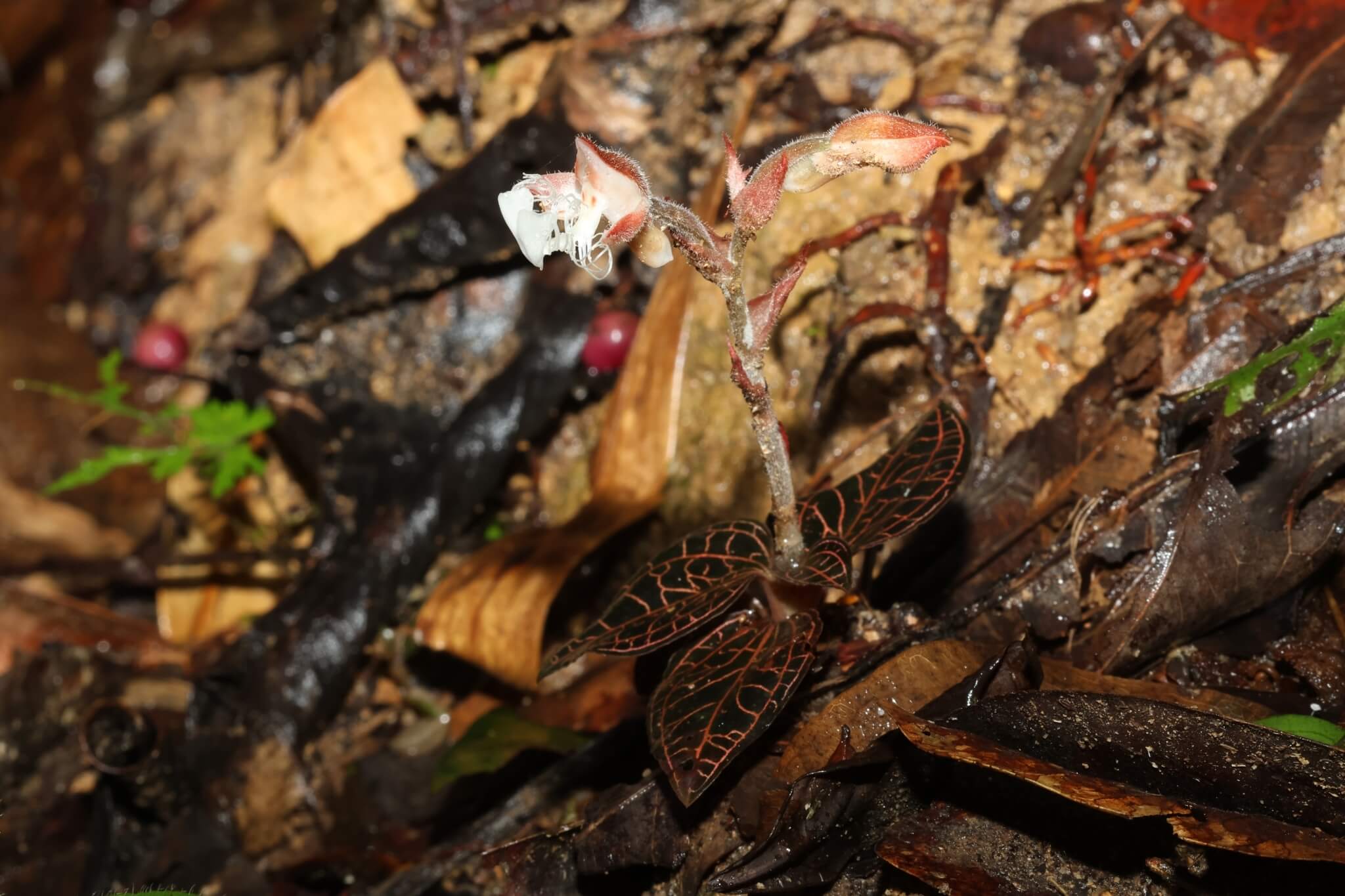
Photo by BioM_Akekachoke.B·CC BY-NC 4.0
Care
Light
Humidity
Temperature
Soil
Moisture
Soil pH
Appearance
Growth habit
Leaf shape
Leaf texture
Distribution
Propagation
References
- 1
POWO (Kew) — Anoectochilus geniculatus Ridl. (accepted name; IPNI LSID: urn:lsid:ipni.org:names:616576-1; family Orchidaceae; native distribution: Myanmar to W. Malesia — Myanmar, Thailand, Peninsular Malaysia, Sumatra, Borneo; rhizomatous geophyte; wet tropical biome)
https://powo.science.kew.org/taxon/urn:lsid:ipni.org:names:616576-1 - 2
Orchid Species (orchidspecies.com) — Anoectochilus geniculatus Ridl. (miniature to small terrestrial; obliquely and broadly ovate to elliptic leaves; dark green-brown with gold to copper-reddish reticulated veins; 4 leaves on a short stem; inflorescence 14 cm, 1–5 flowers; white flowers with fringed lip; blooms fall/winter; altitude 600–1,100 m; Myanmar, Thailand, Peninsular Malaysia, Sumatra, Borneo)
https://www.orchidspecies.com/anoetgeniculatus.htm - 3
Raingreen Tropicals — Culture of Anoectochilus: Deep Forest Jewel Orchids (light ~500 fc; temperature tolerates 2–36 °C, best ~22 °C; humidity above 50% minimum; pH 5.5–6.0 fragmentary; well-drained humus substrate; water approx. weekly March–September, fortnightly October–February; high humidity with relatively dry roots; creeps and branches; suited to closed terrariums)
https://raingreentropicals.com/culture-anoectochilus.htm - 4
Black Jungle Terrarium Supply — Anoectochilus geniculatus (listed as terrarium plant; velvety dark brownish-green leaves with gold veining; creeping growth; sold for closed terrarium / vivarium use; requires enclosed humid environment)
https://www.blackjungleterrariumsupply.com/Anoectochilus-geniculatus-Jewel-Orchid_p_2626.html - 5
Botanico Hub — Anoectochilus geniculatus (preferred temperature 18–27 °C; low light; high humidity; moist well-drained substrate; moderate care difficulty; creeping terrestrial orchid; gold venation on dark leaves)
https://www.botanicohub.com/plant-species/anoectochilus-geniculatus - 6
Andy's Orchids — Anoectochilus geniculatus (temperature: min 58 °F / 14 °C, max 88 °F / 31 °C; light: 500–1,500 fc; humidity: 70–80%; velvety leaves with gold-copper reticulate venation; miniature; terrarium suitable)
https://andysorchids.com/pictureframe.asp?picid=7300 - 7
ASPCA — Non-Toxic Plants: Jewel Orchid (Haemaria discolor; non-toxic to dogs, cats, and horses; family Orchidaceae — covers the jewel orchid group broadly including Anoectochilus)
https://www.aspca.org/pet-care/aspca-poison-control/toxic-and-non-toxic-plants/jewel-orchid - 8
Terrarium Tribe — Jewel Orchid Care Guide (high humidity; low light; closed terrarium ideal; moist but well-aerated substrate; creeping growth suits terrarium floor)
https://terrariumtribe.com/jewel-orchid-guide/ - 9
GBIF — Anoectochilus geniculatus Ridl. (species distribution data; occurrence records across Myanmar, Thailand, Peninsular Malaysia, Sumatra, Borneo)
https://www.gbif.org/species/5308508