Aerangis luteoalba var. rhodosticta (Kraenzl.) J.Stewart
The Beige Aerangis with Red Spots, Red Column Aerangis
Aerangis luteoalba var. rhodosticta is a miniature epiphytic orchid from the montane riverine forests of equatorial Africa — found across Cameroon, the Central African Republic, the Democratic Republic of Congo, Ethiopia, Kenya, Tanzania, and Uganda at elevations between 1,250 and 2,200 m, where it clings to the twigs and small branches of trees overhanging streams. Its compact fan of leathery leaves rarely exceeds 15 cm in spread, yet in winter and spring it produces arching to pendant racemes up to 40 cm long carrying rows of crystalline-white, star-shaped flowers roughly 2.5 cm across, each centred on a striking bright red-orange column — the feature that gives the variety its name, from the Greek rhodosticta, meaning red-spotted. The fragrant blooms are arranged in two flat, evenly spaced rows along the inflorescence, giving the plant a distinctly architectural look when in flower. In cultivation it does best mounted on cork or in a loose bark mix at intermediate temperatures (13–27 °C) with humidity around 70–75% and filtered light, making it well suited to a ventilated closed terrarium or orchidarium.
Build a terrarium with this plant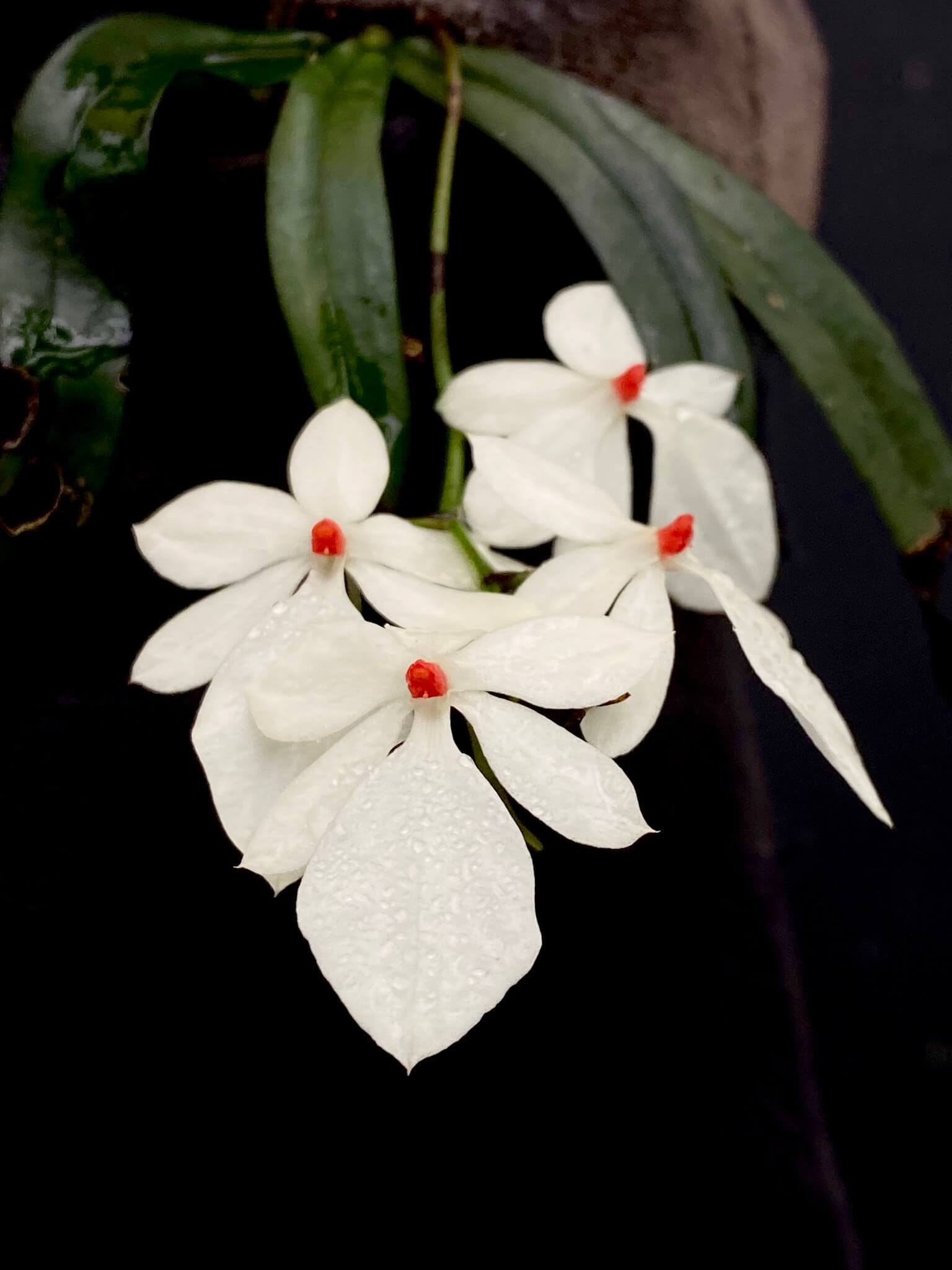
Photo by Guido van Asten·CC BY-NC 4.0
Care
Light
Humidity
Temperature
Soil
Moisture
Appearance
Growth habit
Leaf shape
Leaf texture
Distribution
Propagation
References
- 1
POWO (Kew) — Aerangis luteoalba var. rhodosticta (Kraenzl.) J.Stewart (accepted name, first published Kew Bull. 34: 310 (1979); family Orchidaceae; native range West-Central and East Tropical Africa to South Ethiopia; epiphytic subshrub; seasonally dry tropical biome; synonyms: Aerangis rhodosticta, Angraecum rhodostictum; distribution: Cabinda, Cameroon, Central African Republic, Democratic Republic of Congo, Ethiopia, Kenya, Tanzania, Uganda)
https://powo.science.kew.org/taxon/urn:lsid:ipni.org:names:887234-1 - 2
IOSPE (orchidspecies.com) — Aerangis luteoalba (Kraenzl.) Schltr. 1918 (common name: The Beige Aerangis with Red Spots; distribution: Central African Republic, Cameroon, Congo, Zaire, Ethiopia, Kenya, Tanzania, Uganda in riverine forests at 1,250–2,200 m; miniature to small epiphyte; very short stem with several spreading leaves in the same plane; pendant inflorescence to 40 cm, flowers 1–1¼ inch, winter or spring blooming)
https://www.orchidspecies.com/aerangisluteoalba.htm - 3
Travaldo's Blog — Aerangis luteoalba var. rhodosticta care and culture (temperature: summer days 24–27 °C, summer nights 14 °C, winter days 21–23 °C, winter nights 13–14 °C; humidity 70–75% most of year, 55–60% in winter; light 12,000–20,000 lux filtered; substrate: cork pieces with sphagnum or loose fir bark; watering: keep moist in spring/autumn, slight drying in winter/summer; fertilise weekly at 1/4–1/2 recommended dose during growth period)
https://travaldo.blogspot.com/2018/01/aerangis-luteoalba-var-rhodosticta-care-and-culture.html - 4
OrchidWeb — Aerangis luteoalba var. rhodosticta (intermediate-warm; medium-high light, tolerates low-medium; crystalline-white 1-inch flowers with bright red-orange column; winter and spring blooming; grows in moss or bark; approach dryness between waterings, especially in moss; 70%+ humidity for slab mounting; very forgiving plants; distribution: Central African Republic, Cameroon, Congo, Zaire, Ethiopia, Kenya, Tanzania, Uganda)
https://www.orchidweb.com/orchids/angraecoid/species/aerangis-luteoalba-var-rhodosticta - 5
Pumpkin Beth — Aerangis luteoalba var. rhodosticta (miniature epiphytic orchid; Kenya and broader equatorial Africa; attractive white crystalline flowers with bright orange-red column; fragrant; successfully grown and reflowered in Orchidarium and Rainforest Terrarium; suitable for closed terrarium environments)
https://www.pumpkinbeth.com/plants/aerangis-luteoalba-var-rhodosticta/ - 6
ASPCA Toxic and Non-Toxic Plants — Phalaenopsis Orchid (Orchidaceae family confirmed non-toxic to cats, dogs, and horses; Aerangis not individually listed; orchids broadly non-toxic within the family)
https://www.aspca.org/pet-care/aspca-poison-control/toxic-and-non-toxic-plants/phalaenopsis-orchid